

You probably spend more time staring at the ceiling than you realize—lying in bed, lounging on the couch, or just zoning out after a long day. And yet, for most homeowners, the ceiling is the last surface that gets any creative thought. It’s almost always white, almost always forgotten. But here’s the thing: what color to paint ceiling can completely transform how a room feels, how large it looks, and how pulled-together the whole space appears.
Interior designers have known this for years. The ceiling is the literal “fifth wall” of any room, and treating it as a design opportunity rather than an afterthought is one of the most impactful—and underused—moves in home decorating. Whether you’re renovating a single bedroom or rethinking every room in the house, understanding the right ceiling paint color choices can save you from a flat, forgettable space and lead you toward something truly special.
In this guide, we’re diving deep into everything: from classic whites and off-whites to bold, dramatic choices like navy or matte black, from small rooms that need a lift to kitchens that beg for something unexpected. By the end, you’ll know exactly what color ceiling makes sense for your space—and why.
Why the Ceiling Color Matters More Than You Think
Most people assume the best ceiling color is simply white—end of discussion. But that assumption is based on habit, not design logic. In reality, white can look cold, stark, or even yellowed depending on the light in your room and the undertones in your wall color. The ceiling affects:
- Perceived room height: Light colors push ceilings up visually; dark colors bring them down and create intimacy.
- Light reflection: A pure white ceiling reflects the most light, which is great for dark rooms but can wash out warm, cozy spaces.
- Color harmony: The ceiling and walls share reflected light, so a mismatched ceiling can make your wall color look off.
- Mood and atmosphere: A painted ceiling—even subtly—signals intentionality and design sophistication.
Understanding these dynamics is the foundation of knowing how to choose ceiling paint that actually works in your favor.
What Color Should I Paint My Ceiling? The Classic Answer
The Case for White (and Why It’s Not as Simple as You Think)
If you’ve ever asked yourself what color should I paint my ceiling, white is the obvious first answer. And it’s not wrong—white ceilings remain the most popular choice for very good reasons. They reflect light, feel clean and fresh, and work with virtually any wall color or décor style.
But here’s where most homeowners go wrong: not all whites are the same. What color is ceiling paint when it’s “ceiling white”? Most dedicated ceiling paints come in a flat or matte finish and tend to lean toward a bright, slightly cool white. This is deliberately formulated to hide imperfections and reduce glare—but it can clash badly with warm-toned walls or flooring.
The real question isn’t just white versus color—it’s which white. Here are some go-to options for the best white ceiling paint color:
- Pure Bright White (e.g., Benjamin Moore Chantilly Lace): Best for modern, minimalist, and Scandinavian interiors. Crisp and clean.
- Warm White (e.g., Sherwin-Williams Alabaster): Works beautifully with warm wood tones, creamy walls, and traditional or farmhouse spaces.
- Off-White (e.g., Farrow & Ball All White): A softer, more forgiving choice that doesn’t feel clinical.
- Ceiling White with Blue Undertone: Great for spaces with cool grey or blue walls, as it maintains a cohesive look.
The best color for ceiling paint isn’t always the brightest white—it’s the white that harmonizes with the rest of your room.
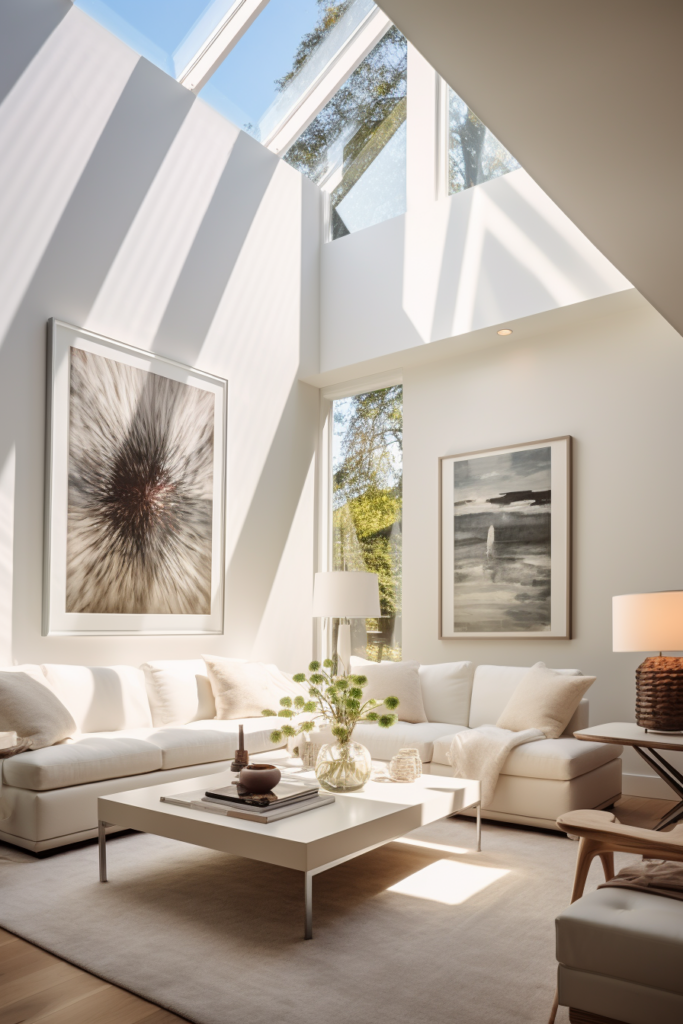
A bright, airy living room showcasing a classic white ceiling — the most popular ceiling paint color choice for modern and minimalist interiors.
What Color Should a Ceiling Be Painted in Different Room Types?
This is where things get genuinely interesting. The best color for ceiling depends heavily on the room’s function, size, and existing palette. Let’s break it down by room.
Living Room Ceiling Colors
Living rooms often benefit from a ceiling color that complements the walls without matching them exactly. A common and highly effective technique is to paint the ceiling 1–2 shades lighter than the wall color. If your walls are a soft sage green, a very pale sage or warm white ceiling will make the room feel cohesive and enveloping rather than choppy.
For larger, open-plan living rooms with high ceilings, this is also where you can get a little adventurous. Deep blues, soft greens, or even a warm terracotta on the ceiling can add drama and warmth—especially in rooms that get good natural light.
Bedroom Ceiling Color
In a bedroom, the ceiling is literally your most-stared-at surface. This makes it the most emotionally impactful ceiling in the house. What color to paint a ceiling in a bedroom often comes down to how you want to feel when you wake up and when you go to sleep.
- Soft blues and greens: Associated with calm and rest. A pale duck-egg blue ceiling can create a serene, cloud-like effect.
- Warm whites and creams: Comforting and gentle without being stark.
- Deep, moody tones: Navy, forest green, or even charcoal can create a cocoon-like, luxurious feel—especially with warm lighting.
Research in environmental psychology consistently shows that cooler, softer ceiling colors in bedrooms contribute to better perceived restfulness. That’s not just aesthetics—it’s function.
Kitchen with Dark Ceiling: A Bold Choice That Works
The kitchen with dark ceiling trend has gained enormous traction in the last several years, and it deserves serious consideration. A deep navy, forest green, or charcoal ceiling in a kitchen does something remarkable: it grounds the space. Kitchens are often bright, light-filled, and utilitarian—a dark ceiling adds warmth, intimacy, and a sense of architectural drama.
This works best when:
- The kitchen has good natural light or layered artificial lighting
- The cabinetry and walls remain lighter (cream, white, warm grey)
- There’s enough ceiling height (above 9 feet is ideal)
Pairing a dark ceiling with white or light shaker cabinets is a particularly effective combination—it creates contrast without chaos.
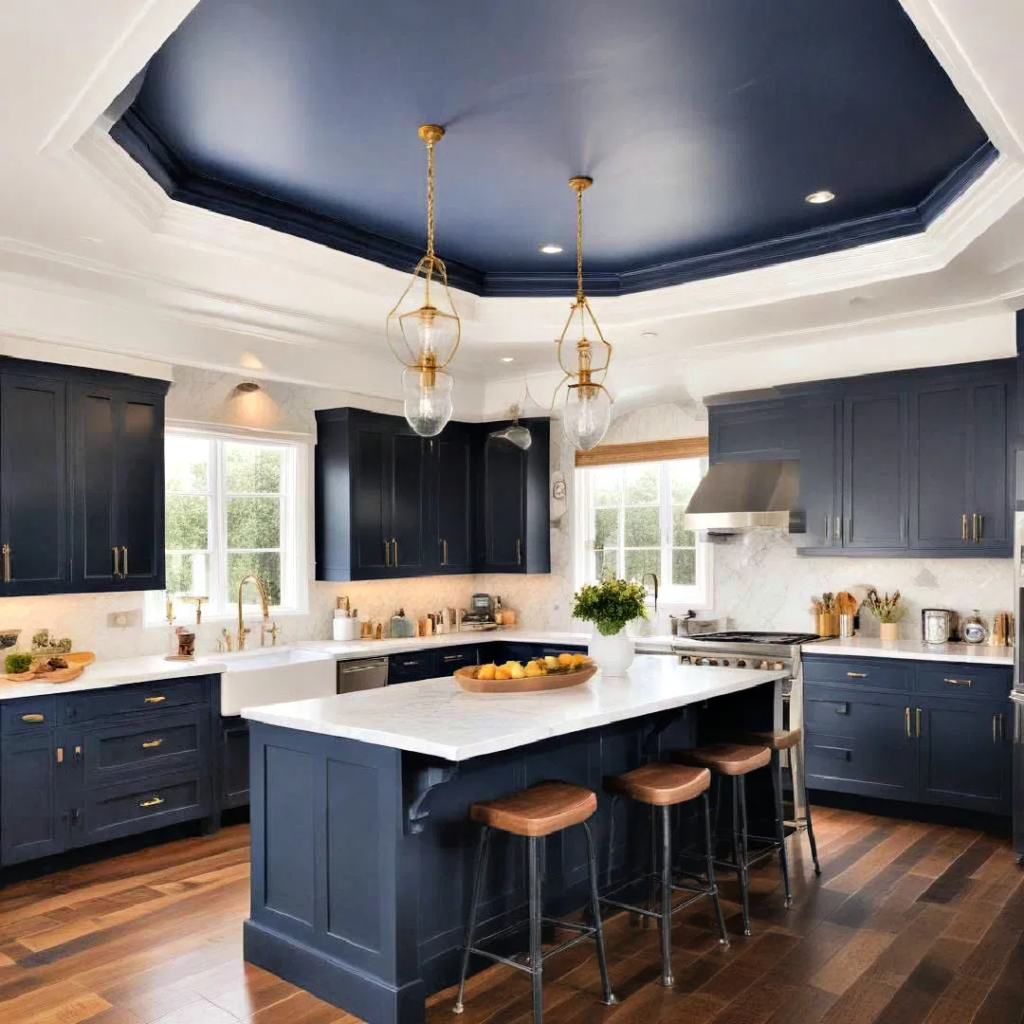
A stunning kitchen with a dark navy ceiling paired with crisp white cabinetry and brass hardware — a bold yet sophisticated best ceiling color choice that adds warmth, depth, and architectural character to a high-traffic room.
Black Ceiling with White Walls: The Most Dramatic Move
If you’re ready to make a real statement, few combinations are as visually arresting as a black ceiling with white walls. This is a bold, high-contrast look that has roots in traditional English pub design, Victorian architecture, and contemporary maximalism.
Here’s why it works—and when it doesn’t:
When it works:
- High ceilings (the dramatic drop of a black ceiling is more powerful—and less oppressive—when there’s space)
- Rooms with strong, intentional lighting (recessed lighting, statement pendants, sconces)
- Spaces where you want intimacy and theatre—like a dining room, home bar, or bedroom
- Paired with rich textures: dark velvet, warm brass, worn leather
When to think twice:
- Low ceilings in small rooms (a black ceiling here will feel suffocating rather than dramatic)
- Rooms with very limited natural light
- Spaces that need to feel airy and open for practical reasons (e.g., a home office where you spend long focused hours)
If the full black feels like too much, consider a very deep charcoal (like Farrow & Ball Railings or Benjamin Moore Wrought Iron)—it gives you the drama without the full contrast of true black.
What Color Are Ceilings Usually Painted: The Research Behind Trends
Survey data from major paint brands like Sherwin-Williams, Benjamin Moore, and Farrow & Ball consistently shows that what color are ceilings painted in most American homes is overwhelmingly white or off-white—roughly 85–90% of residential ceilings. The typical ceiling paint color is a flat, bright white, applied with low-sheen paint to minimize shadows and imperfections.
But there’s a clear and growing trend toward colored ceilings. According to a 2023 Sherwin-Williams Color Trends Report, requests for ceiling color consultation increased by over 40% compared to 2019, with deep blues, warm greens, and terracotta-adjacent tones leading the shift. This mirrors a broader movement toward “enveloping” interiors—rooms where color wraps all the surfaces rather than just the walls.
The best paint color for ceiling is no longer always white. Color is having a real moment on the fifth wall.
How to Choose Ceiling Paint: Practical Tips from the Pros
Match the Finish to the Function
Before you even think about color, nail down the finish. The right finish can make any paint color for ceiling look better:
- Flat/Matte: The gold standard for ceilings. Hides imperfections, absorbs light rather than reflecting it, and gives a clean, intentional look. Recommended for most rooms.
- Eggshell: Slightly more washable. Good for kitchens and bathrooms where moisture and steam are concerns.
- Satin: Rarely recommended for ceilings—it can highlight every bump and crack.
- Gloss: Only for intentional effects (like a lacquered ceiling in a formal dining room).
Test Before You Commit
The single biggest mistake people make when choosing a ceiling paint color is picking from a chip and never testing it. Paint a 12-inch by 12-inch swatch on the actual ceiling, in the actual room, and observe it at different times of day and under different lighting. The same paint chip can look warm and creamy in daylight and dingy under incandescent bulbs.
Consider the Room’s Proportions
What color should the ceiling be often comes down to architecture:
- Low ceilings: Go lighter than the walls—bright whites, very pale tints, or simply a lighter shade of the wall color. Avoid any color darker than the walls.
- High ceilings: You have more flexibility. A ceiling that’s darker than the walls can create a sense of warmth and proportion rather than emptiness.
- Rooms with crown molding: The molding acts as a visual boundary. You can be bolder with ceiling color when there’s a clear architectural separation between ceiling and walls.
The 1-Shade Rule
One of the most reliable formulas in interior design: paint the ceiling the exact same color as the walls but one shade lighter. It’s subtle, sophisticated, and almost never fails. This works particularly well with greens, blues, and warm neutrals.
Best Colors for Ceilings by Design Style
Different design aesthetics call for different colors to paint ceiling. Here’s a quick style-by-style breakdown:
Modern/Minimalist: Bright white or very pale grey. Crisp, clean, with no visual noise above.
Traditional/Classic: Warm white or a very subtle cream. Works beautifully with rich wall colors like burgundy, deep green, or navy.
Farmhouse/Rustic: Off-white, warm linen, or even a very soft sky blue (referencing the old Southern tradition of “haint blue” porch ceilings).
Maximalist/Eclectic: This is where you truly let loose. Jewel-toned ceilings in emerald, sapphire, or deep plum work brilliantly in rooms where every surface is curated.
Industrial: Dark ceilings in charcoal or near-black, left exposed or painted, reflect the raw aesthetic of the style.
Coastal/Hamptons: Soft blue, pale aqua, or bright white ceilings that reference open sky and ocean.
Best Paint Colors for Ceiling: Specific Shades Worth Knowing
Here are some of the most highly recommended specific shades across design communities:
- Benjamin Moore Chantilly Lace OC-65: The definitive crisp white ceiling paint. Clean, bright, and utterly versatile.
- Sherwin-Williams High Reflective White SW 7757: Maximizes light reflection. Ideal for dark rooms.
- Farrow & Ball Borrowed Light 235: A barely-there blue that works as a dreamy bedroom ceiling color.
- Benjamin Moore Hale Navy HC-154: A deep, rich navy for a dramatic ceiling in dining rooms or bedrooms.
- Sherwin-Williams Aged White SW 6119: A warm, soft off-white for traditional and farmhouse spaces.
- Farrow & Ball Pitch Black 256: For those committing fully to the black ceiling moment.
- Benjamin Moore Wythe Blue HC-143: A cool, sophisticated blue-grey that works especially well in coastal or transitional spaces.
These aren’t just popular—they’ve proven themselves across thousands of real rooms and consistently read well on ceilings specifically.
Common Mistakes When Painting Ceilings
Knowing what color to paint ceilings is only half the battle. Here are mistakes to avoid:
- Using wall paint on the ceiling. Ceiling paint has a different formulation—flatter, thicker, with reduced spatter. Always use ceiling-specific paint or specify a flat finish.
- Skipping primer. Especially on previously unpainted or stained ceilings, primer is non-negotiable.
- Choosing the same white as the trim. The ceiling white and trim white are usually different—trim is often brighter and slightly glossier. Using the same shade blurs architectural definition.
- Going too dark without enough lighting. A deep ceiling color can look stunning in a well-lit space and oppressive in a dim one.
- Rushing the dry time. Ceiling paint takes longer to cure than wall paint. Applying a second coat too soon leads to streaks and uneven finish.
FAQ
What color should I paint my ceiling if my room is small?
For small rooms, the best ceiling paint color is generally a light, bright white or a shade slightly lighter than your walls. This helps the ceiling visually recede, making the room feel taller and more spacious. Avoid dark colors in small, low-ceilinged rooms.
What color are ceilings usually painted in most homes?
The typical ceiling paint color in most homes is a flat, bright white or off-white. It remains the most common choice because it reflects light, hides imperfections well, and works with almost any wall color. However, colored ceilings are increasingly popular in design-forward spaces.
Is a black ceiling with white walls a good idea?
A black ceiling with white walls can be stunning—but it requires commitment. It works best in rooms with high ceilings, strong lighting, and a clear design vision. It creates incredible drama and intimacy but can feel oppressive in small or poorly lit spaces.
What’s the best white ceiling paint color?
The best white ceiling paint color depends on your room’s undertones. For cool, modern spaces, Benjamin Moore Chantilly Lace is a top pick. For warm, traditional rooms, Sherwin-Williams Alabaster or Aged White are excellent. Always test before committing.
Can I paint my kitchen ceiling a dark color?
Absolutely. A kitchen with dark ceiling—navy, forest green, or charcoal—can be a fantastic design choice when the kitchen has good lighting and lighter cabinetry. It adds depth and sophistication to what’s often the most utilitarian room in the house.
What finish should ceiling paint be?
The best color for ceiling paint matters, but finish matters just as much. Flat or matte is the standard recommendation for ceilings in living spaces and bedrooms. Eggshell is appropriate for kitchens and bathrooms. Avoid glossy finishes unless it’s an intentional design statement.
Should the ceiling be lighter or darker than the walls?
In most cases, the best ceiling color is slightly lighter than the walls. This is a safe, effective formula that makes rooms feel cohesive and proportional. Exceptions exist—notably in rooms with high ceilings where a darker ceiling adds warmth and brings the room together.
How do I choose ceiling paint color for an open-plan space?
For open-plan spaces, consistency is key. A single ceiling paint color throughout creates visual continuity and helps unify different zones. A warm white or off-white is usually the most flexible choice across different areas with varying functions and wall colors.
What color should ceilings be in a bedroom?
Soft, calming colors tend to work best. Pale blues, warm whites, gentle greens, or very light versions of your wall color are all excellent choices. Bold, dark colors can also work beautifully in bedrooms—they create a cocooning effect that many people find deeply restful.
Does ceiling paint color affect the perceived room size?
Yes, significantly. Color ceiling choices directly impact perceived height and spaciousness. Light ceilings make rooms feel taller; dark ceilings make them feel lower and more intimate. Warm colors bring the ceiling closer; cool colors push it away.
Conclusion
The ceiling has been overlooked long enough. What was once an afterthought is now one of the most exciting surfaces in interior design—a place to add depth, drama, calm, or personality to any room. Whether you’re drawn to the clean simplicity of a carefully chosen white, the cozy drama of a kitchen with dark ceiling, or the bold statement of a black ceiling with white walls, there’s no single right answer—only the answer that’s right for your space, your style, and how you want to feel in your home.
The best approach is always the same: understand your room’s proportions and light, test your colors before committing, and don’t be afraid to treat the ceiling with the same intention you’d bring to any other design decision. The fifth wall is waiting. It’s time to do something interesting with it.