

It’s 2 a.m., you roll over to get comfortable, and your bed answers with a groan loud enough to wake the whole house. If you’ve ever lain there mid-turn, frozen, hoping the next creak won’t come — you already know why so many people search for how to stop squeaky bed noise at the worst possible hour.
The good news is that a squeaky bed is almost never a sign that something is broken beyond repair. In the vast majority of cases, the noise comes from two pieces of wood or metal rubbing against each other where they shouldn’t, and the fix takes less than an hour and costs less than a movie ticket. The frustrating part isn’t fixing it — it’s figuring out exactly where the sound is coming from.
This guide walks through how to track down the source of a squeak, the specific fixes for wooden frames, metal frames, slats, and headboards, and what to do when a quick fix isn’t enough. By the end, you’ll know exactly how to stop squeaky bed noise whether your frame is held together with bolts, dowels, or nothing but hope.
Why does a bed start squeaking in the first place
Before jumping into fixes, it helps to understand the mechanics. A bed frame is a collection of joints — places where wood meets wood, metal meets metal, or metal meets wood. Every joint is designed to fit snugly, but over time, a few things change that:
- Wood naturally shrinks and expands with humidity and temperature, which loosens joints that were once tight.
- Hardware loosens from repeated motion. Bolts, screws, and brackets get nudged every time you shift in your sleep, and gradually they back out a fraction of a millimeter at a time.
- Friction surfaces lose their natural cushioning. Wood-on-wood or metal-on-metal contact points often had a thin layer of wax, oil, or finish that wears away with use.
- Weight distribution shifts. A new mattress, an added person, or even just months of use can change how pressure moves through the frame, exposing weak points that weren’t a problem before.
None of these issues mean your bed is falling apart. They mean it’s a normal piece of furniture experiencing normal wear — and that’s actually good news, because normal wear has predictable, repeatable fixes.
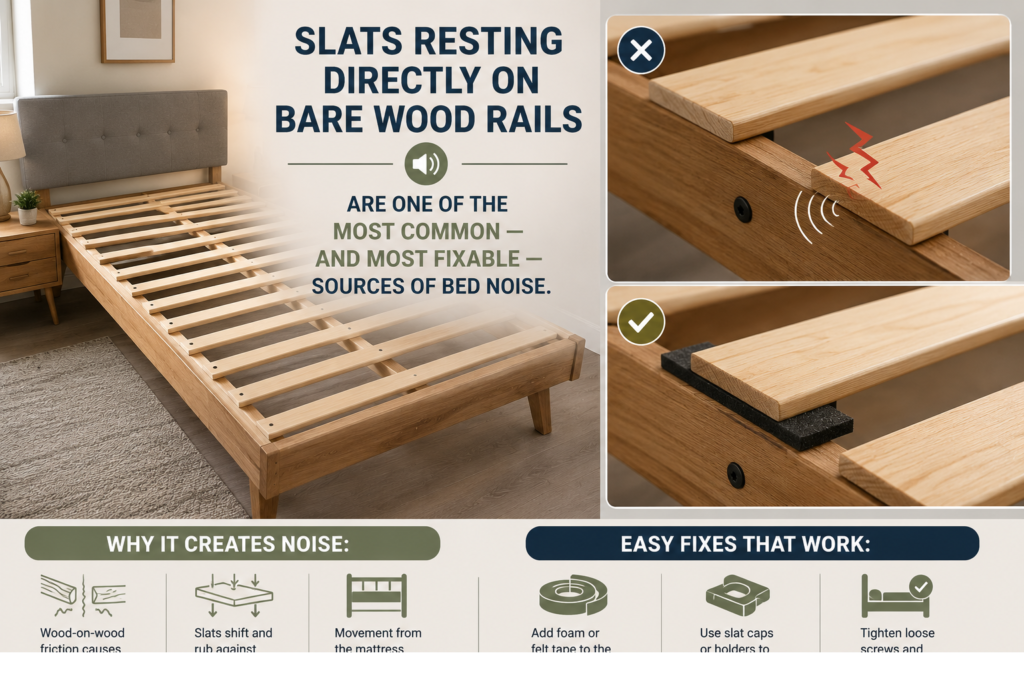
Slats resting directly on bare wood rails are one of the most common — and most fixable — sources of bed noise.
How to find exactly where your bed is squeaking
You can’t fix what you can’t find, and this is the step most people skip. Guessing at a fix without locating the squeak wastes time and can lead you to “fix” parts that weren’t broken in the first place.
Here’s a simple diagnostic process:
- Strip the bed down to the frame. Remove the mattress and box spring if you have one. You need to see and access the actual structure.
- Recruit a second person if possible. Have them sit, shift their weight, and roll around on the bare frame (carefully) while you watch and listen at each joint.
- Work through the frame systematically — headboard connections first, then the side rails, then the center support beam, then the legs, then the slats.
- Press down firmly on each section with your hands and listen for the sound. A squeak that happens right where you press is a strong clue.
- Check for movement, not just sound. Any joint that wiggles even slightly under pressure is a candidate, even if it didn’t squeak during this specific test.
Once you know where the noise lives, the rest of the process is fast.
The diagram above shows the five spots that account for the overwhelming majority of bed noise complaints: the headboard joint, the rail-to-leg connection, the center support beam, the slats, and the legs themselves. If you’re not sure where to start listening, start there.
How to fix a squeaky wooden bed frame
Wooden frames are the most common source of search queries like how to fix a squeaky wooden bed frame, mostly because wood moves more than metal does as humidity changes through the seasons. Here’s the standard repair sequence.
Step 1: Tighten every bolt and screw
This sounds obvious, but it solves the problem more often than any other single fix. Wooden bed frames are typically held together with hex bolts at the corners and sometimes additional screws along the rails.
- Use an Allen wrench or socket wrench to go over every bolt on the frame, even ones that feel tight.
- Tighten in small increments rather than cranking hard in one go — overtightening can strip the wood threads, especially in softer woods like pine.
- If a bolt spins freely without tightening, the threads in the wood have likely worn out. Skip ahead to the wood glue and toothpick method below.
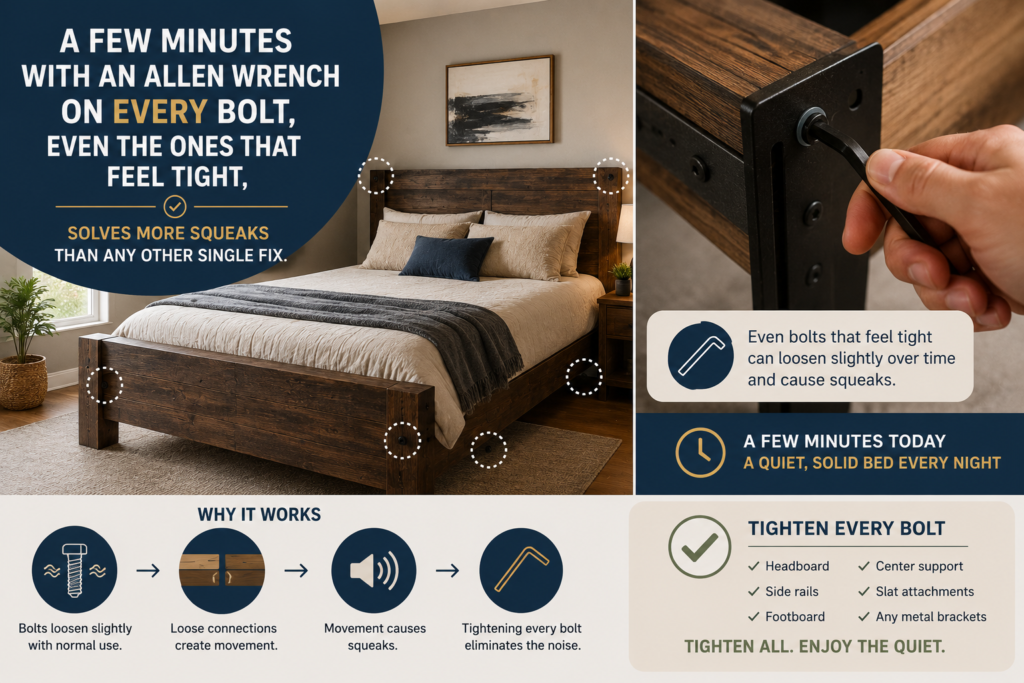
A few minutes with an Allen wrench on every bolt, even the ones that feel tight, solves more squeaks than any other single fix.
Step 2: Apply lubricant to wood-on-wood contact points
Where two wooden pieces rub directly against each other — like a rail resting in a corner bracket — friction is the cause, and lubrication is the fix.
Good options for wood:
- Paraffin wax or a plain candle, rubbed directly onto the contact surface
- Beeswax, which is slightly more durable than paraffin
- Powdered graphite, especially useful in tight joints where you can’t easily apply wax
Avoid cooking oils or petroleum-based products on wood — they can stain the wood, attract dust over time, and in some cases degrade the wood’s finish.
Step 3: Fix loose screw holes with the toothpick and glue method
This is the single most useful trick for anyone wondering how to fix a squeaky bed when the bolts simply won’t stay tight anymore. When a screw hole has worn larger than the screw itself, the screw can’t get a grip, and the joint flexes with every movement.
- Remove the screw completely.
- Insert 3–4 wooden toothpicks or a few wood matchsticks into the hole, coated in wood glue.
- Snap off any toothpick that sticks out, then let the glue dry for at least an hour (ideally overnight).
- Re-drive the original screw into the now-filled hole. It will bite into the toothpick wood and hold far more securely than it did before.
Step 4: Reinforce with corner brackets if needed
If a wooden frame is squeaking at the corners even after tightening and lubricating, the joint itself may have loosened structurally. L-shaped metal corner brackets, screwed across the joint on the inside of the frame, add rigidity that stops the wood pieces from flexing against each other. This is a permanent, inexpensive fix available at any hardware store.
How to stop bed slats from creaking
Slats are a frequent offender and a separate issue from the frame itself. If your frame is solid but you still hear creaking specifically when you change positions in bed, the slats are the likely source.
Common slat-related causes and fixes:
- Slats sitting directly on wood or metal rails. Add thin felt pads, rubber strips, or even an old leather belt cut into pieces between each slat and the rail it rests on. This is one of the most effective and cheapest fixes available.
- Slats that have shifted out of their brackets. Simply realign them so they sit evenly and securely.
- Slats that are cracked or warped. A bowed or split slat won’t sit flush no matter how many times you adjust it. Replacing the individual slat (most bed brands sell them separately) solves this permanently.
- Slats spaced too far apart, allowing them to flex under weight and rub against their supports. Adding an extra slat or two in wide gaps reduces flex and the noise that comes with it.
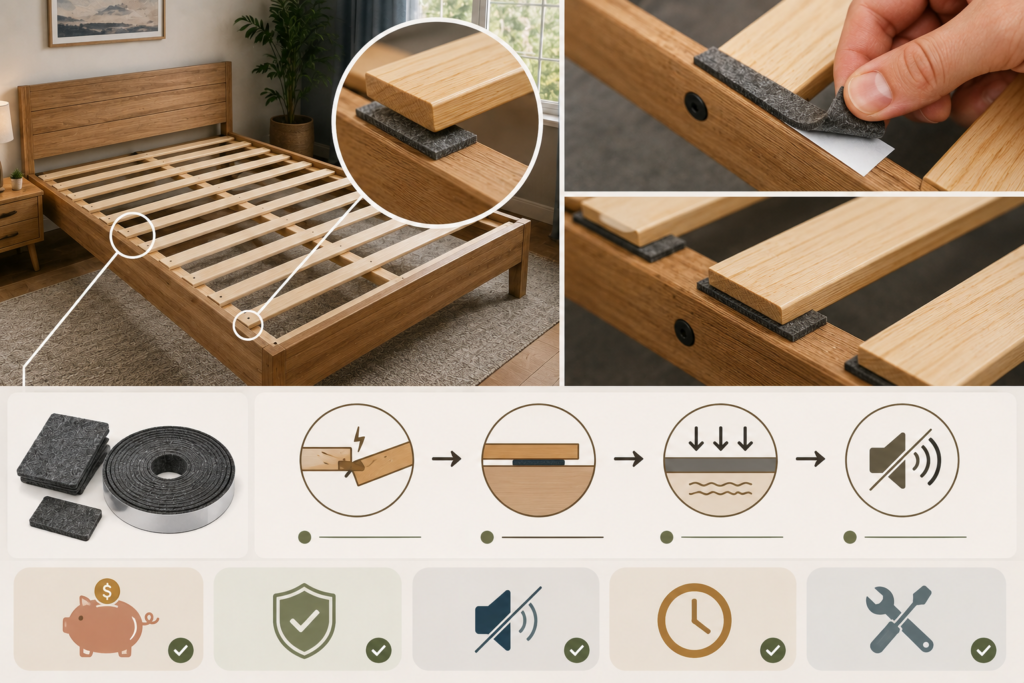
Thin adhesive felt pads between slats and rails absorb friction and are one of the cheapest, most reliable fixes for creaking slats.
How to fix a squeaky headboard
A squeaky headboard has its own quirks because headboards often attach to the frame differently than the rest of the structure — sometimes bolted directly to the bed frame, sometimes free-standing and just pushed against the wall or bed.
To fix a squeaky headboard:
- Check the headboard-to-frame bolts first, the same as with the rest of the wooden frame. These are often smaller and get overlooked during a general tightening pass.
- Look at where the headboard touches the wall. If your headboard leans against or knocks into the wall as the bed shifts, a small felt furniture pad on the back of the headboard eliminates that contact noise entirely.
- Inspect any fabric-covered or upholstered headboards for loose frame joints underneath the fabric — these can creak from the wooden skeleton inside even though the outside looks soft and harmless.
- Add a thin foam or rubber spacer anywhere metal headboard brackets meet a metal bed frame, since metal-on-metal contact squeaks just as readily as wood-on-wood.
How to fix a squeaky bed frame made of metal
Metal frames squeak for a different reason than wood: rather than expanding and contracting, metal parts squeak almost entirely from friction and loose connections.
- Lubricate every metal joint, especially where the frame folds, where legs screw into rails, and where the center support bar connects to the headboard and footboard brackets. A silicone-based spray lubricant or a few drops of household oil applied with a cloth (not sprayed directly, which can drip onto a mattress or floor) works well here.
- Tighten bolts and casters. Metal frame bolts back out from vibration far more easily than wood screws, so this is worth checking every few months as routine maintenance.
- Check rubber or plastic end caps on the legs. These often degrade or crack over time, leaving bare metal in contact with the floor or frame, which both squeaks and scratches floors.
- Inspect any folding or hinged sections for worn-out pivot points, which are a common and overlooked noise source on metal frames with folding center supports.
What is the best lubricant for a squeaky bed frame
The right lubricant depends on the material:
| Material contact point | Best lubricant | Why |
|---|---|---|
| Wood-on-wood | Paraffin wax, beeswax | Won’t stain or attract dust; long-lasting |
| Wood-on-metal | Powdered graphite | Penetrates tight joints; doesn’t drip |
| Metal-on-metal | Silicone spray or light machine oil | Reduces friction without corroding metal |
| Fabric or felt contact points | None needed | Replace with new felt instead of lubricating |
A quick rule of thumb: anything that could drip, stain, or attract dust over time (most cooking and motor oils) should be avoided on visible wood. Dry lubricants like wax and graphite are almost always the safer first choice.
When a new bed starts squeaking right away
It’s worth addressing this specifically, because “new wooden bed creaking” is one of the more common and more frustrating versions of this problem. A brand-new bed frame squeaking within days or weeks of setup almost always points to one of these causes:
- Hardware that wasn’t fully tightened during assembly. Flat-pack and self-assembled frames are the most common culprits — bolts that feel snug by hand often still need another quarter-turn with a proper tool.
- New wood settling into its joints. Especially with solid wood frames, the wood needs a short adjustment period as it acclimates to your home’s humidity and temperature, which can cause temporary noise that often resolves on its own within a few weeks.
- Protective coatings on hardware that haven’t worn in yet, creating extra friction at metal joints that will lessen naturally with use but can be sped up with lubricant.
If your new bed is squeaking, start with a full hardware check before assuming anything is defective. Most “new bed” squeaks are assembly issues, not manufacturing defects.
Quick checklist before you start
Keep this nearby while you work through your frame:
- Identify the squeak location with the weight-and-listen test before touching anything
- Tighten every bolt, screw, and bracket — even the ones that feel fine
- Apply the appropriate lubricant for the material (wax for wood, silicone or oil for metal)
- Add felt or rubber padding anywhere two hard surfaces meet directly
- Fill worn screw holes with the toothpick-and-glue method before re-driving screws
- Recheck slats for alignment, spacing, and cracks
- Test the bed by sitting and rolling on it before putting the mattress back
Working through this list in order, rather than jumping straight to one fix, is the most reliable way to permanently solve the problem rather than temporarily masking it.
When to consider replacing the frame instead of repairing it
Most squeaky beds can be fixed with the steps above, but there are a few signs that point toward replacement rather than repair:
- The frame visibly flexes or sags under normal weight, not just at one joint
- Wood is cracked through, not just worn at the screw holes
- Multiple joints have failed simultaneously, suggesting the frame has reached the end of its structural life
- You’ve already tightened, lubricated, and reinforced the frame and the squeak returns within days
If none of these apply to you, repair is almost always the faster, cheaper, and entirely sufficient solution.
FAQ
Why does my bed squeak when I’m the only one who’s used it for years?
Materials change over time even without new stress being added. Wood contracts and expands with seasonal humidity shifts, hardware loosens slightly from years of small vibrations, and protective coatings or lubricants applied at the factory wear away. A bed that was silent for years can start squeaking simply from gradual material fatigue, not from anything you did wrong.
Can I fix a squeaky bed without taking the mattress off?
For a quick lubrication of accessible joints, sometimes yes — you can often reach the legs and visible frame corners by tilting the mattress to one side. However, a full diagnostic check and proper repair of slats or center support beams requires removing the mattress so you can see and access every joint clearly.
Is WD-40 safe to use on a squeaky bed frame?
It works on metal-to-metal contact points in a pinch, but it’s not the ideal long-term choice because it can attract dust and dirt over time and isn’t suitable for wood. A silicone-based lubricant or dry graphite is generally a better and longer-lasting option for bed frames specifically.
How often should I tighten the bolts on my bed frame?
Checking every three to six months is a reasonable habit, especially for frames that get heavy daily use. A quick tightening pass takes only a few minutes and prevents most squeaks before they start.
Will adding felt pads under the mattress slats actually work?
Yes, and it’s one of the most consistently effective fixes available, especially for platform beds and slatted frames. The felt absorbs the friction between the slat and the rail it sits on, which is one of the most common sources of creaking during movement.
My bed only squeaks when two people are in it. What does that mean?
Added weight exposes joints that were borderline before — they were holding together under one person’s weight but flex enough under two people’s combined weight and movement to create friction. This points toward a joint that needs tightening or reinforcing rather than a different problem altogether.
Can a squeaky box spring be fixed the same way as a frame?
Box springs squeak from worn springs or a loosened internal frame, which is harder to access and repair than a bed frame. In most cases, lubricating the points where the box spring touches the bed frame helps, but persistent internal squeaking from the box spring itself usually means it’s time for a replacement.
Does memory foam reduce squeaking compared to spring mattresses?
The mattress itself rarely causes squeaking — that almost always comes from the frame, slats, or box spring underneath. That said, a heavier memory foam mattress can put more consistent pressure on weak joints, which may reveal a squeak that a lighter mattress didn’t expose.
Final thoughts
A squeaky bed is one of those small annoyances that feels bigger than it is, mostly because it shows up at the exact moment you’re trying to relax. The fix is rarely complicated. Most of the time, it comes down to finding the one or two joints doing the complaining, giving them a proper tightening or a dab of the right lubricant, and adding a little padding wherever two hard surfaces meet. Work through the frame methodically, start with the simplest fixes first, and there’s a good chance your bed will go back to being exactly what it should be: quiet enough that you forget it’s even there.