

Ever walked into a friend’s living room and felt instantly at home, then walked into another and felt strangely out of place — without knowing why? That gut reaction isn’t random. It’s your eye recognizing (or rejecting) a design language, and the fastest way to put a name to that feeling is an interior design style quiz.
Most people don’t actually know what is my interior design style until someone asks them to choose between two photos side by side. We don’t think in style categories day to day — we think in feelings: “I want this room to feel calm,” or “I want it to feel alive.” A good interior design quiz translates those feelings into a vocabulary you can actually shop, plan, and decorate with.
This matters more than it might seem. Research from environmental psychology consistently shows that visual coherence in a home reduces cognitive fatigue and stress, while mismatched, directionless decor — buying a piece here, a piece there, with no unifying thread — tends to leave people quietly unsatisfied with spaces they spent real money on. A home style quiz isn’t a parlor trick; it’s a shortcut to spending your decorating budget with intention instead of regret.
In this guide, we’ll walk through how an interior design styles quiz actually works, the major styles you’re likely to land on, how to interpret your results, and how to use that knowledge to build a home that finally feels like yours.
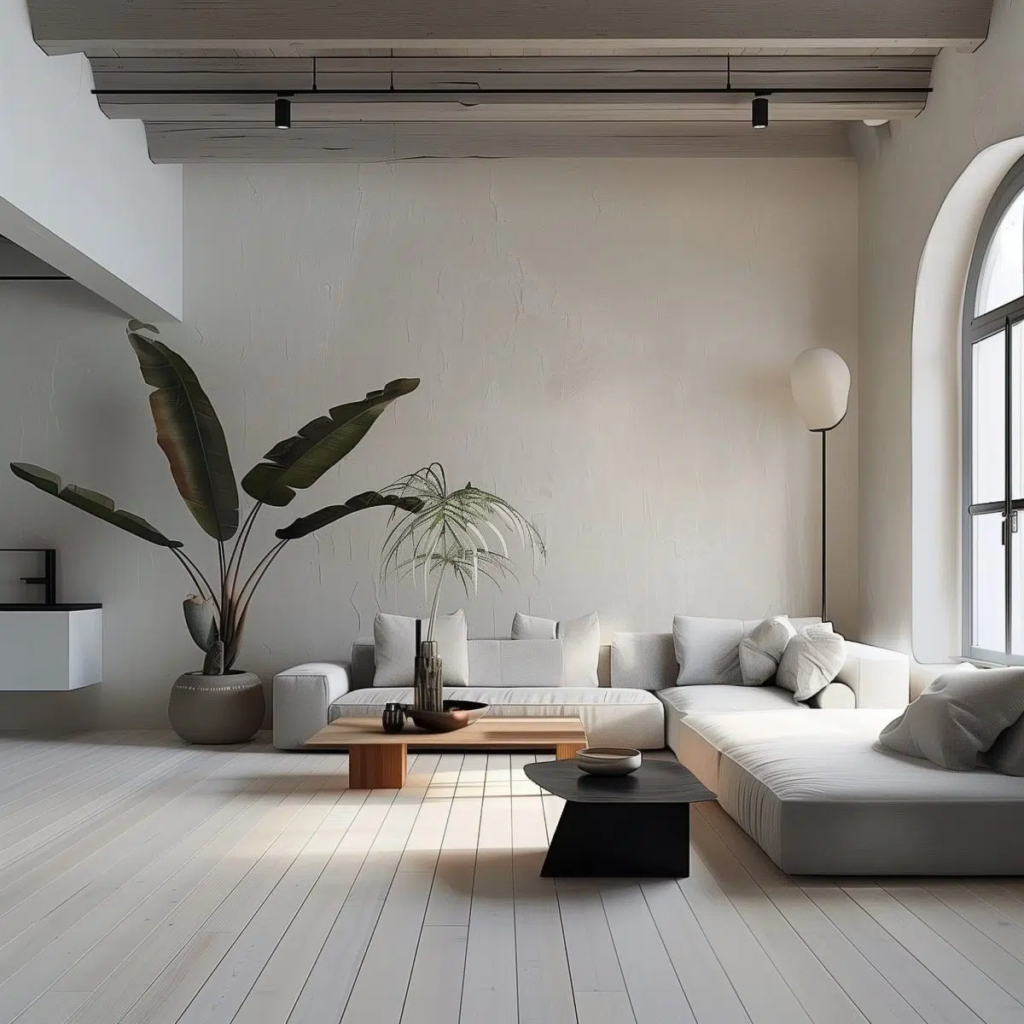
A well-defined style turns a room into something more than the sum of its furniture.
Why Take an Interior Design Style Quiz Before You Decorate
It’s tempting to skip the self-reflection and just start buying furniture. But interior designers will tell you the single biggest regret clients have is purchasing pieces they liked individually but that never came together as a room. A design quiz solves this by forcing you to compare options directly — this sofa or that one, this color palette or that one — which surfaces preferences you didn’t know you had.
Think of it like a personality quiz for your walls. Just as personality tests use forced-choice questions to reveal patterns in how you think, an interior design quiz personality format uses forced-choice images to reveal patterns in how you see. The this or that interior design method is popular for exactly this reason: it removes the pressure of describing your taste in words (which most people are bad at) and replaces it with instinct.
The Psychology Behind Visual Preference Testing
Visual preference is processed faster than verbal reasoning — your brain forms an aesthetic judgment about an image in a fraction of a second, often before you can articulate why you like it. That’s the entire mechanic behind a well-built aesthetic test: it bypasses the part of your brain that overthinks and taps directly into instinct. This is why a 10-question interior design quiz can often nail your taste more accurately than an hour of conscious deliberation over fabric swatches.
The Major Interior Design Styles You Might Discover
When you take a home decor style quiz, your answers usually map to one (or a blend) of several recognizable aesthetic families. Understanding these categories ahead of time makes your results far more useful.
Modern and Contemporary
Modern style favors clean lines, neutral palettes, and a “form follows function” philosophy — minimal ornamentation, lots of negative space, and furniture that’s more about geometry than embellishment. Contemporary style is often confused with modern, but it’s actually more fluid, borrowing whatever feels current rather than sticking to one fixed era.
Minimalist
If your interior design test results lean minimalist, you likely value calm over clutter. Minimalism strips a room down to only what’s essential — a small, intentional collection of furniture and objects, usually in a muted or monochrome palette, with an emphasis on quality over quantity.
Bohemian (Boho)
Boho is the eclectic, layered, globally-inspired opposite of minimalism: think woven textures, plants, vintage rugs, and a relaxed disregard for matching. If your aesthetic quiz results point here, you probably gravitate toward warmth, texture, and a “collected over time” feel rather than a showroom look.
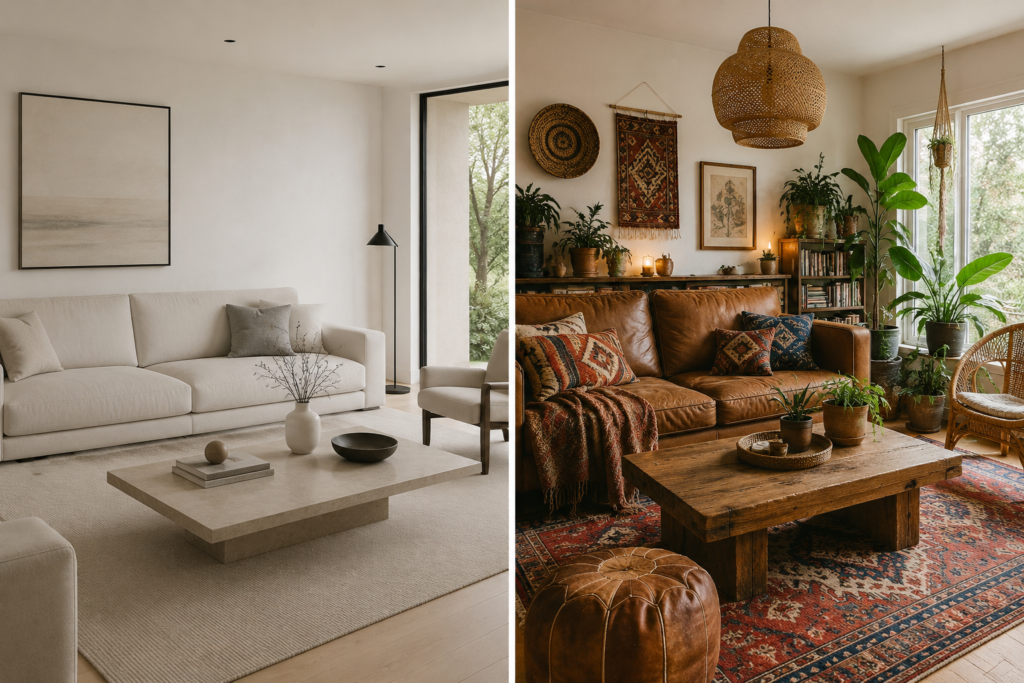
Two opposite ends of the spectrum: minimalist calm vs. bohemian warmth.
Farmhouse and Rustic
Farmhouse style blends cozy, lived-in textures (reclaimed wood, shiplap, neutral linens) with practical, sturdy furniture. It tends to score high with people who want their home to feel grounded and unpretentious.
Scandinavian
Scandinavian (or “Scandi”) style overlaps with minimalism but adds warmth through natural wood tones, soft textiles, and functional simplicity — a balance between coziness and clean design that’s been popular for over a decade for good reason.
Industrial
Industrial style draws on raw materials — exposed brick, black metal, concrete — and works best for people whose home design quiz results show a preference for edgy, urban, loft-like spaces over softness.
Traditional and Transitional
Traditional style leans on classic furniture silhouettes, symmetry, and rich detailing, while transitional style blends those classic shapes with more modern, simplified finishes — a popular middle ground for people whose taste doesn’t fit neatly into one extreme.
How to Find Your Interior Design Style (Step-by-Step)
If you’re wondering how to find my interior design style beyond a single quiz result, here’s a more structured approach.
- Start with a quiz for a baseline. A solid interior design style quiz gives you a starting label, even if it’s imperfect.
- Audit what you already own and love. Look at the clothes, art, or objects you’ve kept for years — your true taste often shows up outside your home before it shows up inside it.
- Build a visual mood board. Save images that make you stop scrolling. Patterns will emerge faster than you expect.
- Test in low-stakes ways first. Try a style through pillows, art, or a rug before committing to furniture.
- Reassess every few years. Style genuinely shifts as life circumstances change, and that’s completely normal.
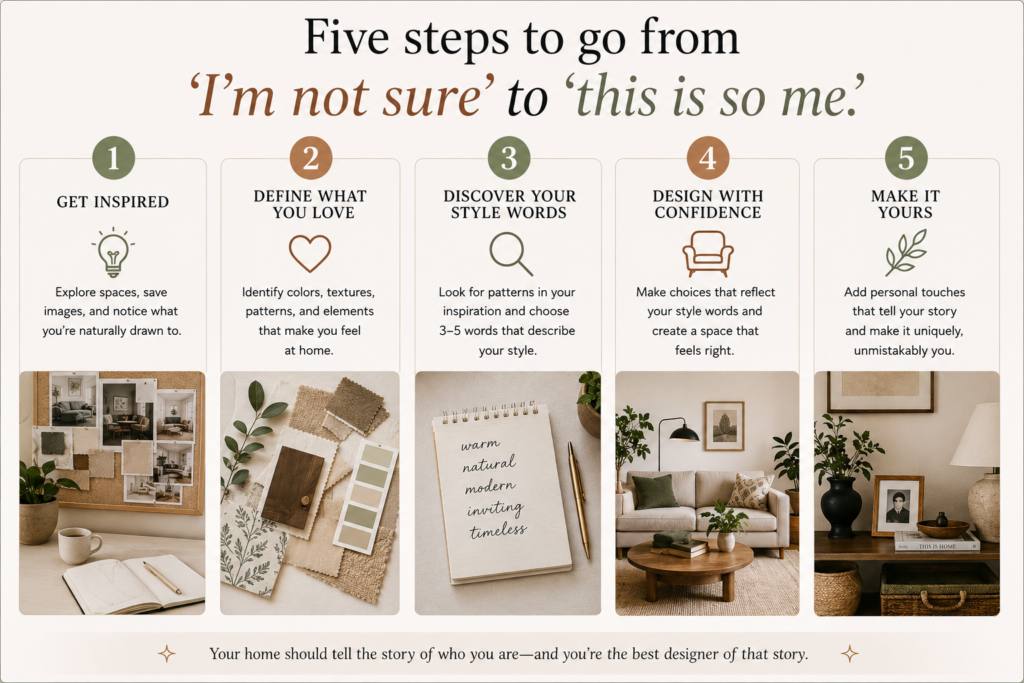
Five steps to go from ‘I’m not sure’ to ‘this is so me.
What Is My Interior Design Style? Reading Your Quiz Results
Here’s the part most quizzes skip: interpreting your result well. If your interior design style quiz says “eclectic” or shows a blend of two styles, that’s not a flaw in the test — most real homes are a hybrid of two or three influences, not a single pure category. A common, useful pairing is one “anchor” style (your wall colors, big furniture, flooring) and one “accent” style (your art, textiles, and small decor) layered on top.
If you’re unsure what is my home aesthetic, look for the throughline in your answers rather than the literal label. Did you consistently pick warmer tones? Did you avoid clutter every time? Those micro-patterns matter more than the single word at the end of the quiz.
Common Mistakes People Make When Decorating Without a Clear Style
Skipping this self-discovery step tends to lead to a few predictable problems:
- Buying trendy pieces that clash with everything else in the room within a year
- Overspending on furniture that gets replaced because it “just didn’t feel right”
- Rooms that look fine individually but feel disjointed as a whole home
- Decision paralysis at every store because there’s no internal filter guiding choices
A clear answer to what is my design style acts as a filter. Once you know your style, shopping gets faster because you can immediately rule out 80% of what doesn’t fit.
How Designers Actually Use Style Quizzes With Clients
Professional designers frequently start client relationships with some version of a design style quiz, even if it’s a more sophisticated, guided conversation rather than a 10-click web form. The goal is identical: extract a client’s gut preferences quickly, before budget and logistics start influencing (and sometimes muddying) the conversation. Some studios, like the approach used in the popular which interior design style are you kdadesignology quiz format, lean heavily on side-by-side image comparisons for exactly this reason — it’s faster and more honest than asking someone to describe their dream living room in words.
Frequently Asked Questions
What is the most accurate way to find my interior design style?
The most reliable approach combines a quick interior design style quiz with a manual audit of things you already own and love — clothing, art, even vacation photos. Quizzes are a fast starting point, but cross-checking with your existing taste sharpens the accuracy.
How many interior design styles are there?
There’s no single official number, but most designers reference somewhere between 10 and 20 widely recognized categories, including modern, minimalist, bohemian, farmhouse, Scandinavian, industrial, traditional, and transitional, with countless hybrid variations in between.
Can my interior design style change over time?
Yes, and it’s extremely common. Life stage, location, and even mood shift people’s preferences. Many homeowners find their style evolves every five to ten years, which is why revisiting a home decor style quiz periodically is genuinely useful.
Is it normal to get a mixed result on a design quiz?
Completely normal. Most quiz results land between two styles rather than one pure category, and most well-designed homes blend two or three influences rather than sticking to a single rigid label.
What’s the difference between a house style and an interior design style?
A house style typically refers to the architecture itself — Colonial, Craftsman, Cape Cod — while an interior design style refers to how the inside is furnished and decorated, which can be entirely independent of the home’s exterior architecture.
Do I need to spend a lot of money once I know my style?
No. Knowing your style actually saves money long-term because it prevents impulse purchases that don’t fit your space. Many people start with small, affordable pieces (textiles, art, lighting) before investing in larger furniture.
How accurate are free online interior design quizzes?
They’re a solid starting point but not perfect. Treat the result as a hypothesis to test against your real preferences rather than a final verdict, especially if the result feels like it’s missing a piece of your taste.
What if I don’t like any of the categories a quiz gives me?
That’s a sign you likely fall into an eclectic or hybrid category. Many modern homes intentionally blend styles — for example, Scandinavian with industrial accents — and there’s nothing wrong with not fitting a single box.
Final Thoughts
Decorating a home you genuinely love starts with a small amount of honest self-reflection, and an interior design style quiz is simply the fastest, lowest-pressure way to get there. Whether your results point toward minimalist calm, bohemian warmth, or some hybrid in between, the real value isn’t the label itself — it’s the clarity it gives you the next time you’re standing in a store deciding what to bring home.