

Daffodils are spring-flowering bulbs you plant in autumn, about 6 inches deep, pointed end up, in a sunny spot with good drainage. Treat them right after they flower, and they’ll come back every spring for years, often multiplying as they go.
They’re among the easiest bulbs you can grow, and deer and rodents usually leave them alone. The same toxins that protect them make them dangerous to pets, so that’s covered here too.
This guide walks through the whole year: choosing types, planting this fall, care after flowering, fixing daffodils that stop blooming, and growing them in pots, vases, and indoors.
What are daffodils?
Daffodils belong to the genus Narcissus, in the amaryllis family. “Daffodil,” “narcissus,” and “jonquil” are often used interchangeably, though gardeners usually reserve “jonquil” for the small, fragrant, multi-flowered types.
They’re perennial bulbs, hardy in roughly USDA zones 3 to 8 (HGTV). Each bulb stores a year’s worth of energy, and a cold winter triggers it to flower in spring.
That cold period is the key to everything. It’s why you plant in autumn, and why gardeners in hot climates have to work a little harder.
Types of daffodils worth knowing
The Royal Horticultural Society sorts daffodils into 13 divisions by flower shape. You don’t need all of them, but knowing the main types helps you pick varieties that suit your garden.
| Type | What it looks like | Good for |
|---|---|---|
| Trumpet | One large flower; trumpet as long as the petals | Classic borders; ‘Dutch Master’ is a long-time favorite |
| Large-cupped | Shorter cup, often in a contrasting color | Bold color, cutting |
| Small-cupped | Tiny cup, often orange or red-rimmed | Naturalizing in grass |
| Double | Ruffled, layered centers | Showy beds and vases |
| Cyclamineus | Swept-back petals, early bloom | Rock gardens, pots |
| Jonquilla | Several small, very fragrant flowers per stem | Scent near paths and doors |
| Tazetta (incl. paperwhites) | Clusters of fragrant flowers | Indoor forcing, warm climates |
| Poeticus (poet’s narcissus) | White petals, tiny red-rimmed eye | Late-season fragrance |
| Split-corona | Cup split open and flattened | Unusual, eye-catching displays |
Mix early, mid and late types, and you can stretch the show across six weeks or more of spring.
When to plant daffodils
Plant bulbs in autumn, once the soil has cooled but before it freezes. In most climates, that means September to November.
Johnny’s Selected Seeds recommends planting about 5 to 6 weeks before the ground freezes, so roots have time to form (Johnny’s). Bulbs planted in warm soil too early can rot.
Where winters don’t get cold enough, bulbs need help. Johnny’s advises pre-chilling them at 38 to 45°F (3 to 7°C) for about 16 to 18 weeks before planting.
Keep them in the fridge in a paper bag, away from fruit, which releases ethylene gas that can damage the flower inside. Expect them to bloom for one season only; for repeat flowering in warm areas, choose tazettas, jonquils or paperwhites.
How to plant daffodil bulbs
Good planting accounts for most of the success with daffodils. Get the site, depth, and drainage right, and the rest is easy.
Choose the spot
Pick a place with full sun to light shade, at least six hours of sun while the leaves are growing. Spots under deciduous trees work well, since the daffodils flower and feed before the canopy leafs out.
Drainage matters more than soil richness. Bulbs sitting in soggy ground rot, so avoid low spots where water collects, or plant in raised beds.
| Bulb size | Planting depth | Spacing |
|---|---|---|
| Standard daffodils | About 6 inches (15 cm) to the base of the bulb | 3 to 6 inches apart |
| Miniature daffodils | About 3 to 4 inches (8 to 10 cm) | 2 to 3 inches apart |
The simple rule is to plant at two to three times the bulb’s height. Johnny’s notes that a little too deep is better than too shallow.
Step by step
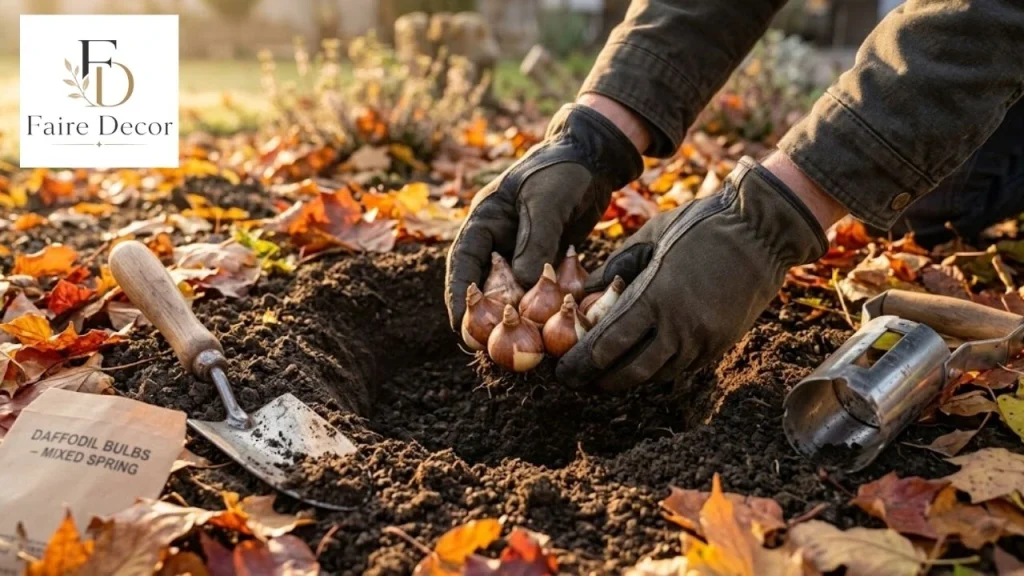
Loosen the soil to about 8 to 12 inches deep, and mix in compost if it’s heavy clay.
Dig the hole or trench to the right depth. A bulb planter speeds up large plantings.
Set the bulb pointed end up, roots down. If you can’t tell, plant it on its side, and it will right itself.
Plant in groups of 5, 7, 9, or more for a natural clump instead of single soldiers in a row.
Backfill and water well to settle the soil and start root growth.
Feed lightly. Mix a bulb fertilizer into the whole bed rather than dropping it in the hole, because HGTV notes bulbs shouldn’t touch granular fertilizer.
Mark the spot. It’s easy to dig into dormant bulbs by accident in summer.
Naturalizing in grass or woodland
For a wild, drifting look, toss handfuls of bulbs across the area and plant them where they land. Small-cupped and cyclamineus types naturalize especially well.
In a lawn, you’ll need to delay mowing that patch until the foliage has yellowed, about six weeks after flowering. Plan for a slightly shaggy look in late spring.
Caring for daffodils after they bloom
This is where most people go wrong. What you do in the weeks after daffodils flower decides whether they bloom again next year.
Deadhead the flowers. Snap off spent blooms just below the swollen seed pod, so energy goes back into the bulb instead of into seeds.
Leave the leaves. The foliage is the bulb’s solar panel. The standard advice is to wait about six weeks after flowering, until the leaves are yellow and flop, before cutting them down.
Don’t tie or braid them. Knotting the leaves to look tidy cuts off light to the leaves and starves the bulb. Instead, hide fading foliage behind emerging perennials such as hostas or daylilies.
Water in dry springs. Keep the soil moist while leaves are green. Once they die back, the bulbs go dormant and prefer dry summer soil.
Feed once a year. A light bulb fertilizer in autumn or as shoots appear in spring is plenty. Too much nitrogen gives you leaves instead of flowers.
Why your daffodils aren’t blooming
“Blind” daffodils, with healthy leaves but no flowers, are one of the most common bulb complaints. The cause is usually one of these.
| Cause | Sign | Fix |
|---|---|---|
| Leaves cut too early last year | Few or no flowers this spring | Leave foliage for six weeks after bloom |
| Overcrowding | Thick clumps of thin leaves | Dig up and divide every 3 to 5 years |
| Too much shade | Leaves stretch toward light | Move bulbs to a sunnier spot after leaves yellow |
| Planted too shallow | Small, weak bulbs | Replant at 2 to 3 times bulb height |
| Too little cold | Warm-climate gardens, leaves only | Pre-chill bulbs, or switch to tazettas and jonquils |
| Too much nitrogen | Lush leaves, few flowers | Use low-nitrogen bulb food |
| Pests or rot | Soft, mushy or hollow bulbs | Dig and discard; contact your local extension service |
Dividing overcrowded clumps
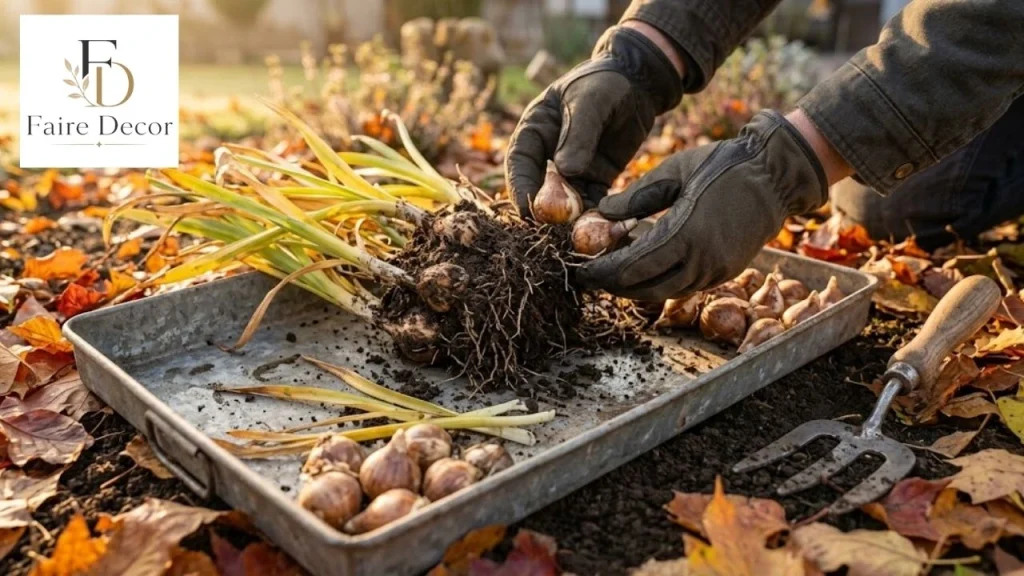
Over time, one bulb becomes a crowded clump. When flowering drops off, dig the clump just as the leaves turn yellow.
Gently pull the bulbs apart, discard any soft ones, and replant immediately at the right depth with more space. Most will flower again within a season or two.
Growing daffodils in pots
Pots let you enjoy daffodils on a patio, balcony or front porch, even without a garden bed.
Choose a container at least 10 to 12 inches deep, with drainage holes. Plant bulbs close together, almost touching, at the same depth as in the ground.
For a longer show, try layered “bulb lasagna” planting. Late tulips go at the bottom, daffodils in the middle, and small crocus or grape hyacinths on top, so they bloom one after another.
In cold areas, move pots to a sheltered spot such as an unheated garage over winter, so the soil doesn’t freeze solid. Water sparingly until shoots appear.
Forcing daffodils indoors
Paperwhites are the easiest daffodils to grow indoors, because they don’t need a cold period. Set bulbs on pebbles in a shallow bowl with water just touching the base, and they’ll flower in about four to six weeks.
Most other daffodils need 12 to 16 weeks of cold first. Pot them in autumn, keep them somewhere cold and dark, then bring them into a cool, bright room once shoots are a few inches tall.
Forced bulbs rarely flower well indoors again. Plant them out in the garden afterward,d and they may recover in a year or two.
Cutting daffodils for the vase
Daffodils make cheerful cut flowers, with one catch. Their sap can harm other flowers sharing the vase, a problem Johnny’s also notes.
Cut stems when buds are just showing color. Stand them alone in water for several hours or overnight so the sap drains out. Then add them to mixed arrangements without recutting the stems.
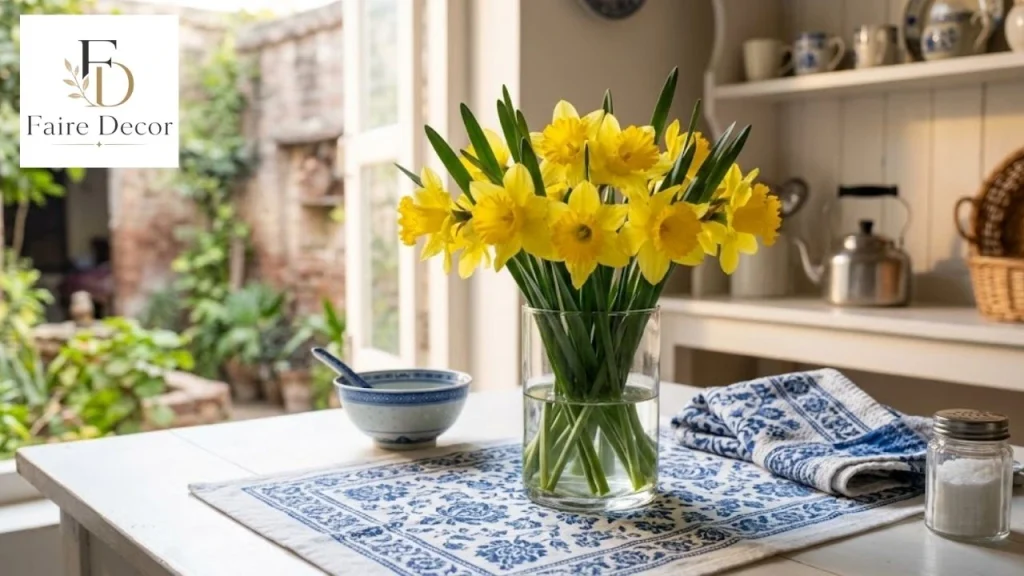
If you’re using them in your home décor, a cluster of yellow daffodils works well with the blue, gray, ay and white pairings in our home color combinations guide.
Are daffodils poisonous?
Yes, and this is important for anyone with pets or small children. The ASPCA lists daffodils as toxic to dogs, cats, and horses, and says the bulbs are the most poisonous part (ASPCA).
The main toxin is lycorine. Signs in pets include vomiting, drooling, and diarrhea, and large amounts can cause convulsions, low blood pressure, tremors, and heart rhythm problems.
Dogs are most at risk when they dig up freshly planted bulbs. If you suspect your pet has eaten any part of a daffodil, call your vet or the ASPCA Animal Poison Control Center at (888) 426-4435 right away.
People can be poisoned too. The most common cause is mistaking a bulb for an onion, so store bulbs away from the kitchen and out of children’s reach (ACVP).
The sap can also irritate skin. Wear gloves when cutting lots of stems or handling bulbs.
Daffodil meaning and symbolism
As one of the first flowers of spring, the daffodil has come to stand for renewal, hope and new beginnings.
It’s the birth flower for March and a traditional gift for 10th wedding anniversaries. It’s also a national emblem of Wales, worn on St David’s Day, 1 March.
Several cancer charities use the daffodil as a symbol of hope, including Marie Curie in the UK. William Wordsworth’s poem about a host of golden daffodils remains one of the most famous flower poems in English.
[Image 5: drift of naturalized daffodils under trees]
The bottom line
Plant daffodils this autumn, in a sunny, well-drained spot, about 6 inches deep, and let their leaves die back on their own after flowering. That’s most of what it takes.
Divide them when blooms fade, keep them away from curious pets, and your daffodils will reward you every spring for many years.
FAQs:
When is the best time to plant daffodil bulbs?
In autumn, usually September to November, about 5 to 6 weeks before the ground freezes.
How deep should I plant daffodils?
About 6 inches deep for standard bulbs, or two to three times the bulb’s height. Plant miniatures about 3 to 4 inches deep.
Do daffodils come back every year?
Yes. They’re perennial bulbs that return for many years if you let their leaves die back naturally after flowering and divide crowded clumps every few years.
When can I cut back daffodil leaves?
Wait about six weeks after flowering, until the leaves turn yellow. Cutting them sooner weakens the bulb and reduces next year’s flowers.
Are daffodils poisonous to dogs and cats?
Yes. All parts are toxic, and the bulbs are the most dangerous. Call your vet or a pet poison hotline right away if your pet eats any part.
Can daffodils grow in pots?
Yes. Use a container at least 10 to 12 inches deep with drainage holes, plant the bulbs close together, and protect the pot from hard freezes.
Why do my daffodils have leaves but no flowers?
The most common causes are cutting the leaves too early, overcrowded clumps, too much shade, or not enough winter cold. Dividing the clump and leaving foliage to die back usually fixes it.