

Few flooring choices change how a room feels as quickly as carpet. Step onto a good one and your feet notice before your eyes do. It softens sound, takes the chill off a bedroom, and makes a cold, echoing room feel finished. It also divides opinion, because the wrong carpet floor in the wrong place can look worn in a year.
This guide helps you choose well. It covers fibers, pile styles, quality checks, padding, installation, air quality,y and care. Sources are linked, and where they disagree or are commercial,al I say so.
Where a carpet floor makes sense
A carpet floor earns its place in rooms where comfort and quiet matter most. Bedrooms are the obvious case, followed by dens, family rooms and stairs where grip and noise reduction help. Basements can work too, but only if moisture is controlled, which I cover later.
It is a poorer fit in places that get wet often, such as bathrooms and entry areas that see snow and mud. There, a hard surface is usually easier to clean. Our best flooring guide compares carpet with the alternatives so you can match each room to a surface.
Think about the household too. Pets, kids, allergies, and how much cleaning you will realistically do all change the answer. The sections below give you the details to weigh.
The five main carpet fibers
The fiber in a carpet floor decides how it looks, wear,s and costs. This Old House, in an editorial guide updated May 27, 2026, lists five common choices and gives per-square-foot price ranges that it attributes to Angi.
The ranges name no region or year, and the site is ad-supported, so treat them as a rough comparison rather than a quote.
| Fiber | Price range cited | What the sources say |
|---|---|---|
| Wool | $4 to $20 per sq ft | Called “the gold standard for carpet fibers” by This Old House; soft, durable and stain-resistant. |
| Nylon | $2 to $5 per sq ft | Close second to wool in durability and feel, with strong soil resistance and colorfastness. |
| Olefin (polypropylene) | $1 to $3 per sq ft | Durable and water-resistant; suited to berber and indoor/outdoor use. |
| Polyester | $1 to $3 per sq ft | Soft, mold-resistant and good at holding color, but less resilient than nylon. |
| Acrylic | $3 to $8 per sq ft | Mimics wool’s look at lower cost, but prone to fuzzing and pilling. |
Nylon
Nylon is the workhorse. An Angi guide, which has no stated date or publisher in the text I opened and appears to steer readers toward local installers, calls it highly resistant to most stains and damage, well suited to high-traffic areas,eas and the most durable synthetic option. It gives an average lifespan of 12 to 15 years.
The downsides: Angi says nylon needs annual steam cleaning to maintain resilience and is not as eco-friendly as some options. It costs more than polyester.
Polyester
Polyester is soft and affordable. Angi calls it fairly stain-resistant, often made from recycled materials and lower in cost than comparable nylon or wool. Its main weakness is crush resistance:
It can stay flattened under furniture and look worn sooner, so Angi says it is less suited to busy areas. This Old House likewise says it suits moderate traffic.
Wool
Wool is the premium natural choice. Angi describes it as warm, naturally stain-resistant, and highly durable. It also lists real drawbacks: it is among the most expensive fibers, cannot be steam cleaned, is not hypoallergenic, and is susceptible to mold and mildew because it holds more moisture than synthetics.
Olefin (polypropylene)
Olefin is a budget fiber that resists water, stains, mold,d and sun fading, per Angi. Because it is solution-dyed, there are no open dye sites for stains to attach to, and bleach does not affect its color. The trade-off is that it is not as crush-resistant as nylon and mats down in high-traffic areas.
Acrylic
Acrylic looks like wool for less. This Old House says it is prone to fuzzing and pilling, so it is less suitable for large areas. I opened no other source on acrylic, so treat it as a niche option.
Pile styles: how the surface looks and wears
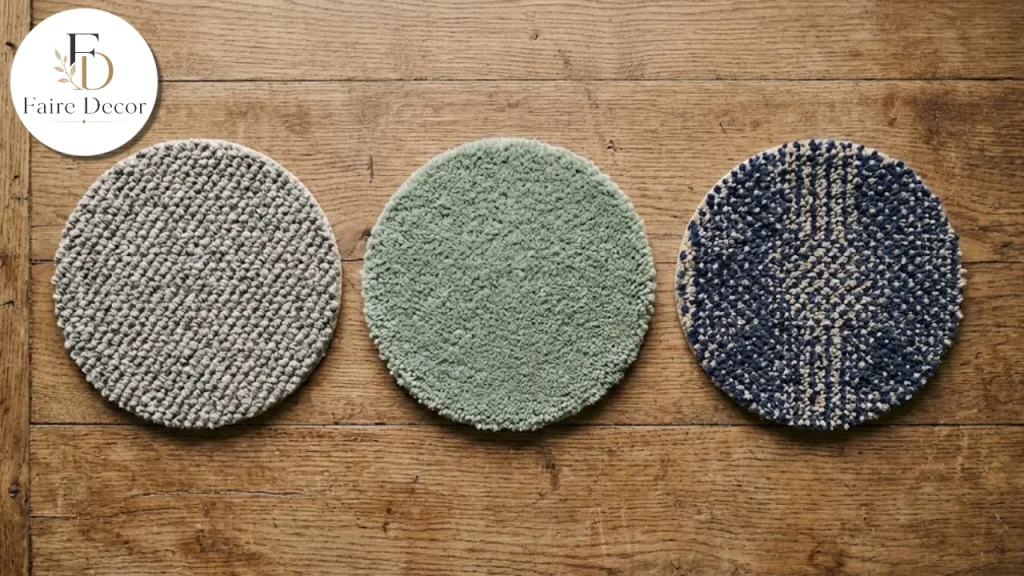
Fiber is half the story. The pile style, meaning how the yarn is formed, changes the look and how well it hides wear. This Old House describes the main types.
Loop pile has uncut yarn tips and is durable, good for high traffic. Level loop is uniform, while multilevel loop has two or three heights for a pattern.
Cut pile has exposed yarn tips and a softer feel. Velvet is formal and uniform, Saxony has longer slightly twisted fibers, and frieze has the longest, most twisted fibers and a casual look.
Cut-loop mixes cut and looped yarn. It hides wear and footprints well and suits family rooms.
Pets change the picture. This Old House says loops can snag claws, velvet and Saxony show footprints and vacuum marks, and shag and frieze hide marks but are harder to clean.
How to judge quality
Two carpets can look alike in the store and wear very differently. This Old House gives several checks.
Face weight. This is the weight of pile per square yard. A source quoted there says higher face weight generally means a longer-lasting product.
Density. Stitches per inch can indicate quality, but standards vary by style and fiber, so do not rely on it alone.
Twist and loop tightness. Look for a tight yarn twist in cut pile and smaller, tighter loops in loop pile.
The backing test. Barbra Wilson of the Carpet and Rug Institute says “You don’t want to be able to see the backing of the carpet.”
Pi,le height. She recommends half an inch or less for high-traffic areas.
Do the backing test with your own hands. Bend a sample back and look at the base. If you can see lots of backing between the yarns, the carpet is thinly made.
Warranties: read them as separate promises
This Old House suggests looking for7-7 to 10-year wear and stain warranties. It also says to review stain and texture-retention coverage separately, because stain warranties often exclude pet stains and blood, grease, ink,and cosmetics.
In plain terms, a long warranty is only as good as its exclusions. Ask for the paperwork before you buy, and ask what maintenance the manufacturer requires, such as regular professional cleaning, to keep coverage valid.
Padding: the part you do not see
Padding affects comfort, wear, and warranty, yet shoppers often treat it as an afterthought. This Old House describes three common types:
bonded or rebonded (a balance of quality and price), natural or synthetic fiber (the densest and most resilient, but the most expensive), and prime urethane (cheapest, but prone to compression).
On specifications, This Old House cites the Carpet and Rug Institute and the Carpet Cushion Council: living rooms, bedrooms,s and dens can take a pad up to 7/16 inch thick and no thinner than 1/4 inch, at 6 pounds per cubic foot density. Berber or low-profile carpet should use no more than 3/8 inch at 8 pounds density.
Flooring Clarity, a commercial site with affiliate links, published a padding guide on September 24, 2025. It says residential density is commonly 6 to 8 pounds per cubic foot, recommends 3/8 to 7/16 inch for most homes, and says density matters more than thickness for durability.
It lists memory foam at 7/16 to 1/2 inch, which is thicker than the CRI-based figure above, and it cites no sources for its numbers. I trust the first set more, and I suggest following the carpet maker’s range either way.
Both sources warn about overdoing it. An overly thick pad can open seams or cause rippling and may void the warranty, and an overly thin one can cause wrinkling.
For a quick guide by room, Flooring Clarity suggests a dense rebond or bonded urethane in living areas and hallways, a thinner dense pad on stairs, and closed-cell rubber or a moisture-barrier pad in basements.
It says pads generally last 8 to 15 years and should be replaced at the same time as carpet when they show permanent compression, odor,r or deterioration.
General information only. Follow the carpet manufacturer’s written installation and padding specifications, since they affect your warranty.
Room-by-room picks
Putting the sources together gives a simple starting point. These are suggestions drawn from the cited material, not rules.
Bedrooms: soft cut pile such as Saxony or frieze, with a 3/8 to 7/16 inch pad per Flooring Clarity. Polyester or nylon both work here because traffic is light.
Living and family rooms: cut-loop or a tight cut pile in nylon, which Angi calls well suited to high traffic. Flooring Clarity suggests a 7/16 inch dense rebond or bonded urethane pad.
Hallways and entries: a short, tight pile of half an inch or less, as CRI’s Barbara Wilson suggests for high traffic, with a dense 3/8 inch pad.
Stairs: Flooring Clarity suggests a 1/4 inch dense bonded urethane or a stair-specific pad. Ask your installer about nosing and wrapping.
Basements: olefin, which Angi says resists mold and mildew, over a moisture-barrier or closed-cell pad, and only after the slab has been tested.
Colors, patterns and the look of the room
Color is the fun part, and it is also where people regret quick choices. A few practical points:
Look at big samples in the actual room, in morning and evening light.
Mid-tones hide dirt better than very light or very dark shades, though this is general design experience rather than a tested claim.
Patterns and texture such as multilevel loops hide footprints. This Old House notes cut-loop styles hide wear and footprints well.
Match the room’s mood. Soft grays and warm neutrals suit bedrooms, while deeper tones can anchor a den.
For inspiration, our cozy living room guide shows how texture and furniture work together, and our Japanese bedroom post is a good study in calm, low-clutter rooms. If you are coordinating with paint, see our gray-green paint guide and the color story in our gray house article.
Walls and window treatments finish the picture. Our guides to decorating walls and custom curtains help you tie the room together once the floor is chosen.

How carpet is installed
Most carpet is installed over padding and tack strips along the walls. Flooring Clarity’s installation guide, published September 2, 2025, lays out the steps. It is a commercial site that promotes a contractor-matching service, so use it as an overview.
Preparation: clear the room, remove baseboards if needed, pull up existing flooring, and clean the subfloor.
Subfloor check: inspect for moisture, levelness,s and structural problems, and repair loose boards or cracked concrete.
Measuring: add 3 to 6 inches to the room dimensions for trimming and seams.
Tack strips: nail them about 1/2 inch from the wall so the carpet can be tucked.
Padding: run pad seams perpendicular to carpet seams, butt the edges together without overlapping and trim the excess.
Positioning and cutting: leave extra material at the walls.
Seaming: align pile direction and pattern, use seam tape and a powered seam iron, and press with a roller.
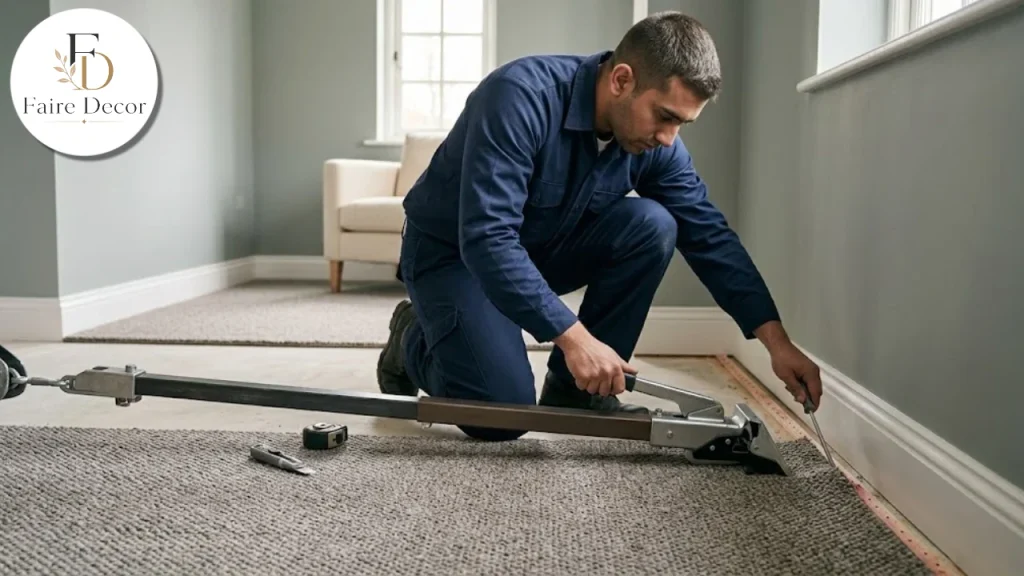
Stretching: use a knee kicker for small adjustments and a power stretcher to pull the carpet onto the tack strips.
Finishing: tuck the edges, reinstall baseboards, and add transition strips.
The same article gives rough timings: preparation 1 to 3 hours per room, padding 30 to 60 minutes, laying 1 to 4 hours, and finishing 30 to 90 minutes, with a simple bedroom taking professionals about 2 to 4 hours. Those are one site’s estimates.
This Old House recommends professional installation and notes that a power stretcher is typically used in rooms larger than 10 by 10 feet. If you want to weigh the cost of a project like this, our renovation tips guide and our shower renovation cost post show how to budget for surprises.
Check the subfloor and moisture first
The most common installation mistake is covering a problem. Flooring Clarity says the subfloor must be dry and lists skipping moisture testing as a common error.
It says concrete needs moisture testing and may need a vapor barrier or concrete-rated adhesive, and that wood subfloors should be secure and squeak-free. Tile or vinyl may need a leveling compound first.
If you suspect water, find the source before you put anything over it. Our guide to roof leaks shows how water travels into a house, and our attic insulation post covers a related moisture problem upstairs.
For basements, remember that the fiber matters too. Angi says wool is susceptible to mold and mildew, while olefin resists mold and mildew, and Flooring Clarity suggests closed-cell rubber padding in moisture-prone areas.
Air quality: what to know about new carpet
New carpet has a smell, and some people worry about it. The Carpet and Rug Institute is an industry trade group, so weigh its claims accordingly, but its technical bulletin
(version 1.01, dated April 19, 2018) is worth reading. It says low-level VOC emissions from new carpet normally dissipate within 48 to 72 hours after installation when there is good ventilation.
It also describes its IAQ testing program, whose label shows a product has met criteria for very low emissions. This Old House advises looking for the CRI Indoor Air Quality label, keeping windows and doors open for at least 72 hours after installation.
And having sensitive people stay away during removal and installation. It suggests asking installers to vacuum before removal and clean the subfloor before laying new carpet.
If anyone in the home has asthma or allergies, ask your doctor, and ask the retailer for emissions documentation. Wool is not hypoallergenic according to Angi, so allergy sufferers should not assume a natural fiber is the safer pick.
Care: keeping a carpet floor looking good
Good care protects your carpet floor and, per many warranties, your coverage. The advice below comes from the sources cited.
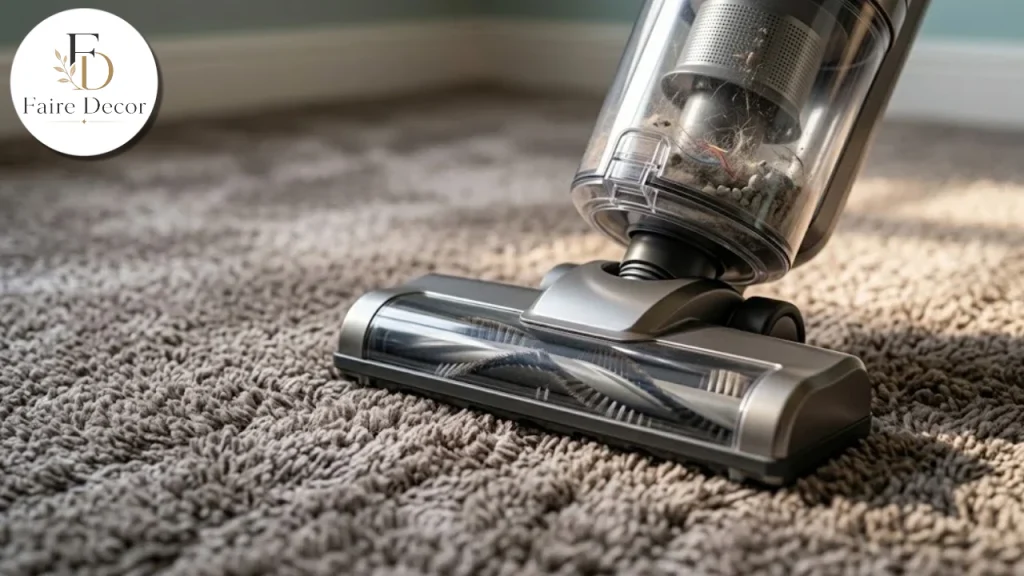
Vacuum regularly. This Old House says at least weekly, more often in high-traffic areas, with adjustable height settings for different piles.
Use a good vacuum. CRI recommends one with strong airflow and an enclosed high-efficiency filtration bag.
Blot spills. This Old House says to use a clean white cloth rather than rubbing. CRI adds that quick spot and spill removal helps prevent stains and fungal growth.
Deep clean on a schedule. Both CRI and This Old House say professional or extraction cleaning every 12 to 18 months, or per the manufacturer.
Do not over-wet. CRI advises drying the carpet quickly.
Mind fiber rules. Angi says nylon needs annual steam cleaning, while wool cannot be steam cleaned.
If you share your home with pets, our guide to keeping your yard looking good with dogs can help reduce what gets tracked indoors.
How long will a carpet floor last?
Lifespan figures vary, and none are guarantees. Angi gives an average of 12 to 15 years for nylon. Flooring Clarity says residential carpet lasts about 8 to 15 years. Traffic, fiber, pile, and care all change the real number.
Signs it is time to replace: permanent flattening in walkways, visible backing, odors that remain after cleaning, ripples that stretching cannot fix and stains that keep returning. A worn pad can make a decent carpet feel bad, so ask your installer to check it.
Carpet versus hard flooring
A carpet floor is not always the answer. Hardwood and similar surfaces last longer and are easier to wipe clean, but they are colder, louder a,nd often slippery. Many homes use both: hard flooring where it is wet and busy, carpet where people sit, sleep, and play.
If you have hardwood, our guide to cleaning hardwood floors safely covers care. And if you are considering a new layout, our home additions guide discusses how new rooms change your flooring choices.
Mistakes to avoid
Most disappointments with a carpet floor are avoidable.
Buying on color only. Check fiber, pile, density, and the backing test.
Choosing polyester for a busy hallway. Angi says it is less suited to busy areas.
Skipping the pad. It affects comfort, wear, and warranty.
Over-thick padding. It can open seams or cause rippling.
Ignoring moisture. Test concrete and fix leaks first.
Skipping ventilation. Keep windows and doors open for at least 72 hours, per This Old House.
Forgetting the warranty fine print. Stain coverage often excludes pet stains and common spills.
Never cleaning professionally. Many makers expect cleaning every 12 to 18 months.
Buying the cheapest installer. Stretching and seaming skill shows for years.
Questions to ask before you buy
Bring these to the showroom.
- What fiber is this, and how is the pile built?
- What is the face weight, and what do the warranties exclude?
- Does it carry the CRI Indoor Air Quality label?
- What pad do you recommend, and does it fit the maker’s range?
- Who installs it, and what is the seaming plan?
- Do you test the subfloor for moisture?
- What does the price include, such as removal, furniture moving, and transitions?
- How should I clean it to keep the warranty?
Selling and long-term value
I did not find a sourced figure for how carpet affects resale value, so I am not claiming one. What I can say is that fresh, clean flooring generally makes a better impression than worn flooring. If you are preparing to sell, our guide on how to sell your home fast covers other steps buyers notice.
Final thoughts on a carpet floor
The right carpet floor is the one that fits the room, the household and the budget: a fiber suited to the traffic, a tight, dense build, a pad that follows the maker’s specs and an installer who checks the subfloor. Then it needs a vacuum schedule and a cleaning plan to last.
Compare samples at home, ask for the paperwork, and be wary of any claim without a source. A little homework now means a floor you enjoy for years rather than one you replace early.
This article is general information, not professional installation, healt,h or financial advice. Confirm product specifications and warranty terms with the manufacturer and a qualified installer.
FAQs:
What is the most durable carpet fiber?
An Angi guide calls nylon the most durable synthetic option and well suited to high traffic. This Old House calls wool the gold standard and puts nylon a close second. Wool costs more.
How thick should carpet padding be?
This Old House, citing the Carpet and Rug Institute and the Carpet Cushion Council, says living rooms, bedrooms and dens can take a pad up to 7/16 inch and no thinner than 1/,4 inch at 6 pounds per cubic foot. Berber or low-profile carpet should use no more than 3/8 inch at 8 pounds per cubic foot. Follow the carpet maker’s range to protect the warranty.
How long does new carpet smell last?
The Carpet and Rug Institute, an industry trade group, says low-level VOC emissions from new carpet normally dissipate within 48 to 72 hours after installation with good ventilation. This Old House advises keeping windows and doors open for at least 72 hours.
How often should carpet be cleaned?
CRI recommends extraction cleaning every 12 to 18 months, and This Old House gives the same interval or the manufacturer’s guidance. Vacuum at least weekly, more often in high-traffic areas.
Is wool carpet hypoallergenic?
No. Angi lists wool as not hypoallergenic, and says it is susceptible to mold and mildew and cannot be steam cleaned.
Can I install carpet over concrete?
Flooring Clarity, a commercial site, says concrete needs moisture testing and may need a vapor barrier or concrete-rated adhesive. Ask your installer how they test and what the carpet maker requires.