
Choosing among popular bathroom themes is harder than it looks. Everyone has seen a photo they love, and then the tile samples arrive, and the room starts to feel like a mix of everything. A theme gives you a set of rules: a palette, a few materials,s and a handful of fixtures that belong together.
This guide walks through popular bathroom themes one at a time. For each one, I list the colors, materials, and fixtures that design sources use to define it, then close with a way to choose and mix.
Nearly every source here is commercial, such as a design magazine, a software company, or a retailer, so treat the descriptions as common shorthand rather than strict rules.
Where these themes come from
The descriptions below draw on four pages I opened:
Houzz, “10 Popular Bathroom Design Styles” by contributor Laura Gaskill (published April 2, 2021). Houzz is a home design marketplace.
RoomSketcher, a guide to 19 bathroom styles by Trine Bretteville (published January 5, 2022, last updated October 23, 2026). RoomSketcher sells design software, and the guide promotes its bathroom planner.
Family Handyman, a list of popular bathroom styles quoting designers Artem Kropovinsky and Ariana Lovato. The page shows no date.
Homes & Gardens, “What are the most popular bathroom themes?” by Amelia Thorpe (published October 17, 2022). The site may earn affiliate commissions.
Names for styles overlap,p and designers use them loosely. Where two sources describe a look differently, I say so.
Modern
Houzz describes modern bathrooms as sleek and streamlined, with strong horizontal lines. Typical pieces include a floating vanity, a glass shower, a freestanding tub, minimalist faucets, streamlined lighting, and frameless mirrors. The palette is crisp white, neutrals, and black, with color added through towels and plants.
RoomSketcher defines the term a little differently. It says modern draws on the early to mid-1900s, with geometric shapes, chrome accents,s and quality materials, and focuses on architecture over color. If you are shopping, check what meaning a seller intends.
Contemporary
Houzz says contemporary bathrooms fully embrace the latest technology, materials, and trends. Look for a sleek vanity, minimalist faucets, a glass shower, statement tile, slim-profile mirrors,s and tech such as digital shower controls and smart mirrors. Black and white is popular, though any high-contrast pairing works.
RoomSketcher’s version is similar: neutrals or high-contrast black and white, straight-line vanities, a freestanding tub and minimalist hardware, with the key idea of open space and clean lines.
If the technology side appeals to you, our guides to smart home design and the 2026 smart home device guide cover gear that pairs well with this look.
Transitional
Transitional is the middle path. Houzz says it walks the line between traditional and contemporary. Typical pieces are a Shaker-style vanity, light stone surfaces, an undermount sink,
subway tile, a pedestal tub, a glass shower enclosure, drum pendants or chandeliers,rs and sleek wall sconces. Colors stay soft and subtle, with blue, brown, gray, or wood tones for a richer feel.
It suits people who like a classic base but do not want the fuss of full traditional detailing.
Traditional
Houzz calls traditional bathrooms timeless, comfortable, and refined, with gleaming surfaces and high-end materials. The list of features includes a furniture-style vanity, elegant stone, antique-style lighting, a claw-foot or pedestal tub, a dressing table, wainscoting, wallpaper, and decorative moulding.
Colors run to subtle neutrals and pale blue or green, or deeper blue, brown, gray,y and wood tones. RoomSketcher adds that traditional rooms feel classic and elegant, with moulding or decorative wallpaper.
Farmhouse
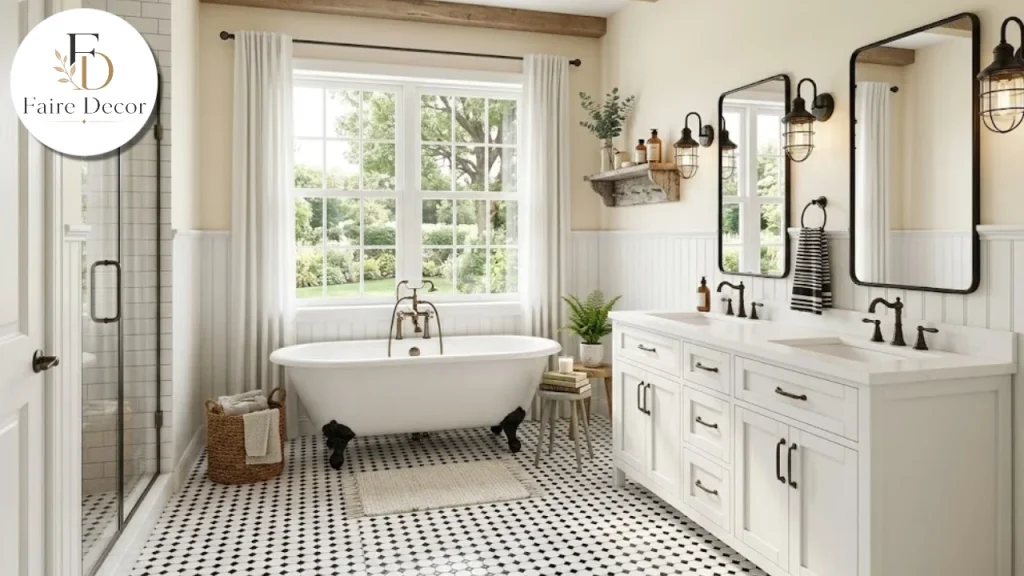
Houzz describes farmhouse as simple, honest, and homespun. Pieces include a Shaker-style vanity, barn lighting, wall paneling, a claw-foot tub, sliding barn doors, and a trough sink. White with crisp black trim is popular, with nature-inspired neutrals for richer looks.
Family Handyman, which calls the look rustic farmhouse, adds natural wood, vintage details such as clawfoot tubs and classic black-and-white mini hex tile, in a palette of wood, black, white, and gray
, sometimes with a color accent. RoomSketcher mentions exposed beams and patterned tile. Our custom curtains guide is a good place to look at fabrics that soften this look.
Rustic
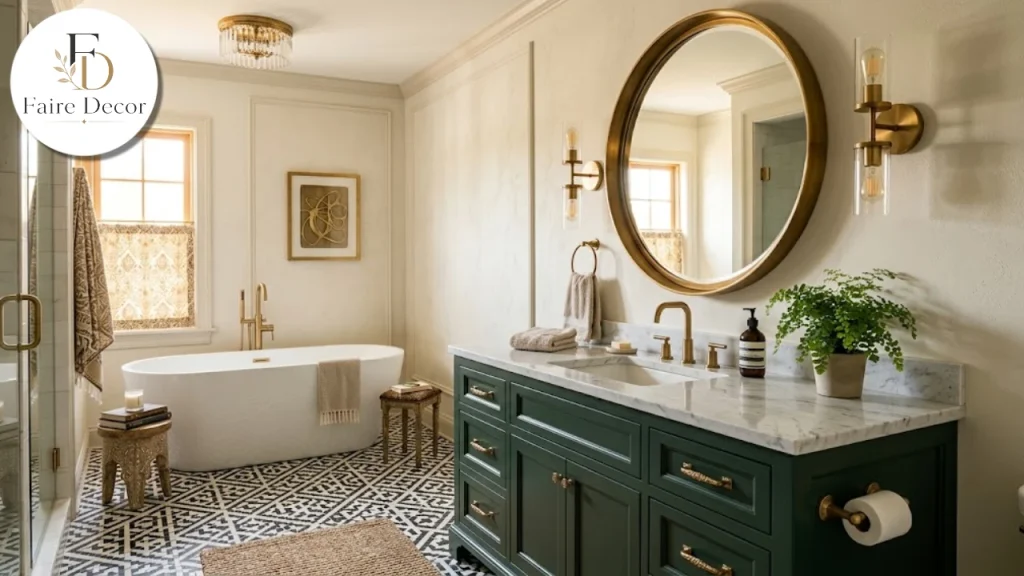
Rustic overlaps with farmhouse but leans harder on raw nature. Houzz says rustic bathrooms embrace the natural beauty of the outdoors, with a wood or wood-look vanity, stone or copper vessel sinks,
natural stone, a copper or Japanese-style soaking tub, weathered hardware, kilim rugs, and filament bulb vanity lights. Hues echo stone and warm woods.
RoomSketcher calls it wood-heavy and hand-crafted, with stone or copper sinks and tubs, durable materials and furniture-style cabinetry. If you want a quick sense of how wood tones carry through a whole home, see our best flooring comparison.
Industrial
Houzz describes industrial bathrooms as simple, utilitarian spaces where raw materials and tough fixtures and finishes take center stage. Think a glass-and-steel shower, concrete, stainless steel,
brick, cinderblock, trough and basin sinks, white subway tile, hefty sliding doors, exposed pipes and gear-like hardware. Raw materials form the base, with an occasional saturated accent.
RoomSketcher adds white subway tile with dark grout and a framed glass and steel shower. Black-framed glass is a natural fit here, and our guide to black windows shows the same crisp, dark-framed look on the outside of a house.
Beach and coastal
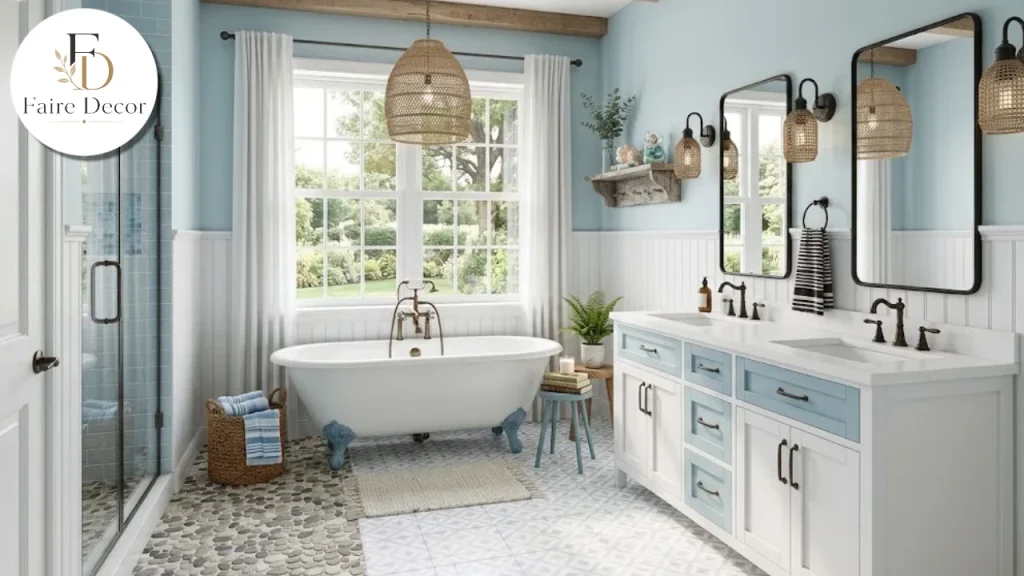
Houzz calls the beach look light and airy, with a focus on natural materials and coast-inspired colors. Features include bold tile, a spacious shower, pebble tile, weathered wood, mother-of-pearl,
wall paneling, statement wallpaper, and coastal accents. Sand, sky,y and sea tones dominate, such as white with seaside blue, or leafy greens and bold corals for a livelier look.
RoomSketcher lists natural wood and rattan, shutters, shiplap, and woven pendants. Family Handyman, calling it modern coastal, names blue-and-white palettes, nautical elements, seagrass, driftwood-style wood and brass or nickel hardware. Our coastal kitchen post shows how the same palette works in another room.
Mediterranean
Houzz calls the Mediterranean bathroom casually elegant and earthy, inspired by sun and sea. Features are ornate lighting, colorful tile, burnished metals such as hammered copper, wrought iron,
oil-rubbed bronze and antiqued brass, a statement mirror, whitewashed walls and organic vessel sinks. Warm earth and sea hues sit against white and natural wood.
RoomSketcher adds intricate tile and mosaic work, arched walls and azure and cobalt tones. For the architecture behind this palette, read our guide to Spanish-style homes.
Craftsman
Houzz says craftsman bathrooms celebrate the simple beauty of natural wood and quality workmanship. Pieces include a Shaker-style vanity, handcrafted tile, rich medium-to-dark wood, natural stone,
stained glass,l gl s and warm rectangular or square lighting with geometric details. Colors are earth tones, vibrant greens, and warm neutrals that complement wood.
RoomSketcher agrees on darker wood and rich earth tones, and adds built-in vanities and artisanal furniture.
Scandinavian
RoomSketcher describes Scandinavian bathrooms as relaxed and simple, with a neutral palette, horizontal lines, light hues, and towels stored in baskets or on a wooden stool. Family Handyman,
which calls it Scandinavian minimalism, lists clean lines, neutral shades, blonde woods, and simple fixtures, quoting Kropovinsky: “Think blonde woods, white or pale paint.”
It is a good theme for small rooms because it relies on light and restraint rather than extra objects.
Japanese and Zen
Family Handyman says Japanese bathrooms use stone and wood, minimal forms and a soaking tub, and quotes Kropovinsky describing them as marked by an economy of means. Experts link the look to peacefulness and cleanliness.
RoomSketcher’s Zen entry lists natural materials in a neutral palette of black, white, brown and beige, with pebbles, sand and water, matte tiles or rough stone and green plants. For the same calm mood in the bedroom, read our Japanese bedroom article.
Organic modern
Family Handyman describes organic modern as marked by warm paint colors and wood tones. It lists natural stone countertops, handmade Zellige tile,e and brass fixtures. It is a softer version of modern that keeps the clean lines but adds natural texture.
If you like warm neutrals with a hint of green, our gray-green paint guide is a good place to test colors that suit this theme.
Mid-century modern
RoomSketcher says mid-century modern brings fun colors and retro details, clean lines, geometric shapes, vintage cabinetry,ry and crisp white paired with bold contrasts.
Family Handyman describes walnut or white oak slab cabinets, natural stone, sleek fixtures, mixed geometric and organic tile,ile and chrome or brass hardware, with deep blues, vibrant yellows or rich greens, and pink or peach as options.
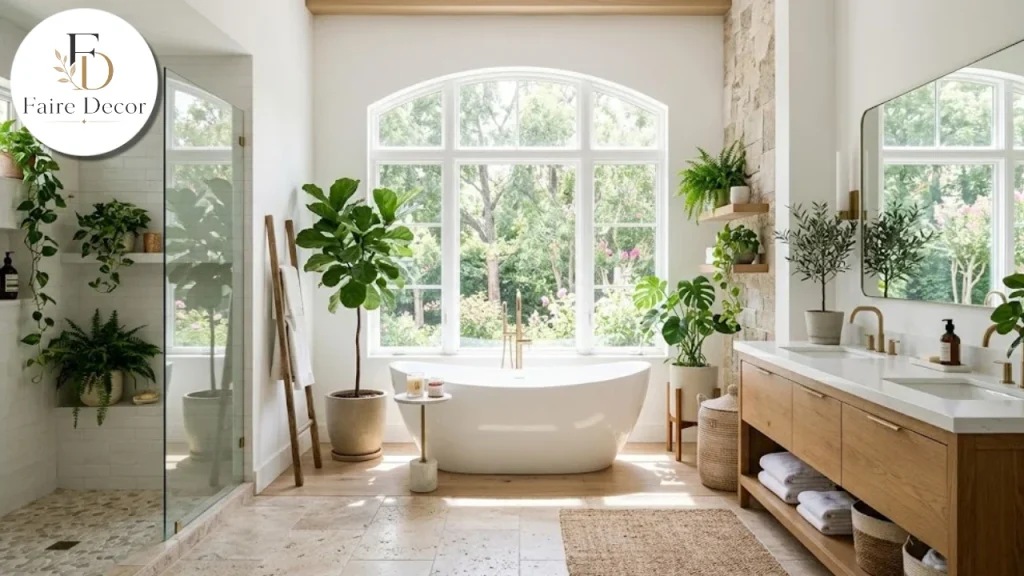
Art Deco glam
Family Handyman, quoting Kropovinsky, describes Art Deco glam as dramatic geometric patterns, vivid colors,lors and glamorous luxury. It lists metallics, foil wallpaper, and glossy paint. It is a bold choice, and works best in a bathroom where you want a showpiece rather than a quiet backdrop.
Designer tips that apply to any theme
The Homes & Gardens article gathers short pieces of advice from designers that cut across styles.
Deep drawers hide clutter. Architect John Pawson says he includes many deep drawers in vanities because clutter makes it hard to relax.
Size the shower generously. Pawson recommends a shower at least 1.5 by 1.5 meters where space allows, with an overhead head and a handheld shower. Designer Nicola Harding puts it more simply: when it comes to showers, the bigger, the better.
Place the controls well. Homes & Gardens describes hotel-style showers with controls placed so users do not have to step into the spray to adjust them.
Choose exposed fittings that are easy to maintain. The same article lists exposed shower fittings as a hotel-inspired choice for that reason.
Make a bathroom feel like any other room. Designer Nicole Salvesen says she likes a bathroom to feel like any other decorative space, with antiques and freestanding elements.
These ideas work as well in a modern room as in a farmhouse one, which is why they are worth keeping on a checklist.
More looks worth knowing
A few other themes appear in the sources, and some may suit your house better than the main 15.
Country-chic. Homes & Gardens describes antiques and freestanding pieces, a bath placed in the center of the room, original wood flooring and soft fabrics such as linen, cotton, chintz and florals.
Minimalist. The same article describes a calm, uncluttered look focused on visual quiet, with marble basins, deep vanity drawers and taps and shower heads treated as design features.
Hotel-inspired. Generous showers, exposed shower fittings that are easier to maintain, handmade tiles, paneling and an upholstered chair, according to Homes & Gardens.
Colorful. Bold color through tiles or painted joinery, balanced by white, off-white or marble surfaces. Homes & Gardens quotes designer Lucy Barlow, saying plain subway tiles in a strong shade are a budget-friendly way to make an impact.
Boho-chic. RoomSketcher lists natural colors with earthy accents, woven baskets and rugs, linen towels, kilim, and plenty of plants.
Tropical. Abundant green plants, lush wallpaper, polished concrete, exotic woods, lots of light, and a waterfall shower, per RoomSketcher.
Moody traditional. Family Handyman lists dark, earthy colors on paint, tile, and wood, natural stone countertops, wood beadboard,d and black or brass hardware.
Victorian and shabby-chic. RoomSketcher describes Victorian as ornate and bold with jewel tones and gold accents, and shabby-chic as distressed white paint, lace, flowers,rs and pastels.
Southwestern and eclectic. Also covered by RoomSketcher, with desert browns and turquoise for the first and a curated mix unified by color, texture,ure and finish for the second.
The main looks at a glance
Here is a quick side-by-side of nine looks from the Houzz list, so you can compare palettes and signature pieces before reading the details.
| Theme | Typical colors | Signature pieces (Houzz) |
|---|---|---|
| Modern | Crisp white, neutrals, black | Floating vanity, glass shower, freestanding tub |
| Transitional | Soft blue, brown, gray, wood tones | Shaker-style vanity, subway tile, drum pendants |
| Traditional | Subtle neutrals, pale blue or green | Furniture-style vanity, claw-foot tub, wainscoting |
| Farmhouse | White with black trim, natural neutrals | Barn lighting, trough sink, sliding barn doors |
| Rustic | Stone and warm wood hues | Wood vanity, copper or stone vessel sinks |
| Industrial | Raw materials, occasional bold accent | Concrete, steel-and-glass shower, exposed pipes |
| Beach | Sand, sky and sea tones | Pebble tile, weathered wood, wall paneling |
| Mediterranean | Warm earth and sea hues with white | Colorful tile, burnished metals, whitewashed walls |
| Craftsman | Earth tones, greens, warm neutrals | Handcrafted tile, stained glass, dark wood |
How to choose a theme
Looking at lists of popular bathroom themes is the easy part. Here are the questions that narrow it down. These are my suggestions rather than a sourced method.
Start with the house. A bathroom that echoes the rest of your home feels settled. A craftsman house suits craftsman details, and a coastal cottage suits a coastal bath.
Look at your room. Small rooms often do better with light themes such as Scandinavian or Japanese. Large rooms can carry dark or dramatic looks.
Think about upkeep. Homes & Gardens notes that hotel bathrooms are heavily used and work as a test of materials and design. Pick finishes you will actually clean.
Choose two materials and one accent. Many themes above rely on two or three recurring materials. Repeat them.
Pick the fixtures last. Faucets, lighting, and hardware can shift a theme quickly, so choose them once the tile and vanity are settled.
Matching a theme to your room
Room size changes which themes feel easy. These pairings are my suggestions, not a set rule.
Small bathrooms often suit Scandinavian, Japanese, or modern looks, because they rely on light colors, clear surfaces, and few objects.
Large bathrooms can carry the heavier themes, such as industrial, craftsman, Art Deco,o or moody traditional, where dark materials need space to breathe.
Narrow bathrooms do well with a single strong feature, such as a patterned floor or a colored vanity, so the eye has one place to land.
Shared family bathrooms benefit from durable, easy-to-clean choices, whatever the theme.
Mixing themes without making a mess
Few real bathrooms follow one of the popular bathroom themes to the letter. Transitional, the Houzz style that blends traditional and contemporary, is an example of mixing done on purpose. RoomSketcher defines eclectic as a curated mix of styles unified by color, texture, and finish.
A simple way to mix is to keep one thing constant. Hold the palette steady and vary the shapes, or hold the finish steady, such as all brass, and vary the colors.
Our home decor ideas that actually work post has more thoughts on blending styles through a house, and our guide on how to decorate walls is a good next read for art and display.
Color and light across themes
Color shapes popular bathroom themes as much as materials do. Houzz lists crisp whites and black for modern, soft blues and browns for transitional, white with black trim for farmhouse, and sand, sky, and sea tones for beach.
For a calm, spa-like mood, consider the quiet palettes in our gray house post, and do not forget the ceiling. Our guide on what color to paint a ceiling covers a surface that can change how a room feels.
Lighting differs by theme. Homes & Gardens quotes designer Nicole Salvesen advising that fixtures be IP-rated and approved for bathroom use. Houzz lists sconces for transitional, barn lighting for farmhouse and ornate lighting for Mediterranean. Whatever you pick, confirm the rating with an electrician.
Practical checks before you commit
Even the most popular bathroom themes are looks, and a bathroom still has to work. Check these before you order anything.
Clearances and codes. Your building department decides what applies. Confirm layout rules before you buy a vanity or tub.
Moisture. Homes & Gardens says washable or outdoor-grade fabric works in humid rooms, and that vinyl-quality wallpaper suits bathrooms, with clear varnish protecting standard wallpaper.
Materials that need care. Homes & Gardens says wood is acceptable if sealed. Marble is lovely but needs sealing and maintenance, a point Bob Vila makes in its list of master bathroom ideas.
Ventilation and privacy. If the plan includes a window, ask about privacy glass. Our guide to a privacy screen shows outdoor ideas that can help.
I did not find sourced costs for any of these themes, so I am not quoting prices. A theme can cost almost anything depending on tile, fixtures, and labor. If you are weighing a shower remodel,
our guide to shower renovation cost can help you think through the budget, and our renovation tips article helps you plan the order of work.
Does the theme matter when you sell?
I did not find a sourced figure for how a themed bathroom affects resale, so I am not claiming one. Many sellers lean toward timeless choices in finishes they cannot easily change,
and keep bolder themes in accessories that are easy to swap. If you plan to sell soon, our guide on how to sell your home fast covers what buyers tend to notice.
A quick theme checklist
- Three photos saved of bathrooms you love, with the common elements noted
- Theme named in one or two words
- Palette limited to three colors plus a metal finish
- Two main materials chosen: tile and vanity
- Lighting rated for bathroom use
- Fabrics and wallpaper chosen for humidity
- Accessories planned for quick seasonal change
- Permit and layout questions answered with the building department
Final thoughts on popular bathroom themes
The most popular bathroom themes share one trait: they hold a few ideas steady. Modern relies on clean lines, farmhouse on warm simplicity, coastal on light and water, Japanese on restraint, Art Deco on drama.
Pick the one that fits your house and the way you use the room, repeat two or three materials,s and let a few accessories carry the personality.
Remember that style names are loose, and every source here has something to sell. Use the descriptions as a starting vocabulary, bring photos to your designer or contractor, and confirm layouts, ventilation,n and electrical details with your local building department and licensed professionals.
This article is general information, not construction, electrical, plumbing,ing or design-licensed advice. Confirm all requirements with local professionals before you build.
FAQs:
What are the most popular bathroom themes?
Sources commonly list modern, contemporary, transitional, traditional, farmhouse, rustic, industrial, beach or coastal, Mediterranean, and craftsman (Houzz), plus Scandinavian, Japanese or Zen, organic modern, mid-century modern, and Art Deco glam (RoomSketcher, Family Handyman).
What is the difference between modern and contemporary?
Houzz describes modern as sleek and streamlined with strong horizontal lines, and contemporary as embracing the latest technology, materials,ls and trends. RoomSketcher says modern draws on the early to mid-1900s.
What colors define a farmhouse bathroom?
Houzz says white with crisp black trim is popular, with nature-inspired neutrals for richer looks. Family Handyman lists a palette of wood, black, white,e and gray, sometimes with a color accent.
Which bathroom themes suit a small room?
Scandinavian, Japanese,se and modern looks rely on light colors and few objects, which is why they often suit small rooms. This is a design suggestion, not a code rule.
Can I mix bathroom themes?
Yes. Houzz describes transitional as a deliberate blend of traditional and contemporary, and RoomSketcher defines eclectic as a curated mix unified by color, texture,ure and finish.
What should I check besides style?
Layout clearances and permits with your local building department, bathroom-rated lighting, moisture-resistant fabrics and wallpaper, and whether materials such as wood and marble need sealing.