

A chipped, dull, or stained tub makes a whole bathroom feel tired. Ripping it out feels like the only fix, until you see the invoice and the tile damage that comes with it.
That is why so many homeowners start by searching for the bathtub refinishing cost. It is the cheapest way to make an old tub look new again.
The trouble is that the numbers online don’t agree. One guide says $480, another says $727 and up, and a third says a few hundred dollars. This article puts the published figures side by side and shows where they differ and why.
Every dollar figure below is attributed to the page it came from, so you can check it yourself. None of it is a quote for your tub. Only a written estimate from a local refinisher can give you that.
What bathtub refinishing actually is
Refinishing means putting a new coating over the surface of your existing tub. The tub stays in the wall, the plumbing stays untouched, and the old surface gets cleaned, repaired,d and recoated.
This Old House describes the usual process in six steps. The room is ventilated, the tub is cleaned and repaired, the surface is etched to help the coating grip, a primer goes on, several coats of finish are sprayed, and then the finish cures.
You will also see the words “reglazing”, “resurfacing” and “resurfaced”. In everyday use,se they mean nearly the same thing, and many contractors use them interchangeably.
Angi does draw a line. It says reglazing also includes stripping off the previous coating and sanding the tub down. That distinction matters later, because stripping is where the most serious safety risk sits.
Bathtub refinishing cost: the headline numbers
Here is what each source I opened says about the typical price of a professional job. I have kept their wording and their dates, because the dates matter.
Angi says the national average is $483, based on 7,355 verified projects from Angi Pros. It says most homeowners pay between $337 and $631.
This Old House (updated March 17, 2026) gives an average of $480, with most projects between $335 and $630.
Thumbtack (updated June 5, 2026) gives a national range of $263 to $687. Its low-end figure is $,135 and its high-end figure is $1,393.
Inch Calculator says the national average is $450 and that most jobs fall between $300 and $1,000. The page title says 2026, but the page itself says “Updated Jul 19, 2023”.
Homewyse (May 2026) says the estimated national average starts at $727 to $1,473 per bathtub.
Read together, the bathtub refinishing cost for a standard tub sits around $450 to $500. That is my reading of the Angi, This Old House and Inch Calculator figures, not a number any one source printed.
Homewyse is the outlier. Its page says the estimate assumes “basic mid-range work by proficient professionals”, sanding, priming and spraying two coats, and it adds a supervision allowance of 13% to 22%. Those assumptions help explain the higher range.
One more caution. Even within a single site, the numbers shift. Angi lists $483 as its headline average, but its own method table says refinishing averages about $450. This Old House shows $336 to $629 on one page and $335 to $630 on another.
That is normal rounding between articles, and it is a reminder not to treat any single figure as exact.
Cost by tub material
Material changes both the prep and the price. Here is how two sources break it down.
Angi lists fiberglass at $300 to $1,000, porcelain at $350 to $600, antique porcelain at $500 to $1,200, cast iron at $350 to $600, and enamel at $350 to $600.
This Old House lists fiberglass at $250 to $600, porcelain at $350 to $600, cast iron at $300 to $650, and enamel at $350 to $600.
The two agree closely on porcelain and enamel. They disagree on fiberglass, where Angi’s range runs much higher at the top end.
Thumbtack gives no dollar figures by material. It only says fiberglass usually costs the least, porcelain falls in the middle, and cast iron tends to cost the most because it needs more prep work.
Inch Calculator puts porcelain over cast iron at about $350 to $600 and fiberglass at about $300 to $1,000, which matches Angi.
The honest takeaway is that a standard porcelain or enamel tub is the safest case to budget around. Fiberglass can come in low or high depending on its condition.
Cost by tub type and size
Size matters because a bigger surface takes more material and more time. This Old House notes that a standard tub is about 13 square feet, and larger tubs cost more.
Angi says freestanding and claw-foot tubs cost more because of their greater surface area. Its claw-foot range is $400 to $1,400, and a tub-shower combination runs $600 to $1,000.
This Old House gives different numbers. It lists a clawfoot tub at $300 to $650 and a bath-shower combination at $500 to $1,000.
The claw-foot gap is wide. If you own one, expect quotes to vary a lot and ask each refinisher whether the outside of the tub is included.
Tub-shower combinations are costlier because there is more to coat. This Old House says a tub with the shower walls done through the Miracle Method costs $1,000 to $1,200, against $500 to $650 for the tub alone. The Miracle Method is a franchise brand, so treat that as one company’s pricing.
Refinishing, reglazing, inlay, liner, replacement
When people ask about bathtub refinishing cost, they are often comparing it with other fixes. Here is how two sources price the alternatives.
Angi lists an inlay at $100 to $200, reglazing at $280 to $600, a liner at $2,700 to $10,200, and full replacement at about $5,700 on average and up to $14,700.
This Old House lists an inlay at $100 to $200, reglazing at $200 to $650, and a liner at $1,700 to $2,500. It gives a replacement range of $1,400 to $10,500.
That second source then contradicts itself. Another This Old House article puts liners at $2,656 to $10,110 and full replacement at $1,961 to $9,239.
So the safe reading is that refinishing costs hundreds of dollars, while liners and replacement cost thousands. Where exactly the thousands land depends on the source and on your bathroom.
An inlay, according to Angi, covers only the tub bottom. It is the cheapest option and only addresses a worn floor.
A liner is a custom-fit acrylic or plastic shell that goes over the whole tub. This Old House says liners suit homeowners who want a uniform look with minimal demolition, though some find them “plastic”. It adds that many liner companies won’t work with fiberglass or acrylic tubs.
Replacement means removing the old tub and installing a new one. Angi puts the average around $5,700 for a reason: plumbing, tile, and wall repair often come with the job.
What drives the final price

A few factors move the quote more than anything else.
Condition. This Old House gives a rough guide: about $275 for a tub in good condition, $450 for fair, and $900 for poor. It also says sandblasting a corroded or peeling tub adds labor time.
Repairs. Angi says major cracks, scratches, or gouges need filling, which raises the price. Inch Calculator separates optional chip and crack repair at $200 to $300.
Method and materials. Premium coatings cost more but are meant to last longer, according to Thumbtack. Angi adds that custom or specialty colors raise the price.
Complexity. Thumbtack lists unusual shapes, hard-to-reach tubs,s and reglazing surrounding tile as things that add cost.
Labor rates. Thumbtack says rates are often higher in urban areas than in rural ones.
If you are also redoing the surround, price that separately. Our shower renovation cost guide covers what a full shower update involves.
Where the money goes
Most of the bathtub refinishing cost on a professional quote is labor, not materials. Inch Calculator’s table splits a typical job into labor at $300 to $550 and supplies at $75 to $150.
Add optional repair at $200 to $3,00 and its estimated total runs from $375 to $700.
This Old House makes a related point about DIY. It says labor is about 80% of a project, which is why skipping the pro can cut the bill sharply.
Homewyse prices differently. It builds its estimate from basic labor under favorable conditions plus a two-hour minimum charge, and the page does not list task hours or a labor rate.
When you read a quote, ask whether it includes repair work, a second coat, and the cost of the finish color. Those are the line items that move totals.
DIY kits: cheaper up front, riskier in the long run
DIY kits are the other side of the bathtub refinishing cost question. The kit price is low, but the trade-offs are real.
Angi puts kits at $30 to $150. This Old House says a kit can cost under $100. Inch Calculator says $75 to $150 and notes that kits include sandpaper, cleaner, primer, rollers, brushes,hes and paint or gel.
Angi says homeowners can save more by doing it themselves, but warns that mistakes can leave less-than-perfect results.
Thumbtack lists the risks plainly: peeling, an uneven finish, and poor ventilation. It also points out you still need a respirator and tools on top of the kit.
Durability is where the gap shows. Inch Calculator says “a DIY kit is usually only good for two to three years”, while “a professional refinish typically lasts five to fifteen years”.
I opened a couple of vendor pages that quote much more precise lifespans for DIY and professional work. Because they sell refinishing products or services, I have not used their numbers.
This Old House recommends a technician for the best results, since reglazing chemicals can be dangerous and the process is not easy.
A kit makes the most sense on a tub in decent shape, in a home you plan to keep, when you accept a less polished result. It is a poor fit for badly damaged surfaces, an older tub that may have lead, or a tub you plan to sell around.
Safety: the part that rarely makes the cost guides
Price guides skip this, and it is the most important section here. Refinishing involves strong chemicals in a small room.
The CDC’s NIOSH bulletin, written by Ronald M. Hall and posted February 4, 2013, says at least 14 workers have died since 2000 from stripping agents containing methylene chloride during bathtub refinishing.
It explains why bathrooms are dangerous. Vapors can build up in the tub basin right where the worker is breathing.
On ventilation, NIOSH is blunt: “Bathroom fans or open windows do NOT provide adequate ventilation.” It recommends mobile local exhaust ventilation units, which pull vapors out of the room.
A notice on the same page says the EPA finalized a ban on most uses of methylene chloride on April 30, 2024. That notice was added after the original 2013 bulletin, so it describes the current rules, not the bulletin’s text.
Angi adds that the epoxy coatings used to finish bathtubs can also emit dangerous vapors such as isocyanates when sprayed. It advises household members to leave the property during the entire process, including while the coating cures.
On odor, Angi says it takes about 24 hours for the smell to fade. It also says to expect to wait two to three days before using the tub.
This Old House mentions one more hazard. Older porcelain tubs may contain lead, and it suggests sealing them with an epoxy primer and a paint topcoat.
If you have kids, pets, or anyone sensitive to fumes at home, plan to stay elsewhere. Ask any refinisher what products they use, how they ventilate, and what protective gear they wear.
How long the job takes and when you can bathe
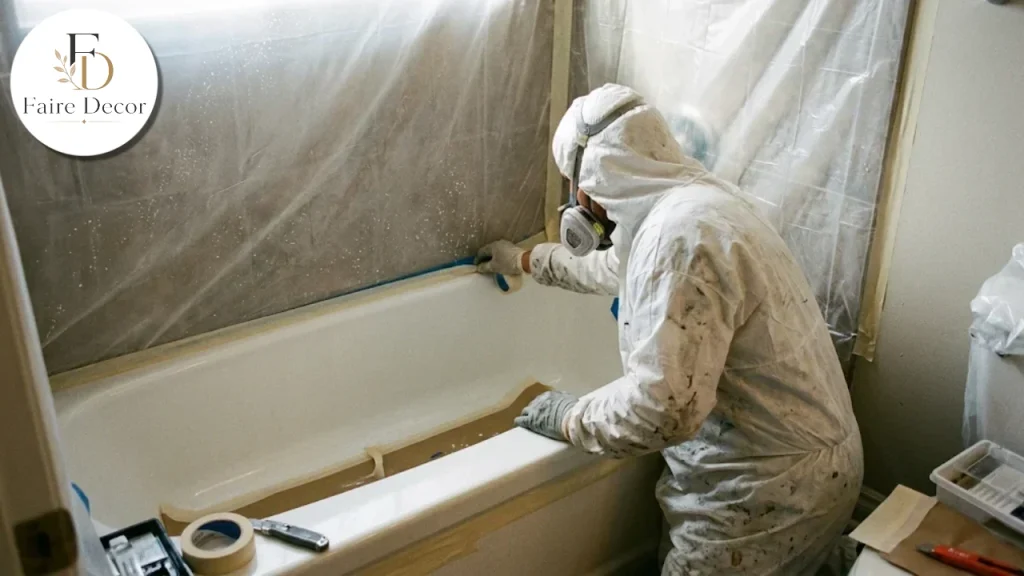
Time estimates vary by source, so build in a cushion.
Angi says refinishing takes two to four hours of work, then 24 to 48 hours before use. For reglazing, it says about three to five hours, with the tub ready 48 hours after completion.
This Old House’s process article says four to six hours of work, with 24 to 48 hours of cure time. A second This Old House page says a typical project takes eight hours or less and that many people can use the tub within 24 hours.
Thumbtack agrees with the 24 to 48 hour range for most professional coatings.
My advice is to plan on two full days without that tub, and three if you can manage it. If you only have one bathroom, arrange somewhere else to shower.
How long does a refinished tub last?
This is where the sources disagree the most, so here is every figure I found.
Angi says a refinished tub lasts “10 years or more” once set, and reglazing lasts 10 to 15 years. Thumbtack says a professionally reglazed tub typically lasts 10 to 15 years with proper care.
This Old House gives three numbers across its pages. One says at least 10 years with proper maintenance. Another says reglazing can last 15 to 20 years. A third says refinishing’s expected lifespan is 5 to 10 years.
Inch Calculator says five to fifteen years for a professional job.
The fair summary: expect somewhere between 5 and 15 years, and treat the 10-to-15-year figures as what a careful job in a lightly used bathroom might reach.
Making the finish last
Care matters as much as application. This Old House says to use only mild, nonabrasive cleaners and to avoid bleach.
It also says to avoid dropping heavy objects, which can chip the coating, and to consider reapplying a clear topcoat every few years.
Don’t let anyone use the tub for the first day or two. Wait out the full cure time your refinisher gives you, even if the surface feels hard.
Use a soft sponge, not a scouring pad. Wipe the tub down after use so soap scum and hard-water film don’t build up on it.
For other cleaning routines around the house, our guide on how to clean hardwood floors safely shows the same gentle-products approach.
Refinish or replace? A simple way to decide
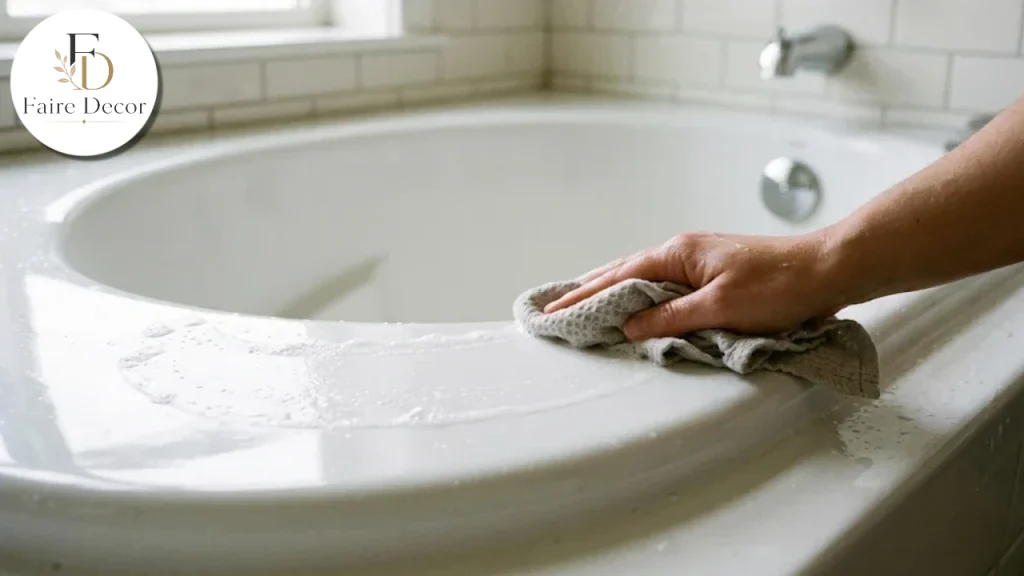
Paying the bathtub refinishing cost makes sense when the tub’s structure is sound, and the problem is cosmetic. Angi says it is worth considering first if the structure is still sound, since the savings over replacement are substantial.
Replacement makes more sense in a few cases. Angi lists major cracks, deep gouges or severe damage, and a tub that leaks. It says that if a tub is beyond repair, a liner is an option, though it costs far more than refinishing.
This Old House adds that fiberglass tubs tend to warp or crack 10 to 15 years after installation. If yours is that old and flexing underfoot, a new coat won’t fix it.
Also think about the rest of the room. If the floor, walls,s or vanity are all being redone, replacing the tub may be cheaper than it looks because the demolition is already paid for.
Here is some arithmetic of my own, using the sourced figures. A $480 job that lasts 10 years costs about $48 a year. At 5 years, the same job costs about $96 a year. A replacement priced at $5,700 would need to last far longer to match that.
That comparison is rough, and replacement also changes the look and fit of the tub, not just its surface.
Refinishing before you sell
A refinished tub is one of the cheaper ways to freshen a bathroom before listing a home. Buyers notice stained, chipped enamel quickly.
For a wider look at what sells, see our guide on how to sell my home fast.
If you are planning bigger projects, our renovation tips guide can help you decide what to do first.
White is the safest finish for resale. Angi notes that custom and specialty colors raise the price, so a bold color is a personal choice, not a bargain.
Budgeting with the rest of the house in mind
A bathroom refresh rarely happens alone. If you are weighing a small budget across several projects, it helps to see what else is competing for the money.
Water problems come first. A tub that leaks, or a ceiling stained from above, belongs ahead of cosmetics. Our guide on roof leaks explains how to spot and handle the usual causes.
Energy and comfort come next. If the attic is thin on insulation, read about attic insulation before spending on finishes.
Exterior jobs can wait on the same list. Gutters often rank high, and our gutter installation cost calculator breaks down that spending.
If a new floor is on the wish list, our best flooring guide compares the main options.
For finishing touches, ideas on how to decorate walls and custom curtains can lift a bathroom for far less than a remodel.
Color choices matter too. Our guides on gray-green paint and the best ceiling paint shades pair well with a fresh white tub.
Glossary
Refinishing: Applying a new coating over a tub’s existing surface.
Reglazing: Usually used the same way as refinishing. Angi says it also includes stripping and sanding.
Resurfacing: Another everyday term for the same kind of job.
Inlay: A cover for the tub bottom only. Angi prices it at $100 to $200.
Liner: A custom-fit shell installed over the whole tub.
Etching: Roughing the surface, often with chemicals, so the coating grips.
Cure time: The wait before the finish is hard enough to use. Sources say 24 to 48 hours is common.
Methylene chloride: A stripping solvent linked to worker deaths in bathtub refinishing, per NIOSH.
Isocyanates: Vapo.rs Angi says epoxy coatings can emit when sprayed.
A quote checklist
Before you sign, get these answers in writing.
Is the price per tub, or per tub and surround?
Does it include chip and crack repair, and how much?
How many coats are applied, and what is the finish called?
What color is included, and what do custom colors cost?
What is the warranty, and what voids it?
How long until I can use the tub?
What ventilation and protective gear do you use?
Do you strip the old coating, and with what product?
Is there a minimum charge or trip fee?
Questions to ask any refinisher
Ask whether they are insured. Thumbtack says professionals typically offer a warranty and insurance. Ask what they do about lead on an old tub, and who pays if the finish fails.
Mistakes to avoid
Picking the lowest quote without comparing scope. A low price may skip repairs or a coat.
Using the tub too soon. Waiting out the cure time is the cheapest warranty you have.
Using a harsh cleaner. Bleach and scouring powder shorten the life of the finish.
Trying DIY stripping in a small bathroom. NIOSH says bathroom fans and open windows are not adequate ventilation.
Ignoring structural problems. If the tub leaks or flexes, a coating will not fix it.
Forgetting to plan for a bath-free few days. Line up an alternative before the work starts.
A sensible budget range
Based only on the sources I opened, the bathtub refinishing cost for a plain professional job on a standard tub in decent condition is most often quoted in the mid-hundreds. That fits the Angi, This Old House, and Inch Calculator figures.
Add room for repairs if the surface is damaged. This Old House’s condition guide suggests a poor-condition tub can reach about $900, and Thumbtack’s high end reaches $1,393.
Claw-foot and fiberglass tubs, tub-shower combinations, and tile surrounds are where quotes spread out the most.
DIY costs $30 to $150 for the kit, but the sources say it may last only a couple of years.
Pricing is local, dates matter, and a written estimate always beats a national average. Use these figures to judge whether a quote is in range, not to replace one.
Prices and lifespans in this article come from the sources listed in the notes and may differ in your area. This is general information, not professional advice. Chemicals used in refinishing can be hazardous, so follow the product label and your local safety rules, and consider hiring a licensed pro.
FAQs:
How much does bathtub refinishing cost?
Angi gives a national average of $483, with most homeowners paying $337 to $631. This Old House gives $480 and a range of $335 to $630. Thumbtack’s range is $263 to $687. Your quote depends on tub material, size, and condition.
Is refinishing cheaper than replacing a tub?
Yes, by a wide margin in every source opened. Refinishing is quoted in the hundreds of dollars. Angi puts full replacement at about $5,700 on average, and This Old House gives $1,400 to $10,500. Replacement often brings plumbing and tile work with it.
How long does a refinished bathtub last?
Sources disagree. Angi and Thumbtack say 10 to 15 years for a professional job. Inch Calculator says five to fifteen years. One This Old House page says 5 to 10 years. Careful cleaning and a sound tub help the finish last.
How long before I can use the tub?
Thumbtack and This Old House say most professional coatings need 24 to 48 hours to cure. Angi says to expect to wait two to three days. Follow the cure time your refinisher gives you.
Can I refinish my own bathtub?
You can. Kits cost about $30 to $150 depending on the source. Thumbtack lists peeling, an uneven finish,sh and poor ventilation as risks, and Inch Calculator says a DIY kit is usually good for two to three years.
Are bathtub refinishing fumes dangerous?
They can be. The CDC’s NIOSH says at least 14 workers have died since 2000 from methylene chloride stripping agents, and that bathroom fans and open windows do not provide adequate ventilation. Angi says epoxy coatings can emit isocyanates and advises household members to leave during the process.