

Some trees demand a big yard and a long wait. Acer circinatum, better known as vine maple, asks for a shady corner and a little patience, and pays back with soft green leaves in spring, a graceful branching habit, and a blaze of fall color.
It is a native of the Pacific Northwest, and it has a loyal following among gardeners who want something less formal than a typical ornamental maple.
This guide explains what the plant is, how big it gets, where it grows wild, what it wants in a garden,n and where the sources disagree. The facts come from university and extension pages and a gardening society, and I name each one. I did not find any prices or nursery availability on those pages, so none appear here.
What is Acer circinatum?
Acer circinatum is the botanical name of vine maple, a deciduous tree or large shrub in the maple group. Oregon State University’s Landscape Plants page describes it as a multistemmed, broadleaf deciduous tree or large shrub. The same page says the species name refers to the leaf outline, which it describes as rounded or circular.
NC State Extension lists another common name, Oregon vine maple. The University of Washington’s plant data sheet calls it a long-lived deciduous shrub or small tree. All three agree on the basic picture: a multi-stemmed, rounded-leaf maple that behaves differently in sun and shade.
Where it grows wild
Knowing where a plant grows in nature tells you what it likes at home. Oregon State says Acer circinatum grows in moist woods and along stream banks from British Columbia south to northern California. The University of Washington adds more detail:
Southwest British Columbia to northern California, from the eastern slopes of the Cascades to the coast, from sea level up to 1,400 meters. It prefers the climate west of the Cascades.
The same sheet lists the habitats: coniferous forest understory, stream banks, forest openings, clear cuts, and talus slopes. NC State’s distribution list reads Alaska, California, Oregon, and Washington, which is wider than the other two pages, so it is worth reading that one as a loose range rather than a precise one.
The takeaway for a gardener is simple. This is a woodland-edge plant that is used to moisture, dappled light,t and rich forest soil.
How big does it get?
Size is where the sources disagree most, and the differences matter if you are planning a small space.
| Source | Height | Spread | Notes |
|---|---|---|---|
| Oregon State University | 10 to 20 feet (3 to 6 m) | Not given | Landscape Plants page |
| NC State Extension | 10 to 25 feet | 15 to 20 feet | Plant Toolbox |
| Royal Horticultural Society (RHS) | 4 to 8 meters | 4 to 8 meters | Time to maturity 20 to 50 years |
| University of Washington | Up to 15 meters | Not given | Describes wild plants |
The University of Washington figure describes wild plants, so treat it as an upper limit rather than a garden expectation.
The RHS number is in meters, so 4 to 8 meters is roughly 13 to 26 feet by my arithmetic. For planning, a range of about 10 to 25 feet in height covers the garden-scale sources, with a spread that can be as wide as it is tall.
The RHS also says it can take 20 to 50 years to reach its ultimate size, which fits a plant that grows at a steady rate rather than a fast one. NC State lists the growth rate as medium.
Form: vine-like in shade, upright in sun
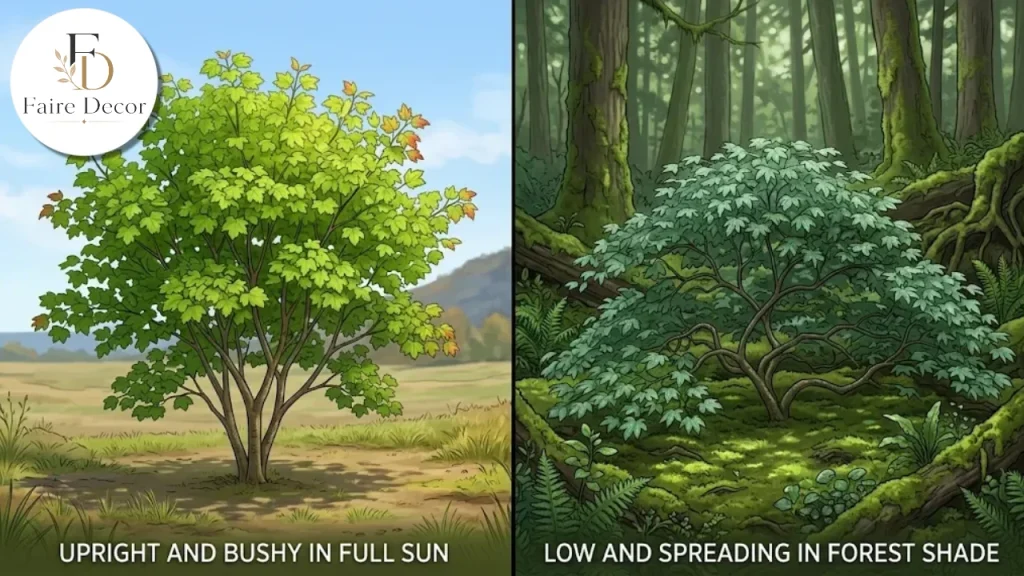
The most charming thing about Acer circinatum is how its shape responds to light. Oregon State says it sprawls and grows vine-like in forest shade but becomes bushy and dense in sun, with an upright crown.
NC State says it is upright in sunny spots and horizontal in shade, with a short trunk and several branches that turn and twist from the base.
Oregon State quotes Grant and Grant (1990), who describe an upright form in sun and an “ethereal horizontal grace” in shade. The same page notes a drawback seen from the wild: hunters find its low, long-running branches obstructive.
Oregon State also mentions that voyageurs once called it “Bois de diable,” a name recorded by the Scottish plant collector David Douglas (1799 to 1834). It is a fun detail, and a hint at how tangled the plant can look in dense forest.
Leaves, flowers and fruit
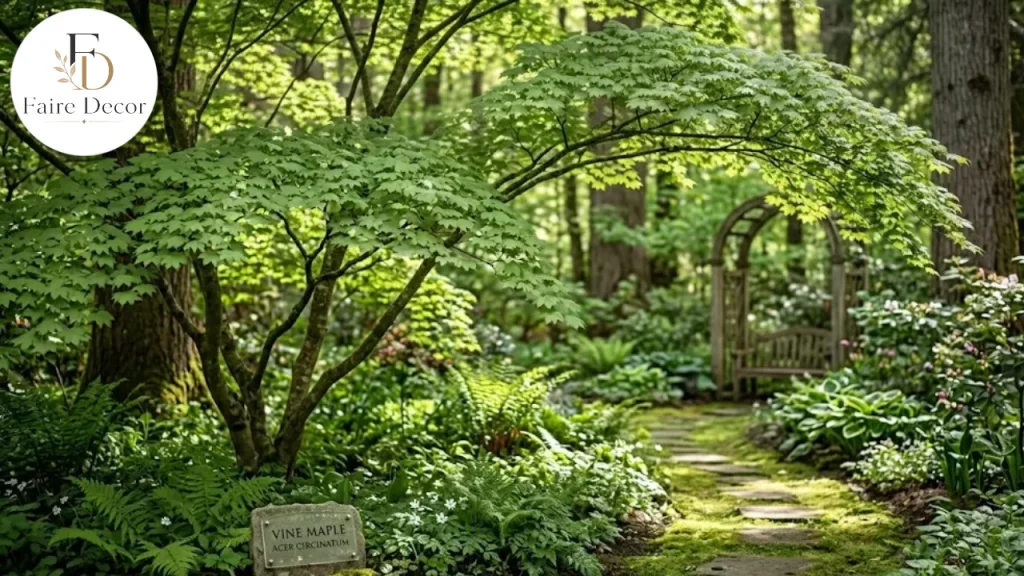
Oregon State describes the leaves of Acer circinatum as opposite and simple, nearly circular, 6 to 12 centimeters across, with a heart-shaped base and 7 to 9 lobes (the page gives a wider count of 5 to 11 lobes in places).
NC State gives 7 to 9 lobes and 3 to 6 inches long and wide. In spring, NC State says the foliage is bright emerald green, often with a reddish tinge at first.
The flowers arrive in spring. Both pages describe clusters of 3 to 6 flowers with deep red sepals and greenish-white petals. They are small, and they are easy to miss from a distance, but they look lovely up close.
The fruit is a winged seed, called a samara. Oregon State says it is about 4 centimeters long with horizontally spread wings, deep red at maturity. NC State describes deep red, two-winged samaras about 2 inches long, ripening in fall, with an attribute range of 1 to 3 inches.
NC State also describes the bark: green when young and becoming smooth and reddish-brown with age.
Fall color
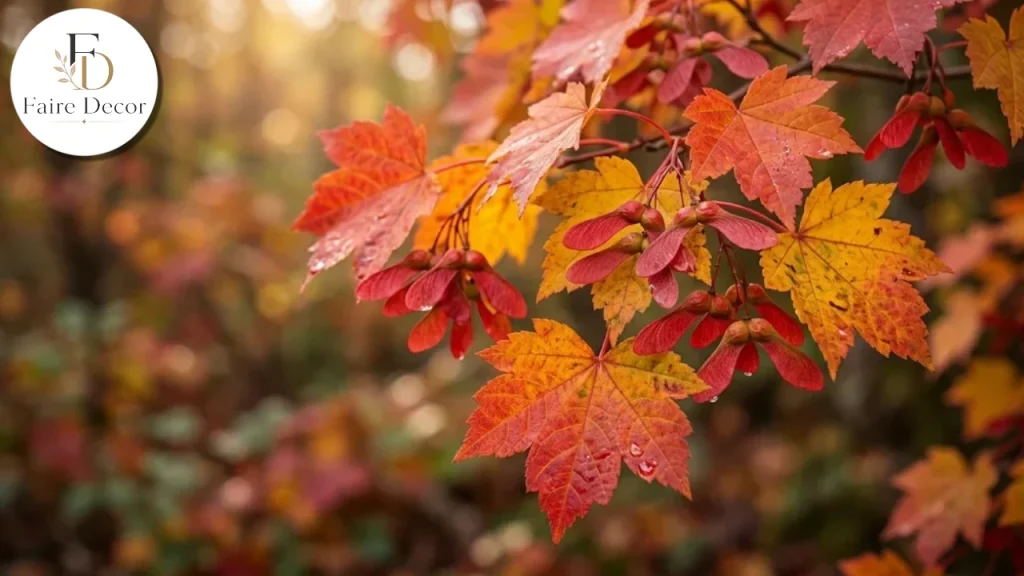
For many gardeners, fall color is the main reason to plant Acer circinatum. Oregon State says the leaves turn red, orange, and yellow, with color developed in sun. NC State lists yellow, orange, and red or burgundy, with stronger color when the tree is planted in sun.
Both pages point the same way: more sun means stronger color. If color matters most, give it as much light as the rest of its needs allow.
If you want a backdrop that makes foliage glow, our guide to black windows shows how dark frames set off bright leaves, and our gray house post shows how a quiet exterior lets garden color take center stage.
Light: sun or shade?
Acer circinatum is unusually flexible about light. Oregon State lists sun or deep shade. The University of Washington says it is highly shade tolerant but also thrives in open areas.
NC State recommends partial shade for best performance, and lists full sun and deep shade as tolerated. The RHS says full sun or partial shade, in sheltered or exposed positions.
Taken together, the sources suggest a plant that survives almost anywhere in the light range, with the best balance in part shade.
That is my reading of the four pages, not a rule any of them states. In deep shade you get the graceful, horizontal form and a quieter fall. In sun,n you get a denser, more upright plant and stronger fall color.
Soil and water
On soil, the sources lean the same way. The University of Washington says it prefers rich, well-drained soil. NC State says humus-rich, well-drained soil, listing loam or sand in acid (below pH 6.0) or neutral (6.0 to 8.0) conditions. The RHS says moist but well-drained, in clay or loam, with acidic, alkaline,ne or neutral pH.
On water, the story gets more interesting. Oregon State says it prefers moist, shady sites but tolerates sun. The University of Washington says it prefers moist soil.
NC State says consistent moisture is ideal and that the plant will not tolerate hot, dry conditions. However, that same page’s resistance field lists dry soil and heat, so the page contradicts itself.
If you garden in a hot, dry climate, treat that as a warning rather than a promise. A plant native to moist woodland may struggle with heat and drought. Check with a local nursery or extension office before you plant.
For general water-wise gardening ideas that suit many yards, our guide to designing a low-maintenance backyard is a useful companion.
Hardiness
Hardiness figures vary by source. Oregon State lists USDA Zone 4- 5. NC State lists USDA 4a through 7b. The RHS rates it H6, described as hardy in all of the UK and northern Europe, with a minimum temperature range of about minus 20 to minus 15 degrees Celsius.
If you are near either edge of the range, ask a local nursery how the plant performs in your area.
Where to plant it
NC State lists uses that show how flexible Acer circinatum is: shady borders, small groupings, patio trees, lawn specimens, naturalized and woodland areas, and riparian sites. Oregon State calls it the most useful native tree for Pacific Northwest landscapes, which is a strong endorsement from a university landscape page.
A few ideas for your own space:
Woodland border. Plant it at the edge of taller trees where it gets dappled light and shelter.
Patio or courtyard. Its multi-stemmed form suits a small tree role near a seating area.
Lawn specimen. In sun,n it forms a dense, upright shape that holds its own as a focal point.
Stream or rain garden edge. NC State lists riparian sites among its uses.
Privacy and screening. A group of vine maples can soften a boundary. Our havenlydiy privacy screen article covers more ways to add privacy to a yard.
If you are designing around an entry or a porch, see our guides to a front porch and the front door entryway living room combo ideas for ways to carry a softer, more natural look from the garden to the doorway.
How to plant it
The University of Washington sheet is written for propagation and restoration planting, but several of its points apply to home gardeners too.
It says to transplant after one or two years of growth, or install as bare root in winter. For spacing, it gives 3 to 5 feet on center, which is a restoration-planting figure for massed plantings rather than a spacing for a single ornamental specimen.
Seedlings need sparing water in their first summer, according to the same sheet. After planting, water only when necessary. It also notes that unimproved garden soil is enough for propagation, with a layer of leaf mulch recommended.
A few common-sense steps, which are my suggestions rather than sourced rules:
Pick the spot first. Match the light to the form you want: more sun for a denser shape, more shade for a looser one.
Prepare the soil. Work in compost if your soil is thin or heavy, since three sources favor rich, well-drained soil.
Plant at the right depth. Keep the root flare at the soil surface.
Mulch. A leaf mulch layer helps hold moisture and mimics the forest floor.
Water as needed. Check the soil rather than watering on a fixed schedule.
If you are planning a larger landscape change that includes a deck or hardscape near the tree, our HavenlyDIY deck company guide can help you think through the work, and our gutter installation cost calculator is worth a look if falling leaves are a concern for the roofline.
Pruning: less is more
Both Oregon State and NC State warn against heavy pruning. Oregon State says heavy pruning removes much of the plant’s form. NC State says heavy pruning is not recommended, or the unique form is lost.
The RHS puts it in a different frame. It places the plant in pruning group 1 and says to prune only from late autumn to midwinter while the plant is dormant, removing misplaced or crossing shoots to keep a healthy framework.
Those pieces fit together. If you prune at all, keep it light, remove only what crosses or rubs, and do the work while the tree is dormant. Do not try to force Acer circinatum into a tidy shape, because its relaxed form is the whole point.
Pests, diseases and wildlife
The sources are a little split on problems. NC State says there are no serious problems. It also says deer normally leave the plant alone, and that it hosts Imperial Moth (Eacles imperialis) larvae.
The RHS is more cautious. It says the plant may be susceptible to acer gall mite, aphids, caterpillars and horse chestnut scale, and to the diseases Verticillium wilt, acer leaf scorch and honey fungus. Note that the RHS wording is “possibly susceptible,” so these are risks to watch rather than certainties.
If your plant looks unwell, take a leaf to a local extension service or nursery for identification. I did not find sourced treatment advice, so I am not offering any here.
Growing Acer circinatum from seed or layering
The University of Washington sheet is the most detailed source on propagation. It says seed production is low, so the plant reproduces mostly through vegetative methods. The options are seed, layering, and collecting seedlings around parent shrubs.
For seed, it says plants over the age of ten produce seed, to be collected in September or October when the samaras begin to dry.
It gives a two-step treatment: warm, moist stratification at 20 to 30 degrees Celsius for 30 to 60 days, followed by cold stratification at 3 degrees Celsius for 90 to 180 days. Seeds are sown in trays under leaf mulch, germinate in spring, and can be transplanted after one year.
This is a slow route. For most home gardeners, buying a nursery plant is quicker, and layering a low branch is an interesting project if you already have a plant.
The sources disagree a little about vegetative methods: NC State’s description mentions layering, while its attribute list mentions root cuttings and seed. I did not find a sourced method for cuttings, so I leave that out.
Popular cultivars
Oregon State and NC State name several cultivars. Together they describe:
| Cultivar | Described as | Source |
|---|---|---|
| ‘Little Gem’ | Dwarf shrub with small leaves | Oregon State, NC State |
| ‘Monroe’ | Deeply dissected or deeply cut leaves | Oregon State, NC State |
| ‘Pacific Fire’ | Red bark | Oregon State, NC State |
| ‘Pacific Sprite’ | Dwarf, often multi-trunked, slow-growing | Oregon State, NC State |
| ‘Sunglow’ | Dwarf, slow-growing, apricot and peach spring leaves fading to chartreuse-yellow | Oregon State, NC State |
| ‘Burgundy Jewel’ | Purple-red leaves | NC State |
| ‘JFS-Purple’ | Bronze new growth | NC State |
Cultivars are a good choice if you have a small garden, since several are described as dwarf. Ask your nursery which are available near you.
A year in the life of a vine maple
It helps to picture the plant across the seasons, using the details the sources give.
Spring. NC State describes bright emerald green foliage, often with a reddish tinge at first, and clusters of small flowers with deep red sepals and greenish-white petals.
Summer. The plant is in full leaf. Consistent moisture is ideal, per NC State, and seedlings need careful watering in their first summer, per the University of Washington.
Fall. The leaves turn red, orange, and yellow, and the red winged fruit ripens.
Winter. With the leaves gone, the bark is the feature. NC State says it is green when young and becomes smooth and reddish-brown with age. Winter is also when the University of Washington says bare-root plants can be installed, and the RHS says pruning belongs from late autumn to midwinter.
If you like the idea of a garden with something to look at in every season, our home decor ideas that actually work post has ways to bring that seasonal feeling indoors, and our guide to ranch-style homes is a good read if your house has the wide, low lines that suit a spreading tree.
Using vine maple in a bigger garden plan
A tree is a long-term decision, so it helps to think about how it fits with the rest of your yard. A few thoughts, none of them sourced rules:
Give it room to spread. NC State lists a spread of 15 to 20 feet, so keep it clear of walls and walkways.
Think about the view. Fall color looks best against evergreens or a plain wall.
Plan for neighbors. Understory plants such as ferns and woodland perennials suit the same moist, shaded conditions.
Remember the dog. If you have pets that dig, our guide on keeping your yard looking good when you have dogs has practical ideas, and it is worth reading before you plant a young tree.
If you plan to sell your home, a healthy, well-placed tree adds curb appeal. I did not find a sourced figure for its effect on value, so I am not claiming one. Our guide on how to sell your home fast covers other steps buyers notice.
Questions to ask before you buy
Bring these to your local nursery.
Is Acer circinatum suited to my climate and hardiness zone?
How hot and dry do summers get here, and will it need extra water?
Which cultivars are available, and how large do they grow?
Is the plant grown locally or imported from a different climate?
How much sun does my planting spot actually get in summer?
Are there any local pests or diseases affecting maples?
Write the answers down and compare them with the sources above.
A quick planting checklist
Light checked at the planting spot, morning and afternoon
Soil tested or amended for rich, well-drained conditions
Spread of 15 to 20 feet allowed, away from walls
Cultivar chosen to fit the space
Planting done in a suitable season, with bare root plants in winter
Leaf mulch applied after planting
Watering plan set for the first summer
Pruning limited to dormant season and light shaping
Final thoughts on Acer circinatum
Acer circinatum is a graceful, flexible native that thrives in dappled light and moist, rich soil. It sprawls in shade, stands upright in sun and turns red, orange and yellow in fall. The sources agree on the broad picture and differ on size, hardiness, and heat tolerance, so check your local conditions before you plant.
Give it good soil, steady moisture,e and a light hand with the pruners, and it can become a long-lived centerpiece. This article is general information, not horticultural or professional landscaping advice. Confirm plant choice, hardiness, and planting details with a local nursery, extension office,e or arborist before you buy.
FAQs:
What isAcerr circinatum?
It is the botanical name of vine maple, a multistemmed deciduous tree or large shrub native to moist woods and stream banks from British Columbia to northern California, according to Oregon State University.
How big does Acer circinatum get?
The sources differ. Oregon State gives 10 to 20 feet tall, NC State gives 10 to 25 feet tall and 15 to 20 feet wide, and the RHS gives 4 to 8 meters in height and spread. The University of Washington says wild plants can reach 15 meters.
Does vine maple need sun or shade?
It tolerates both. NC State recommends partial shade, Oregon State lists sun or deep shade, and the RHS says full sun or partial shade. Shade gives a looser, horizontal form, and sun gives a denser, more upright one.
What color does vine maple turn in fall?
Oregon State lists red, orange, and yellow, and NC State lists yellow, orange,e and red or burgundy. Both say the color is stronger in sun.
Can vine maple handle hot, dry weather?
Be cautious. NC State says it will not tolerate hot, dry conditions, though another field on the same page lists dry soil and heat as under resistance. The University of Washington says it prefers moist soil. Check with a local nursery or extension office.
Should I prune Acer circinatum?
Keep it light. Oregon State and NC State both warn that heavy pruning spoils the form. The RHS says to prune from late autumn to midwinter while dormant, removing misplaced or crossing shoots.