

An arched window is one of the loveliest things a house can have, and one of the hardest to dress. Flat blinds do not fit the curve. Curtains hang below it and leave a half-moon of daylight blazing at 5 a.m.
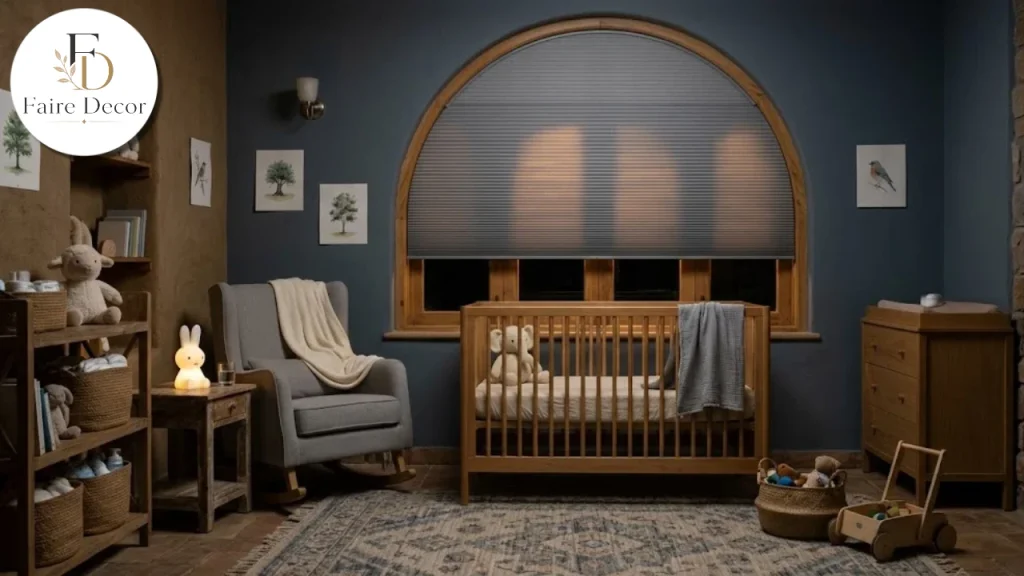
If the arch sits in a bedroom, nursery, or media room, that leftover light is the whole problem. This is where a blackout arch comes in: a shade shaped to follow the curve of the glass and built to block the light behind it.
This guide explains what a blackout arch is, how it differs from other arch coverings, which window shapes it suits, and how to measure and choose one without costly mistakes.
It also covers the alternatives, because a shade is not always the right answer. Where a claim comes from a seller page, I say so. Where I could not verify something, I flag it.
What is a blackout arch?
In the window-covering trade, a blackout arch is a cellular (honeycomb) shade made in an arched shape, with a lining that blocks light. The Blinds.com guide to covering arched windows describes cellular arches as shades of soft-spun material that fan out into a graceful arched shape,
with honeycomb cells that filter light and add insulation. For the blackout version, the same page says blackout cellular shades have an interior lining that blocks the sun’s rays, and that the exterior coating comes in multiple colors.
Select Blinds, a retailer, lists a blackout arch described as total light blocking and designed for stationary arch windows only. That is marketing language from a seller, so treat the performance claims as the maker’s own. The detail worth noticing is the phrase “stationary.”
Most arch shades are fixed in place. They do not raise and lower like a normal blind, which shapes how and where you can use one.
The short version
A blackout arch is a shaped cellular shade with a light-blocking lining.
It is usually fixed, so it works best on an arch that does not need to open and close during the day.
It can add insulation and cut some noise, according to the sellers, though I found no independent test numbers.
It is made to order, so measuring matters correctly.
Why arched windows are hard to cover
Arched windows break the rules that make regular treatments simple. The top edge curves, so a straight headrail will not seat against the frame. Rods sit above the curve and hide it or leave a gap. Shutters and shades must be cut to shape, which pushes up cost and lead time.
One homeowner’s account on The DIY Playbook shows how fast the options narrow. She wanted to darken a room with an arched window above a lower pair.
A large Roman shade would not work because of the sill depth, plantation shutters let light leak at the sides and cost far more than she wanted, and honeycomb shades were an option but not movable at that size and depth. The takeaway is practical:
the window’s depth, the fixtures around it and your tolerance for daily routines all decide what works. Her answer, a removable fabric insert, will not suit everyone, and she says so herself.
Know your arch shape
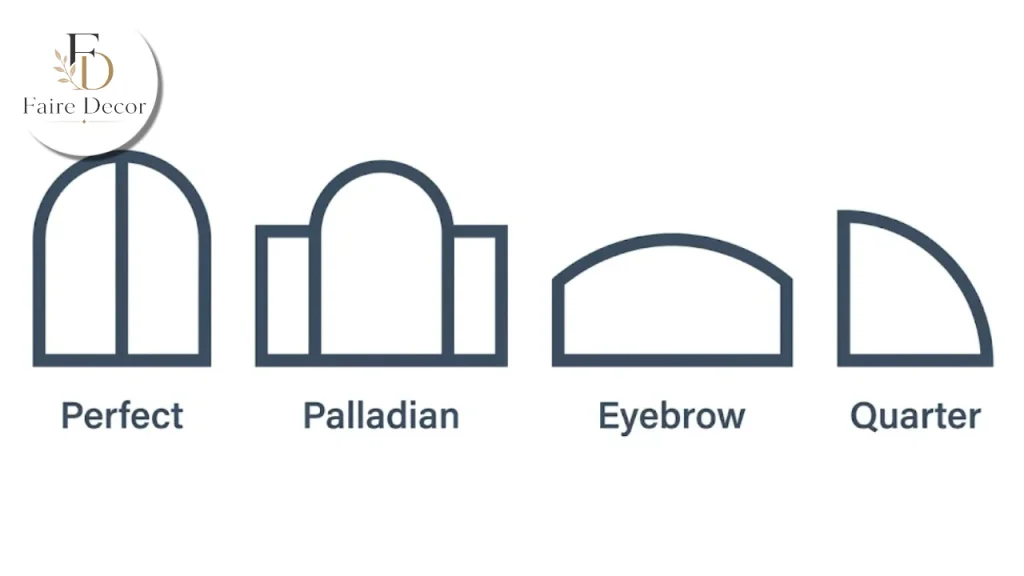
Arch shape determines what product fits. The Blinds.com guide describes four types by height relative to width:
Perfect arch. The highest part of the window is exactly half the width of the window. This is the classic half-round.
Palladian arch. The tallest part is more than half the overall width.
Eyebrow arch. The height is less than half the overall width, so the curve is shallow.
Quarter arch. A straight bottom and side, with one curved side.
Select Blinds adds that its arched shades cover standard, elongated and quarter shapes. Before you shop, work out which shape you have. A shade made for a half-round will not fit an eyebrow, and a wrong guess is expensive when the product is custom.
How to measure an arched window
Neither of the vendor pages I opened gave step-by-step measuring instructions in their text. Both point you to the measuring guide on the product page, and I could not see those instructions. Treat the following as general good practice, and follow your retailer’s guide exactly, since it governs your warranty and remake terms.
Decide inside or outside mount first. Select Blinds says you can choose either. An inside mount sits within the frame; an outside mount sits on the wall or trim around it.
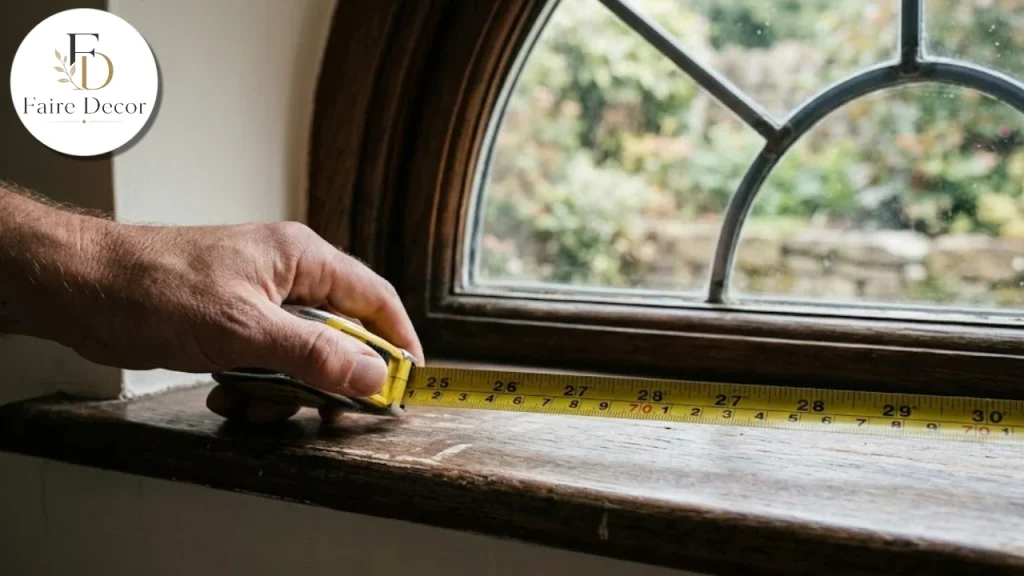
Measure the width at the widest point of the arch base. Take it at baseline heights if the frame looks uneven.
Measure the rise. That is the height from the base line to the top of the curve. It is what tells you which arch type you have.
Check the depth. The DIY Playbook baselines that sill depth can rule out an inside mount.
Photograph and sketch. Mark the base line and any obstacles, such as handles or latches.
Measure twice, on different days. Custom shades are not easy to return.
If the arch is part of the glass itself, Select Blinds suggests a floating headrail option, which it describes in a separate guide I did not open. Ask your retailer how that works for your window.
Blackout arch vs. other ways to cover an arch
Not every arch needs a shade. Here is how the main options compare, based on the sources above and the trade-offs they describe.
| Option | Light control | Operable? | Watch for |
|---|---|---|---|
| Blackout arch (cellular) | Strong light blocking per sellers | Usually fixed | Made to order; accurate measuring |
| Light-filtering arch (cellular) | Softens glare, keeps daylight | Usually fixed | Does not block as much as blackout |
| Composite wood arch shutter | Slats can be adjusted in upgraded versions | Depends on style | Cost; side gaps possible |
| Curtains or drapes | Solid drapes block light; sheers soften it | Yes | Leaves the arch itself uncovered |
| Removable fabric insert | Can be very dark | Removed by hand | Needs daily handling |
Select Blinds, in its guide to arched window blinds and shades, recommends blackout for bedrooms (“Blackout is probably your best bet there”) and light filtering for rooms such as living rooms and entryways.
That fits common sense: darkness matters in sleeping spaces, while daytime rooms usually benefit from light.
The Blinds.com guide also lists composite wood arches, described as shutters made from warp-resistant composite, with sunburst, horizontal slat and blackout-style looks.
Movable-slat versions are offered as an upgrade. It adds that curtains can be layered over other coverings, with solid drapes blocking light and sheers giving an airy feel.
Single cell or double cell?
Cellular shades come in single-cell and double-cell construction. According to the Select Blinds guide:
Double cell provides extra noise blocking and insulation. The trade-off is an extra layer of fabric.
Single cell still traps heat and reduces noise, but to a slightly lesser degree. It is lighter, so the guide suggests it for abnormally large windows.
Which is better for you? If the arch faces the afternoon sun or a busy street, the extra cell may be worth it. If the window is oversized, the lighter single cell may hang and look better.
These are retailer recommendations, and I could not confirm energy savings figures from an independent source. The US Department of Energy has material on window coverings, but my attempt to open that page was blocked, so I am not quoting any percentages here.
Where a blackout arch makes the most sense
Bedrooms. This is the obvious home for one. A half-round window above a bed or dresser can flood a room at sunrise. A blackout arch fills that gap without hiding the architecture. For more on building a calm sleeping space, see our ideas for a Japanese-style bedroom.
Nurseries and kids’ rooms. Parents often want a dark room for naps. The DIY Playbook author notes that sleep needs vary by child, so there is no single right level of darkness. Pick what suits your family.
Media rooms and home offices. Glare on screens is a common headache. A fixed shade can remove it from an arched transom or gable window that regular blinds cannot reach.
Stairwells and landings. Arches here are often high and out of reach. A fixed, cord-free shade means nothing to operate or tangle.
Rooms that mix day and night use. If you need the light during the day, a fixed shade is a poor fit. Consider a light-filtering arch, shutters, or curtains below the arch instead.
Design: making the shade look intentional
A well-chosen blackout arch can look like part of the architecture. A badly chosen one can look like a patch. A few principles help.
Match the shade to the wall and trim
Cream, white and soft gray shades tend to disappear into the frame, which keeps attention on the curve. A contrasting shade turns the arch into a feature. Test fabric samples against your wall color in morning and evening light before ordering a custom product.
Think about the whole window wall
An arch is often part of a larger composition: a pair of tall windows, a door, a built-in. Treat them as one picture. Matching shades below the arch, such as simple Roman or roller styles, will look better than a different texture in every opening. Our guide to custom curtains shows how layered fabric can frame a window wall.
Use curtains to soften the shade
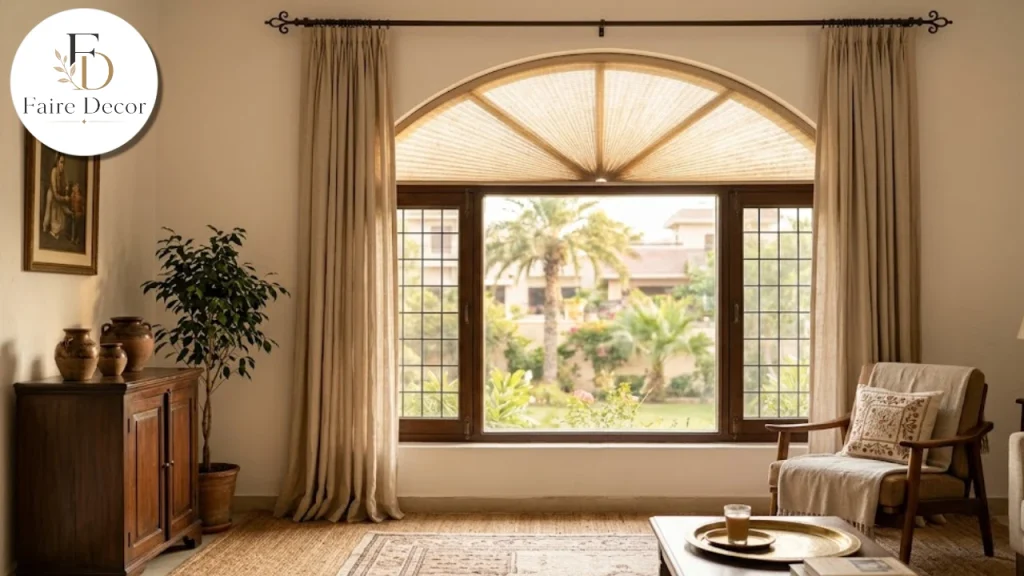
A fixed shade is clean and a little stark. Hang curtains bbelowthe arch, or at the sides, to add texture. Solid drapes will add more light blocking and sheers will keep the look airy, as the Blinds.com guide notes.
Keep the architecture visible
Arches are the star. Avoid heavy valances or rods that hide the curve. If you add wall art or a mirror, keep it clear of the frame. Ideas for balancing the wall are in our guide to decorating walls.
Choose paint that flatters the curve
Wall and trim color changes how an arch reads. A trim shade that contrasts slightly with the wall outlines the curve. See our notes on what color to paint a ceiling if the arch sits near a high ceiling line.
Houses where arches are common
Arched windows show up in many styles. They are a signature of Spanish-style homes, where plain walls and arched openings define the look, and they appear in traditional and transitional homes as accents above doors or in living rooms. In a ranch-style home, an arch may be a single feature window.
If you are choosing a covering for a style-specific house, keep the finish quiet so the architecture carries the room.
If you are replacing or adding windows, shape matters from the start. Our overview of awning windows explains other window types you may be weighing, and our renovation tips guide can help you plan the work in a sensible order.
What a blackout arch will not do
Be realistic. A shade is not a miracle.
It will not make the room perfectly dark on its own. Light can leak around the edges of any covering. The DIY Playbook author reports side leaks with shutters, and an outside-mounted shade can leave gaps. Ask the seller how the product seals at the frame.
It will not open and close like a normal blind if it is a fixed model.
It will not replace good windows. For energy performance, certified windows matter more than any covering.
It will not fix an out-of-square frame. Custom shades are made to a precise curve, so crooked openings need extra care when measuring.
Buying checklist
Before you order a blackout arch, run through this list.
You know your arch type: perfect, Palladian, eyebro,w or quarter.
You have decided on inside or outside mount and checked the sill depth.
You have measured twice and photographed the opening.
You know whether the shade is fixed or operable, and whether that suits the room.
You have chosen single cell or double cell with your sun exposure and window size in mind.
You have asked about edge gaps and how much light still gets through.
You have asked about lead time, remake ppolicycy and warranty, since the pages I opened did not state them.
You have ordered fabric samples to see the color in your own light.
Questions to ask the seller
Custom products live or die on the details. Use this table when you talk to a retailer, and write down the answers.
| Question | Why it matters |
|---|---|
| Is this shade fixed or operable? | Select Blinds says its blackout arch is for stationary windows only |
| How does it mount, and what depth does it need? | Sill depth can rule out an inside mount |
| What shapes can you make? | Standard, elongated and quarter shapes are not the same product |
| How much light leaks at the edges? | Ask for an honest answer, not just “total light blocking” |
| What is the lead time? | The pages I opened did not state one |
| What happens if the measurement is wrong? | Custom orders may not be returnable |
| What does the warranty cover? | The pages I opened did not mention a warranty |
A seller who answers all of these plainly is a good sign. One who dodges the fit and remake questions is a reason to keep looking.
Common mistakes to avoid
Ordering before identifying the arch type. A perfect arch, an eyebrow and a quarter arch need different shades.
Ignoring sill depth. It can decide whether an inside mount is even possible.
Choosing blackout for every room. A dark shade in a living room cuts daylight you may want. Light filtering often suits those spaces better.
Forgetting the edges. A blackout arch that leaves a bright rim at the frame will annoy you every morning.
Skipping samples. Fabric looks different at home than on a screen.
Treating a fixed shade as a daily blind. If you need to open it, pick a different product.
Overdecorating around it. The curve is the feature. Let it breathe.
A simple plan for a bedroom refresh
If the arch is in a bedroom, the shade is usually one piece of a bigger plan. A sensible order helps you avoid rework.
Fix the window first. Repair frames, seals, and any drafts before covering them.
Paint or touch up walls and trim. Do this before the shade arrives so you do not get paint on new fabric.
Measure and order the shade. Allow for the lead time and do not schedule a deadline around it.
Install the lower coverings. Curtains or shades under the arch should be chosen to work with it.
Add layers last. Rugs, beand lighting finish the room and soften the look of a fixed shade.
Think about warm bedside lighting too, since a very dark room can feel stark at night. Soft lamps and warm bulbs keep it cozy while you wind down.
Budget mindset without made-up numbers
I did not find a trustworthy, current price source for arched blackout shades, so I am not printing figures. What the sources do show is the pattern: custom arch products cost more than standard blinds, and shutters can cost much more again.
The DIY Playbook author was quoted about $1,750 for plantation shutters on her arch, which she found a major drawback. That is one homeowner’s quote for one window, not a market price.
To keep your budget honest, get at least two written quotes, confirm what is included (mounting hardware, shipping, remakes) and ask whether the price changes with size or shape.
Then compare the cost of the shade against simpler options such as curtains, which the sources describe as a way to block light below the arch without a custom curve.
Care and long-term use
Cellular fabric can collect dust. The vendor pages I opened gave no care instructions, so follow your maker’s care sheet and do not scrub the fabric until you have read it.
Keep the shade away from direct moisture, and check the mounting every year or so. Because the shade is made to measure, a damaged panel can be more expensive to replace than a standard blind, so treat it with care.
Alternatives if a fixed shade is not right
If you need to open the window or want daytime light, a blackout arch may not be the right tool, and that is fine. Many homes do better with a mix: a light-filtering arch above and operable coverings below, so each part of the window does the job it suits. Consider these options.
Shutters on a shaped frame. They allow adjustable light but cost more and can show side gaps.
A removable insert. It is the most flexible but requires daily handling.
Curtains plus a light-filtering arch. It gives softer light by day and extra darkness by night.
A cornice or fixed fabric panel. It frames the curve without closing it off.
For more ideas on pulling a room together once the window is sorted, browse our home decor ideas that actually work and our guide to creating a cozy living room.
A quick note on safety and kids’ rooms
Cord-free designs matter around children. Select Blinds describes its blackout arch as having a clean, cord-free design, which is one reason fixed shades suit nurseries and high windows. If you add any other covering with cords nearby, keep cords out of reach and follow the manufacturer’s safety guidance. I did not open a safety standard for this article, so check the current rules for your region before buying for a child’s room.
Final thoughts on the blackout arch
A blackout arch solves one stubborn problem: how to block light behind a curved window without hiding the curve. Know your arch shape, measure carefully, decide wwhethera fixed shade fits the way you live, and compae ,it honestly with shutters, inserts and curtains. Ask questions about, dge gaps, lead time and warranty before you pay for a made-to-order product. Choose well and the window stays beautiful by day and dark at night.
FAQs:
What is a blackout arch?
A cellular (honeycomb) shade made in an arched shape with a light-blocking lining, designed for arched windows. Sellers describe most as fixed, not raised and lowered.
Can a blackout arch open and close?
Usually not. Select Blinds describes its blackout arch as designed for stationary arch windows only. Ask the seller before you order.
What arch shapes are there?
Blinds.com names four: perfect, arch (height is half the width), Palladian (taller than half), eyebrow (shorter than half) and quarter arch.
Is a single-cell or double-cell shade better?
Select Blinds says double cell gives extra noise blocking and insulation, while single cell is lighter and suits very large windows.
Does a blackout arch block all light?
Sellers claim total light blocking, but light can leak at the edges of any covering. Ask how the shade seals at the frame.
Can Wshadesse cover an arched window?
Composite wood shutters, light-filtering cellular arches, curtains below the arch, or a removable fabric insert.