

A 2026 guide to Dallas-Fort Worth home prices, inventory, mortgage rates, and what they mean for buyers and sellers.
Scroll through your neighbor’s group chat or sit through ten minutes of local news, and you’ll hear three different opinions about what’s happening with home prices in North Texas. One person swears the market has crashed. Another just got into a bidding war over a three-bedroom in Oak Cliff. Both of them are sort of right, which is exactly why keeping up with real dallas real estate news matters more this year than it has in a long time.
Here’s the thing nobody tells you: Dallas isn’t one housing market. It’s dozens of smaller ones stitched together — Uptown condos, Plano cul-de-sacs, Fort Worth fixer-uppers — and each one is behaving a little differently right now. Some neighborhoods are cooling off. Others are still seeing multiple offers in under a week. If you’re trying to buy, sell, refinance, or just understand what your home is worth this summer, the headlines alone won’t tell you enough.
That’s what this guide is for. We’ll walk through what’s actually happening with prices, inventory, and mortgage rates across Dallas-Fort Worth right now, why the metro keeps growing even when national coverage sounds gloomy, which neighborhoods are holding up best, and the real problems buyers and sellers are running into — along with practical ways to solve them. No jargon, no guesswork, just a clear-eyed look at where things stand.

Downtown Dallas skyline at golden hour — swap in a licensed photo before publishing.
Why Dallas Real Estate News Matters More Than Ever Right Now
A few years ago, you could get away with checking in on the housing market once or twice a year. Prices moved slowly, mortgage rates barely budged, and most people’s home value forecasts held up fine without much updating. That’s not the world we’re in anymore.
Between shifting mortgage rates, a wave of new construction in the suburbs, and a population that keeps adding hundreds of new residents a day, conditions here can change meaningfully in a matter of months. Following dallas real estate news regularly isn’t about obsessing over your home equity — it’s about not getting blindsided. A seller who lists based on what the house down the street sold for two years ago is going to be disappointed. A buyer who waits for “the bottom” without watching the data might miss a genuinely good window.
This is also a market where national coverage tends to flatten everything into one headline number, even though Dallas, Austin, Houston, and San Antonio are telling four very different stories in 2026. Paying attention locally — not just nationally — is what actually helps you make a smart call.
The Big Picture: What 2026 Numbers Are Actually Saying
Let’s get into the actual data behind the dallas real estate news headlines, because this is where most general coverage falls short.
Home Prices — Cooling Off or Catching Their Breath?
Depending on which dataset you look at, the median home price in Dallas currently sits somewhere between roughly $385,000 and $499,000. That’s a wide range, and it’s not a typo — it reflects different methodologies. Some trackers report the median closed price across the broader Dallas-Fort Worth-Arlington area, which includes a huge mix of price tiers and pulls the number down. Others report Dallas city proper, where listings skew toward smaller, more expensive lots closer to downtown, pulling the number up.
What most sources agree on is the direction: after a sharp run-up earlier in the decade, prices have leveled off and even dipped slightly year-over-year in several measures, while a few specific submarkets are still posting modest gains. The Texas Real Estate Research Center at Texas A&M, generally considered the most reliable statewide source, has described the adjustment as a normalization rather than a downturn — sales volume easing, prices softening slightly, and inventory climbing back toward healthier levels.
Inventory Is Finally Loosening Up
If you tried to buy a house in Dallas in 2021 or 2022, you remember the pain: multiple offers within a day, appraisal gaps, bidding wars over a three-bedroom ranch. That era isn’t entirely behind us, but it has cooled considerably. Active listings across the metro have been running roughly 7–8% higher than a year ago, and new listings have ticked up as well. More homes on the market generally means less pressure to overbid and more room to negotiate — a meaningful shift for first-time buyers who’ve felt priced out for years.
Mortgage Rates and What They Mean for Your Monthly Payment
As of mid-June 2026, the average 30-year fixed mortgage rate has been hovering in the 6.4–6.6% range, according to Freddie Mac’s weekly survey — down from around 6.8% a year earlier, but still well above the sub-4% rates many homeowners locked in before 2022. That gap is exactly why so many current homeowners are choosing to renovate or rent out their current place rather than sell and re-buy at a higher rate; it’s often called the “lock-in effect,” and it’s one of the quieter forces keeping inventory tighter than it would otherwise be.
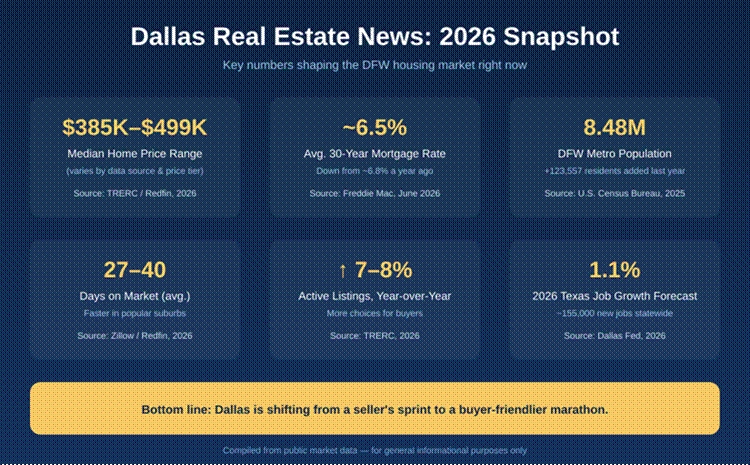
Key 2026 Dallas housing market stats at a glance.
For a buyer, the practical math looks like this: on a $400,000 loan, the difference between a 6.5% rate and a 7% rate works out to roughly $130 more per month — not catastrophic, but enough to change what someone qualifies for. That’s part of why so many buyers are shopping rate buydowns and builder incentives right now instead of waiting around for rates to drop further.
Why Dallas Keeps Growing Even When the Headlines Sound Gloomy
It would be easy to read “prices softening” and “sales down” and assume Dallas is in trouble. The underlying fundamentals say otherwise.
Population Growth Nobody Saw Slowing Down
Dallas-Fort Worth is now the fourth-largest metro area in the United States, with a population north of 8.4 million people. Over the past year alone, the region added more than 123,000 new residents — roughly 339 people every single day. Since 2020, DFW has grown by about 11%, outpacing every other top-five U.S. metro. Fort Worth in particular has been on a tear, growing faster than any other major Texas city over the same period.
That kind of sustained in-migration matters because it’s the single biggest long-term driver of housing demand. People need somewhere to live, and a region adding the population of a mid-sized city every single year isn’t going to stay soft for long, even if individual months look uneven.
Jobs, the World Cup, and Other Economic Tailwinds
Texas employment growth slowed noticeably after 2024, but the Federal Reserve Bank of Dallas projects the state will add roughly 155,000 jobs in 2026 — a meaningful rebound from a nearly flat 2025. North Texas is expected to see an outsized share of that growth, partly thanks to continued corporate relocations and expansions, and partly because the region is set for a real economic lift from hosting World Cup matches in 2026. Major events like this tend to bring a temporary surge in hospitality and service-sector hiring, along with longer-term visibility that keeps companies looking at Dallas for future headquarters and offices.
Add in a diversified economy that isn’t dependent on any single industry — finance, logistics, healthcare, tech, and energy all have a real presence here — and you get a metro that’s more resilient to a single sector’s downturn than most.
Neighborhood Spotlight: Where Buyers Are Actually Looking
Metro-wide averages only tell you so much. Here’s where demand has actually been concentrated.
Family-Friendly Suburbs Holding Their Value
Suburban Dallas continues to be the engine of the local market. Areas like Frisco, McKinney, Prosper, and parts of Plano keep drawing relocating families thanks to strong school districts, newer construction, and more square footage per dollar than you’ll find inside Dallas proper. These communities have generally held their value better than the urban core during the recent cooling period, in large part because demand from families moving in from out of state hasn’t slowed nearly as much as investor demand has.
Up-and-Coming Pockets Worth a Second Look
On the more affordable end, neighborhoods in Oak Cliff, parts of South Dallas, and pockets of Fort Worth’s near-east side have been attracting buyers priced out of the most competitive suburbs. These areas tend to combine older housing stock, shorter commutes to downtown, and lower price-per-square-foot numbers — a combination that’s increasingly appealing as affordability tightens elsewhere. It’s worth noting that “up-and-coming” cuts both ways: appreciation potential is real, but so is the need to do your homework on flood zones, foundation issues common in older North Texas clay soil, and neighborhood-specific permitting rules before you buy.
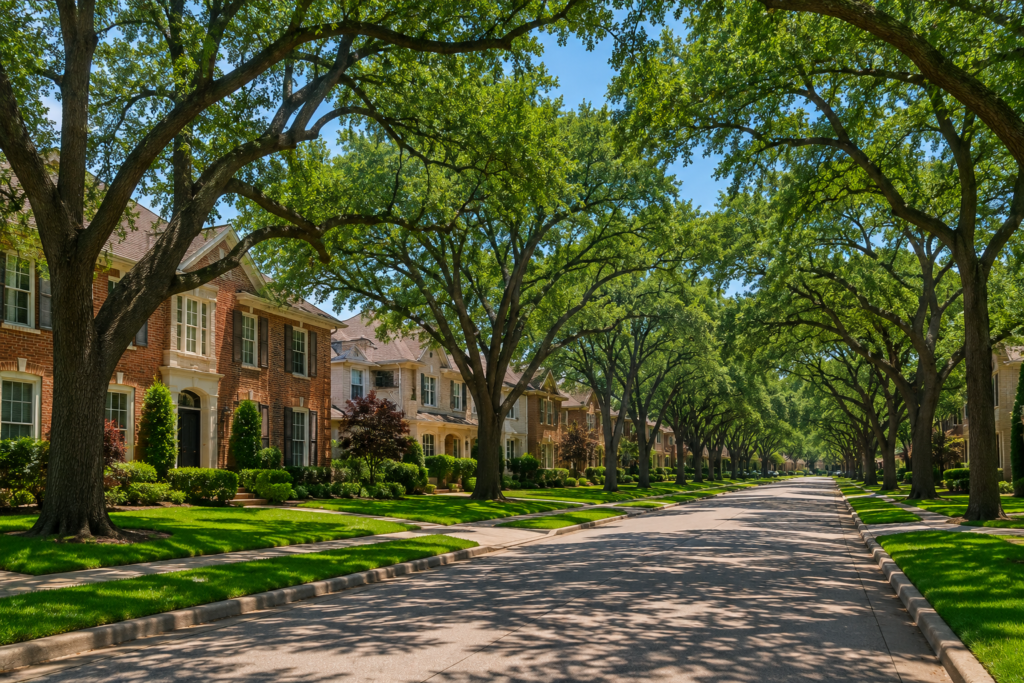
A tree-lined suburban Dallas street — swap in a licensed photo before publishing.
Real Problems Dallas Buyers and Sellers Are Wrestling With (and How to Solve Them)
Numbers are useful, but most people reading this aren’t trying to win a trivia contest about median price-per-square-foot. They’re trying to solve an actual problem. Here are the three that come up constantly.
Problem #1 — “I Can’t Afford What I Could Two Years Ago”
This is the affordability squeeze, and it’s real: even with prices softening slightly, mortgage rates sitting near 6.5% mean monthly payments are still significantly higher than they were when rates were near 3%. The fix isn’t usually “wait for rates to crash” — most forecasts don’t show that happening this year. Instead:
- Get pre-approved before you shop, not after, so you know your real number and aren’t falling for listings outside your range.
- Ask about rate buydowns. Builders in growing suburbs like Frisco and Celina are frequently offering temporary or permanent rate buydowns worth tens of thousands of dollars in savings — often a better deal than a price cut.
- Widen your search radius. Suburbs 30–40 minutes further out frequently offer 15–20% more home for the same budget.
- Consider an adjustable-rate mortgage if you plan to refinance or move within 5–7 years, since ARM rates have been running noticeably below 30-year fixed rates.
Problem #2 — “I Don’t Know If I Should List Now or Wait”
Sellers are stuck between two fears: listing now and “leaving money on the table” if prices recover, or waiting and missing the current window of still-decent demand. The honest answer is that nobody can perfectly time this. What helps is looking at your specific submarket’s days-on-market and price-reduction trends rather than the metro average — a home in a tight, in-demand suburb is a very different conversation than one in an oversupplied condo building downtown. If your local days-on-market has been creeping up and price cuts are becoming common in your specific ZIP code, that’s a more useful signal than any national headline.
Problem #3 — “Every Source Tells Me Something Different”
This is the most common frustration with following dallas real estate news, and it’s a fair one. One outlet reports prices up nearly 10%; another reports them down nearly 5%. Both can be technically accurate because they’re measuring different things — median sale price versus average home value, three-month rolling averages versus year-over-year snapshots, city limits versus the full metro. The fix is simple but takes discipline: pick two or three consistent sources, track the same metric over time rather than comparing one-off headlines, and pay closer attention to your specific neighborhood than to metro-wide figures whenever you can.
How a Good Dallas Real Estate Blog Can Save You From Bad Decisions
This is where a well-run dallas real estate blog earns its keep. Big national sites are useful for broad trends, but they rarely dig into the difference between, say, Lakewood and Lake Highlands, or explain why one Fort Worth zip code is appreciating while the one next to it is flat. A genuinely local dallas real estate blog fills that gap — translating raw MLS data into something an actual buyer or seller can act on.
What Separates a Trustworthy Source From Noise
Not every site calling itself a dallas real estate blog is worth your time. A few things to look for:
- Cites its data sources (TRERC, Redfin, Zillow, local MLS boards) instead of just asserting numbers.
- Updates regularly, ideally monthly, since this market moves fast enough that a post from a year ago can already be stale.
- Covers specific neighborhoods, not just metro-wide averages.
- Discloses any agent or brokerage affiliation, so you understand any potential bias in how listings or areas are framed.
Why It Helps to Read More Than One Texas Real Estate Blog
Zooming out a little: Dallas doesn’t move in isolation from the rest of the state. Mortgage rate trends, statewide construction permitting, insurance costs (which have climbed significantly across Texas due to severe weather risk), and even property tax policy debates in Austin all ripple down into local prices. That’s why it’s worth following at least one solid texas real estate blog alongside your local sources — it gives you the broader context for why Dallas might be behaving differently than Houston or San Antonio in a given quarter.
For instance, the Texas Real Estate Research Center’s statewide 2026 forecast projects roughly 349,000 total single-family home sales for the year, with a year-end median price near $334,000 statewide — useful context for understanding whether Dallas is outperforming or underperforming the rest of Texas. A good texas real estate blog will help you make that comparison without having to dig through a research report yourself.
Building a Simple Habit Around the Best Dallas Real Estate Blogs
You don’t need to read everything every day — that’s a fast way to burn out and end up more confused than informed. A more sustainable approach:
- Pick two or three reliable dallas real estate blogs and check them monthly rather than daily.
- Save listings or reports in one place so you can compare apples to apples over time instead of relying on memory.
- Set a Google Alert or follow a local market newsletter for your specific suburb or ZIP code.
- Talk to a local agent who actively publishes data, not just listings — agents who write up monthly market recaps tend to have a sharper read on hyper-local trends than aggregator sites.
Done consistently, this kind of light, regular habit beats frantic last-minute research every time — whether you’re six months out from buying or just keeping tabs on your home’s value.
What to Watch For in the Second Half of 2026
Looking ahead, a few threads are worth tracking. Mortgage rates remain tied closely to bond market movements and inflation data, both of which have been volatile this year — a meaningful rate drop isn’t off the table, but it isn’t guaranteed either. Builders are watching demand closely, and a continued slowdown in new construction starts could tighten supply again heading into 2027, even as current inventory sits at multi-year highs. And the lead-up to World Cup matches hosted in the area is expected to bring a short-term bump in hospitality demand and visibility for the region, which historically has a modest but real effect on local economic sentiment and, by extension, housing confidence.
None of this points to a dramatic swing in either direction. The more likely scenario, based on current data, is a continued normalization — a market that rewards patience, research, and realistic pricing over speculation in either direction. Keeping an eye on dallas real estate news through the rest of the year will matter just as much as it has so far.
Frequently Asked Questions
Is now a good time to buy a house in Dallas?
It depends heavily on your personal timeline and finances rather than trying to perfectly time the market. With inventory up and price growth flat to slightly negative in several measures, buyers currently have more negotiating room and selection than they’ve had in several years — but mortgage rates near 6.5% still make affordability the central challenge for most shoppers.
Why do different sites report different median home prices for Dallas?
Different sources track different geographies (the city of Dallas versus the full Dallas-Fort Worth-Arlington metro) and different metrics (median closed price versus average estimated home value), so the numbers can legitimately diverge by tens of thousands of dollars even when describing the same week.
Are Dallas home prices expected to drop further in 2026?
Most forecasts point to modest, low-single-digit movement rather than a sharp decline — some models show a slight dip through midyear with stabilization in the second half, while others project a small 2–4% rise for the full year as the market normalizes.
What’s driving Dallas-Fort Worth’s continued population growth?
Job opportunities, a lower cost of living relative to coastal metros, no state income tax, and a steady stream of corporate relocations and expansions continue to draw new residents — the metro added well over 100,000 people in the past year alone.
How much has mortgage availability changed for first-time buyers?
First-time buyers currently account for roughly a third of all home sales nationally, and many builders in fast-growing Dallas suburbs are offering rate buydowns and closing-cost assistance specifically aimed at this group to help offset higher borrowing costs.
Which Dallas suburbs are seeing the strongest demand right now?
Frisco, McKinney, Prosper, and parts of Plano continue to see strong family-driven demand thanks to school quality and newer inventory, while more affordable pockets in Oak Cliff and parts of Fort Worth are drawing buyers looking for value closer to the urban core.
How often should I check Dallas real estate news if I’m not buying or selling right away?
A monthly check-in is plenty for most homeowners — checking a reliable source for dallas real estate news once a month lets you track meaningful shifts in your neighborhood’s value without obsessing over short-term noise that doesn’t actually affect your situation.
What should I look for in a reliable Dallas real estate blog?
Look for sources that cite original data (TRERC, Redfin, Zillow, or local MLS boards), update on a regular schedule, break trends down by specific neighborhood rather than just metro averages, and are transparent about any brokerage affiliation that might influence how they present a given area.
Final Thoughts on Where Dallas Real Estate Is Headed
If there’s one thing worth taking away from all this data, it’s that Dallas isn’t experiencing a crash or a boom — it’s recalibrating. Inventory is healthier, mortgage rates are easing slightly from their recent highs, and the underlying population and job growth that built this market in the first place haven’t gone anywhere. That combination tends to favor people who do their homework over people chasing headlines.
Staying close to trustworthy dallas real estate news, checking in on a dependable dallas real estate blog now and then, and keeping an eye on the wider texas real estate blog conversation will put you in a far better position than reacting to whatever sounds scariest or most exciting on a given week. Whether you’re house-hunting in Frisco, weighing a listing in Oak Cliff, or simply curious what your home is worth this summer, the data is on your side if you take the time to actually look at it — and the best dallas real estate blogs out there make that a lot easier than digging through raw spreadsheets yourself.