

Most people think of decorum as traditional good manners, social etiquette, and polite behavior that maintains harmony in interactions. Decorum, on the other hand, takes on a deeper, more practical meaning when applied to interior design and living spaces. It becomes the art of creating an environment that seamlessly fits your personal rhythm, daily routines, and aesthetic sensibilities.
Spatial decorum ensures that every corner of your home serves a clear purpose while maintaining visual balance, just as social decorum ensures that behavior is appropriate for the occasion. Designing with decorum means aligning form and function so that your living space feels naturally intentional, comfortable, and uniquely tailored to how you live, from structured pantry organization to thoughtfully configured furniture layouts.
Decorum is behavior, speech, or design that fits its situation: proper, tasteful, and appropriate to the moment. The word comes from the Latin for “what is fitting,” and it shares a family tree with décor, decency, and dignity.
Most people meet the word in a courtroom drama or a school handbook. But the idea started just as much about buildings and rooms as about manners, and that older meaning is surprisingly useful when you decorate a home.
Decorum meaning in plain words
In everyday English, decorum means proper, dignified conduct. Dictionary.com defines it as dignified propriety of behavior, speech, and dress, and lists “decorums” as the observances polite society expects.
There’s a second, older sense that dictionaries still keep. Vocabulary.com lists decorum as the fitness of a work’s style to its subject, which is about whether a form suits its content.
That second sense is the key to the whole word. Decorum isn’t a fixed list of rules; it’s a judgment about fit.
Pronunciation: dih-KOR-um, with the stress on the middle syllable.
Part of speech: noun. The adjective is decorous (“a decorous silence”), and the opposite is indecorum.
Synonyms: propriety, decency, dignity, seemliness, good form.
Antonyms: impropriety, indecorum, unseemliness, and rudeness.
Decorum in a sentence
- The judge asked the gallery to keep decorum during the verdict.
- Speaking to the grieving family, she chose her words with quiet decorum.
- The deep velvet sofa had a certain decorum in the old library; in the beach cottage, it looked lost.
That last sentence matters. Notice the sofa didn’t change; only its setting did.
Decorum vs. etiquette vs. manners
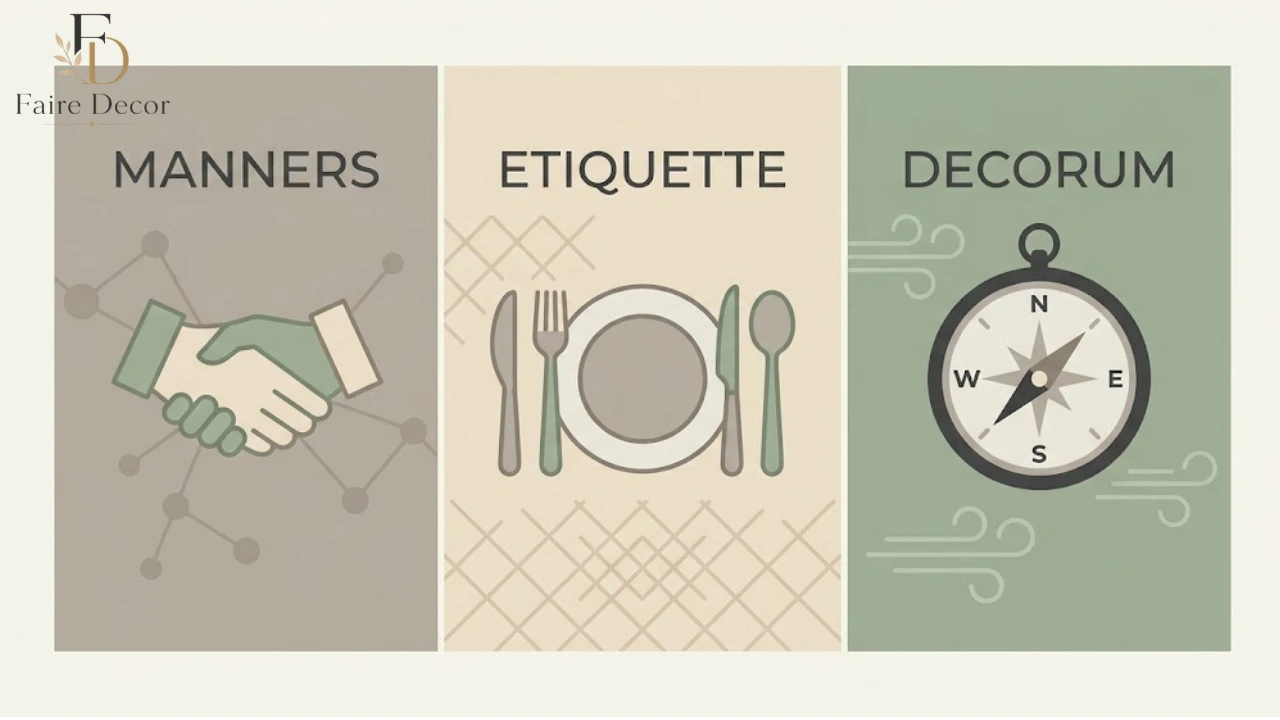
These words overlap, so they’re often used as if they were the same. They aren’t, and the difference explains why decorum is the more flexible idea.
| Word | What it means | Example |
|---|---|---|
| Manners | General habits of courtesy toward others | Saying thank you, not interrupting |
| Etiquette | A specific, often written code for a setting | Which fork to use at a formal dinner |
| Decorum | Reading a situation and choosing what fits it | Lowering your voice at a memorial, even though no rule says to |
Manners travel everywhere with you. Etiquette lives in a rulebook. Decorum is the judgment that sits between them, deciding which behavior suits this room, these people, and this moment.
A person can follow perfect etiquette and still lack decorum. Picture someone reciting formal toasts at a casual backyard barbecue: technically correct, but completely wrong for the setting.
Where the word comes from
The English word arrived from Latin, first recorded around 1560 to 1570, according to Dictionary.com. Its Latin source, decorus, meant proper or becoming, and it grew from decor, meaning beauty or grace.
That same root gives English the word “décor,” as Vocabulary.com notes. So when you talk about home décor, you’re one step away from talking about decorum.
For Roman writers, these ideas weren’t separate. Something fitting was, almost by definition, something beautiful.
Over the 17th and 18th centuries, the word drifted toward its modern focus on social behavior. Its design roots never fully disappeared; they just moved into architecture schools and art history books.
Decorum in everyday life
You already practice decorum dozens of times a day, usually without naming it. It’s the instinct that makes you whisper in a library, dress up for an interview, and stay off your phone at a funeral.
A “sense of decorum” simply means you read the room well. It isn’t stiffness; a well-judged joke at the right moment can show more decorum than solemn silence.
Here are some settings where people expect it most:
- Courtrooms, where rules of address and silence keep proceedings orderly.
- Workplaces, especially meetings with clients or senior colleagues.
- Ceremonies such as weddings, graduations, and memorials.
- Online spaces, where tone in a group chat with family differs from tone on a public forum.
In each case, the right behavior depends on the setting. That same logic, applied to rooms instead of people, is where the word becomes useful for anyone decorating a home.
The design meaning: Vitruvius and the rule of “fitting”
Around the first century BC, the Roman architect Vitruvius wrote De Architectura, the oldest surviving book on architecture. In it, he treated decor, or decorum, as a central design principle: the appropriateness of a building’s form to its purpose and setting.
His temple examples show how literally he meant it. According to a summary of his work on Taylor & Francis, he gave the plain, powerful Doric order to temples for Mars, Minerva, and Hercules, and the softer Corinthian order to temples for Venus and the Nymphs.
Vitruvius grounded this fit in three things. A summary of his framework (University of Malta) describes them as follows.
- Purpose: whether the design suits what the building is for.
- Custom: whether its parts follow an accepted, coherent language.
- Nature: whether the site, orientation, and light suit how the building will be used.
The idea outlived Rome. Architecture historians describe decorum as the general design standard of the Renaissance and Baroque periods, when architects carefully matched facades and ornament to a building’s role.
Researchers studying Roman houses still use the concept today. A 2021 open-access volume examines how decoration was chosen to suit everything from wine-press rooms to grand reception halls.
What decorum looks like in a modern home
You don’t need Roman temples to practice decorum at home. Vitruvius’s three tests translate almost perfectly into everyday decorating decisions, plus one he didn’t need: the people who actually live there.
Fit the room’s purpose
Start with what happens in the room, not what looks good online. A bedroom is for rest, so it earns soft light, quiet colors, and fewer objects.
A kitchen is for work, so clear counters and good task lighting matter more than display pieces. When a room fights its own purpose, it never feels finished, no matter how much you spend.
Calm, low-contrast palettes are one reason earthy bedroom ideas and a Japanese-style bedroom feel so restful.
Fit the house itself
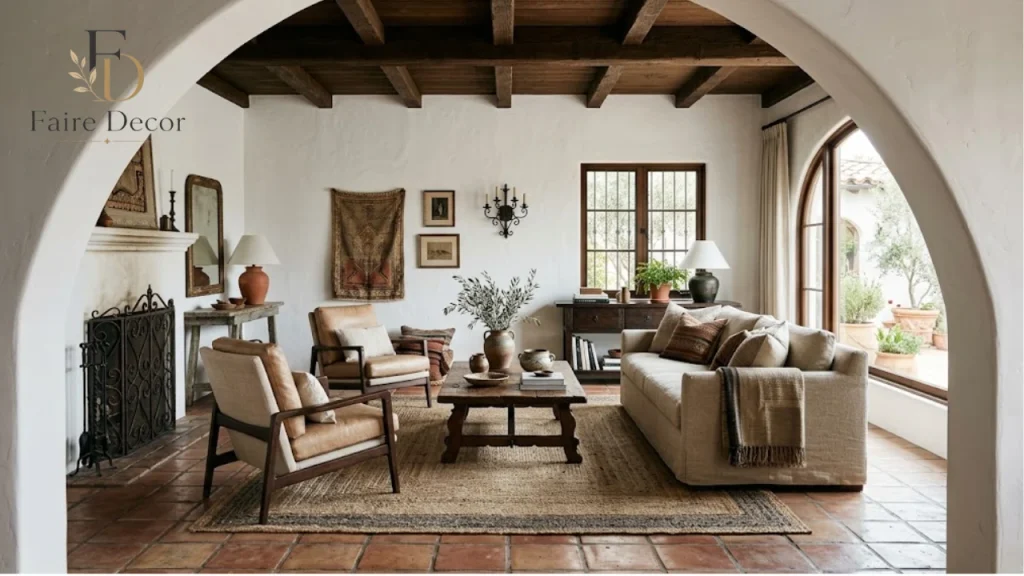
This is Vitruvius’s “custom” test: does the interior speak the same language as the building? A sleek, all-white minimalist scheme can feel strangely out of place inside a house full of arches and terracotta.
That doesn’t mean copying a period exactly. It means letting the architecture lead, whether that’s the warm materials of Spanish-style homes, the low, open feel of a ranch-style home, or the detail of a Victorian-style kitchen.
Fit the light and climate
Vitruvius advised placing bedrooms and libraries toward the east to catch morning light. The modern version is simple: notice where the sun lands before you choose colors.
A north-facing room with cool light can make gray paint look flat and cold. In those rooms, warmer whites and the pairings in our home color combinations tend to hold up better.
Climate counts too. Heavy wool throws suit a cold-country den with a fireplace hearth, and they look oppressive in a hot, humid room.
Fit the people
A home has decorum when it suits the household, not an imagined guest. A white linen sofa in a house with toddlers and a dog is a beautiful object with no decorum at all.
The same goes for a student room. Practical, flexible pieces like those in our dorm room ideas for guys fit that life far better than fragile showroom furniture.
Signs a room is missing decorum
Indecorum in design is usually easy to feel and hard to name. These are the most common patterns in rooms that look expensive but feel slightly wrong.
Scale that ignores the room. An oversized sectional in a small apartment makes the room feel crowded. Furniture that’s too small does the reverse, making a large room feel unfinished.
Trends fighting the architecture. High-gloss modern cabinets in a cottage or heavy ornament in a mid-century house can make both look worse.
Rooms dressed for visitors who never come. A formal dining room that’s never used, while the family eats on the sofa, is a quiet design failure.
Too much of everything. A small guest bathroom with three themes, five candles, and wall quotes on every surface has lost the thread.
Comfort sacrificed for photos. Hard chairs, decorative pillows nobody can move, and rugs too pale to walk on all fail the purpose test.
A five-question decorum check before you buy
Run any piece of furniture or décor through these questions before it comes home. They take about a minute and save a lot of returns.
What will happen in this room? Does the piece support that activity or get in its way? Does it speak the house’s language? Do the materials, shapes, or era sit comfortably with the architecture? How will it look in this room’s light? Check the color in morning and evening light, not just in the store. Does it suit the people who live here? Think about kids, pets, cleaning time, and how people actually sit. Is it the right size for the space? Measure the room and the walkways, and leave space to move around it
If a piece passes all five, it will almost always look “right,” even if it breaks a trend rule.
Decorum without stiffness
The word can sound old-fashioned, even fussy. But design decorum doesn’t mean matching sets or beige caution.
A mix of vintage and modern can have perfect decorum when each piece suits the room’s purpose and the people in it. That’s the whole idea behind modern eclectic interior design: breaking surface rules on purpose, while keeping the deeper fit.
If you’re not sure what your own fit looks like, our interior design style quiz is a good starting point. Our guide on how to get better at interior design builds the judgment behind it.
The short version
In people, decorum is knowing how to act in a particular room. In homes, it’s making each room fit its purpose, its building, its light and its people.
The Romans saw these as the same thing, and they had a point. Whether you’re choosing words at a dinner or a sofa for a den, decorum is the quiet skill of asking what fits here, and then trusting the answer.
FAQs:
What does decorum mean in simple words?
Decorum means behaving, or designing, in a way that fits the situation. It’s proper, tasteful conduct suited to the setting and the people in it.
What is an example of decorum?
Lowering your voice at a memorial service, or standing when a judge enters a courtroom. In design, a cozy, low-lit reading nook is an example of decorum because its form suits its purpose.
What is the difference between decorum and etiquette?
Etiquette is a set of specific rules for a setting. Decorum is the judgment of what fits a situation, even where no rule exists.
Is decorum related to décor?
Yes. Both come from the Latin decor, meaning beauty or grace. For the Romans, being fitting and being beautiful were closely linked ideas.
What does “a sense of decorum” mean?
It means you read situations well and adjust naturally. Someone with a sense of decorum knows when to be formal, when to be relaxed, and when to stay quiet.
What is decorum in architecture?
It’s the principle that a building’s form, ornament, and layout should suit its purpose, its setting, and its users. Vitruvius made it a core rule of design in ancient Rome.
How do you pronounce decorum?
dih-KOR-um, with the stress on the second syllable.