

You move into a new place, set down the last box, and stand in the middle of the room looking up. The walls are bare, painted some forgettable shade of builder beige, and the whole space suddenly feels unfinished — like a sentence missing its punctuation. Figuring out how to decorate walls is one of those projects that sounds simple until you’re standing there with a hammer, three picture frames, and no real plan.
That’s the thing about walls: they take up more visual space than almost anything else in a room, yet they’re usually the last thing anyone thinks about. Furniture gets picked first, rugs get debated, lighting gets fussed over, and the walls just sit there waiting. Once you understand a few core principles, though, decorating walls stops feeling like guesswork and starts feeling like a skill you can use in any room you walk into.
This guide walks through the practical side of wall decorating — measuring, balancing, choosing pieces, and steering clear of the mistakes that make a wall look cluttered instead of curated. Whether you’re tackling a single accent wall or trying to figure out what to put on walls throughout an entire house, the same handful of rules apply.
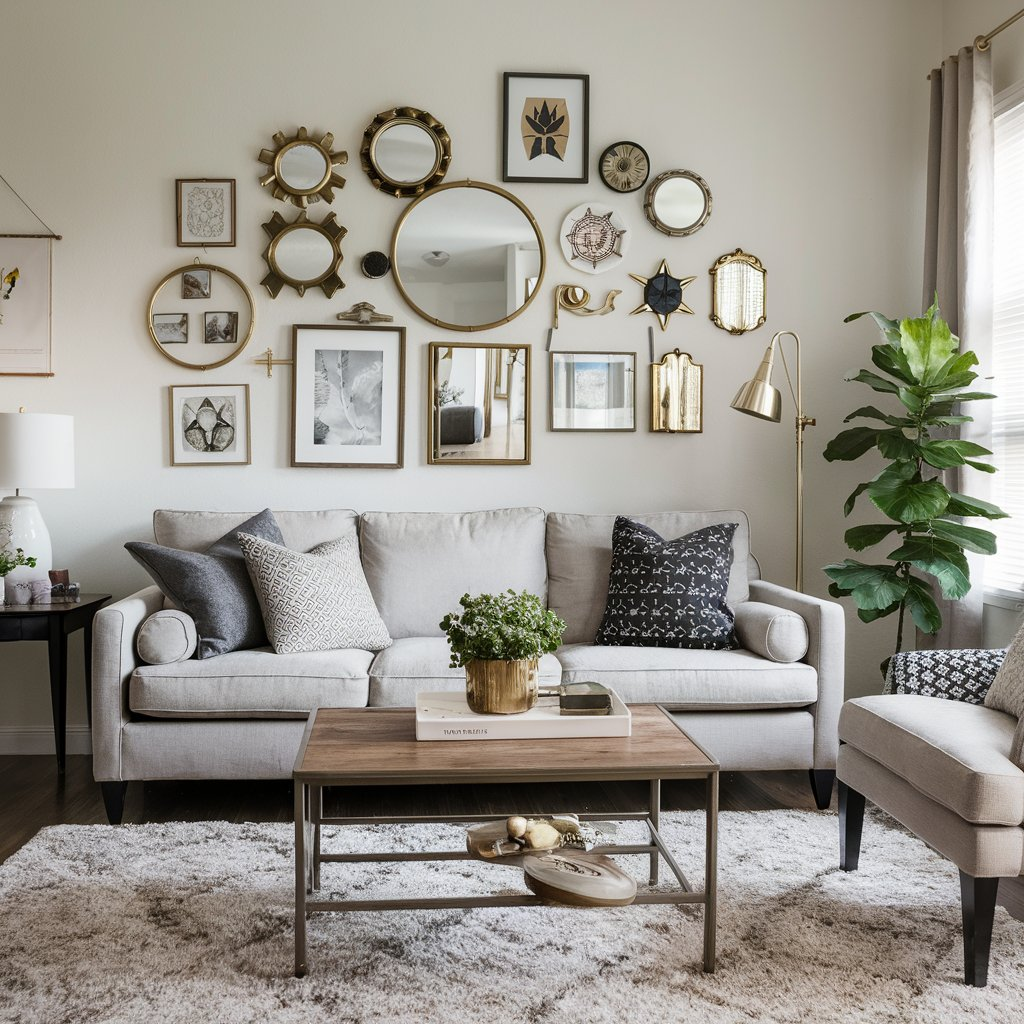
A mix of framed art and a round mirror keeps a sofa wall from feeling flat.
Why How You Decorate Walls Changes the Whole Room
Color and visual texture on a wall do more than fill empty space — they shape how a room actually feels to be in. Design researchers have long pointed to color psychology as a factor in mood: cooler tones tend to read as calming, while warmer tones and bold patterns can make a space feel more energetic or social. A wall covered in art, shelving, or texture also affects acoustics slightly, since soft materials like textiles and woven hangings absorb sound rather than bouncing it around the way a bare, hard surface does.
There’s also a simple spatial reason walls matter so much: in most rooms, the eye travels upward and outward before it ever lands on furniture. A blank wall behind a sofa or bed becomes the visual frame for everything else in the room, so getting it right has an outsized effect on how “finished” a space feels — even if the furniture underneath hasn’t changed at all.
In practice, that means how to decorate walls ultimately comes down to two decisions made well: which wall gets the attention, and what story the colors and materials are telling once you step back and look at the room as a whole.
How Many Walls in a Room Should Be Decorated?
This is one of the most common questions people ask once they start planning, and the honest answer is: it depends on the room’s purpose, but there’s a reliable starting rule. Most professional decorators lean on something close to the rule of thirds — roughly one to two walls per room get the bulk of the visual attention, while the others stay quieter with paint, a mirror, or nothing at all.
A few practical guidelines:
- In a living room or bedroom, pick one focal wall (often the one you see first when entering, or the one behind the bed or sofa) and let it carry most of the decor.
- Leave at least one wall mostly empty, especially if the room already has a lot of furniture, pattern, or color elsewhere.
- In small rooms, decorating every single wall heavily can make the space feel smaller; in larger or open-concept rooms, two or three walls can usually handle decor without feeling busy.
If you’re decorating adjacent walls that meet at a corner, keep one of them simpler than the other so the eye has somewhere to rest. Two heavily decorated walls meeting at a corner is one of the fastest ways to make a room feel visually noisy.
Plenty of people overcorrect once they start researching how to decorate walls properly — filling every surface because empty space feels unfinished. In reality, the quiet walls are doing just as much work as the busy ones; they’re what makes the busy wall read as a deliberate choice rather than visual noise.
How to Decorate Walls: The Basics Everyone Skips
Before any art goes up, a little bit of measuring and planning saves a lot of frustration — and a lot of unnecessary nail holes. Most guides to how to decorate walls jump straight to the fun part — picking art, choosing colors — and skip the unglamorous groundwork that actually determines whether the finished result looks intentional or accidental.
Measure Before You Hang Anything
A widely used rule among framers and designers is to hang the center of a piece of art at roughly 57 to 60 inches from the floor, which approximates average eye level. For groupings, treat the whole arrangement as one shape and center that shape at the same height, rather than centering each individual piece.
Find Your Focal Point
Every wall benefits from one clear anchor — a large piece of art, a mirror, or a cluster of smaller frames arranged as a single unit. Without an anchor, decorating a wall can end up feeling scattered, with the eye unsure where to land first.
Choose a Color Story First
Pulling two or three colors from elsewhere in the room (a cushion, a rug, a piece of furniture) and repeating them in the wall decor ties the whole space together. This single step is often what separates a wall that looks “put together” from one that looks like a random collection of things that happened to end up there.
What to Put on Walls: Idea by Idea
If you’re stuck on what to put on walls, it helps to think in categories rather than trying to find one perfect object. Mixing a couple of these together usually looks more intentional than relying on just one.
There’s rarely one single right answer here, which is exactly why so many people get stuck researching how to decorate walls for weeks without committing to anything. Picking two or three categories from the list below and combining them is almost always more effective than searching for one perfect, do-everything solution.
Framed Art and Photography
Prints, paintings, and personal photography remain the most popular answer to what to put on wall spaces, and for good reason — they’re flexible, available at almost any price point, and easy to swap out as your taste changes. Mixing frame finishes (a little brass, a little black, a little wood) tends to look more curated than matching every frame exactly.
Mirrors That Do Double Duty
A well-placed mirror decorates a wall and makes a room feel larger by bouncing light around. Round and arched mirrors soften a room full of straight furniture lines, while a single oversized leaning mirror can act as the whole focal point on its own.
Textiles, Tapestries, and Woven Wall Hangings
Macrame, woven wall hangings, and fabric tapestries add texture without a single nail hole if you use a tension rod or adhesive hooks. They also soften a room acoustically, which makes them a smart pick for apartments with hard floors and bare walls that tend to echo.
Shelving That Doubles as Decor
Floating shelves let you display books, small plants, and objects in a way that changes over time — unlike a fixed piece of art, a shelf can be restyled in five minutes whenever the mood strikes.
Wallpaper and Removable Decals
Peel-and-stick wallpaper has become one of the most practical answers for renters who want pattern or texture without a permanent commitment. A single wallpapered accent wall is often enough to transform a room without overwhelming it.
Plants and Living Walls
Wall-mounted planters, trailing vines, and vertical plant shelves bring in a living, changing element that flat art simply can’t offer. They also tend to soften corners and shelving units that would otherwise look stark.
How to Decorate Living Room Walls
The living room usually carries the most foot traffic and the most furniture, which makes wall planning a little more strategic than in other rooms. Of all the rooms in a home, the living room is usually where people spend the most time thinking through how to decorate walls, simply because it’s the space guests see first and the one family spends the most hours in.
The Sofa Wall
The wall behind the sofa is the most common focal point in how to decorate living room walls, since it’s typically the largest uninterrupted surface in the room. A horizontal piece (or a horizontal grouping) that spans roughly two-thirds the width of the sofa tends to look the most balanced.
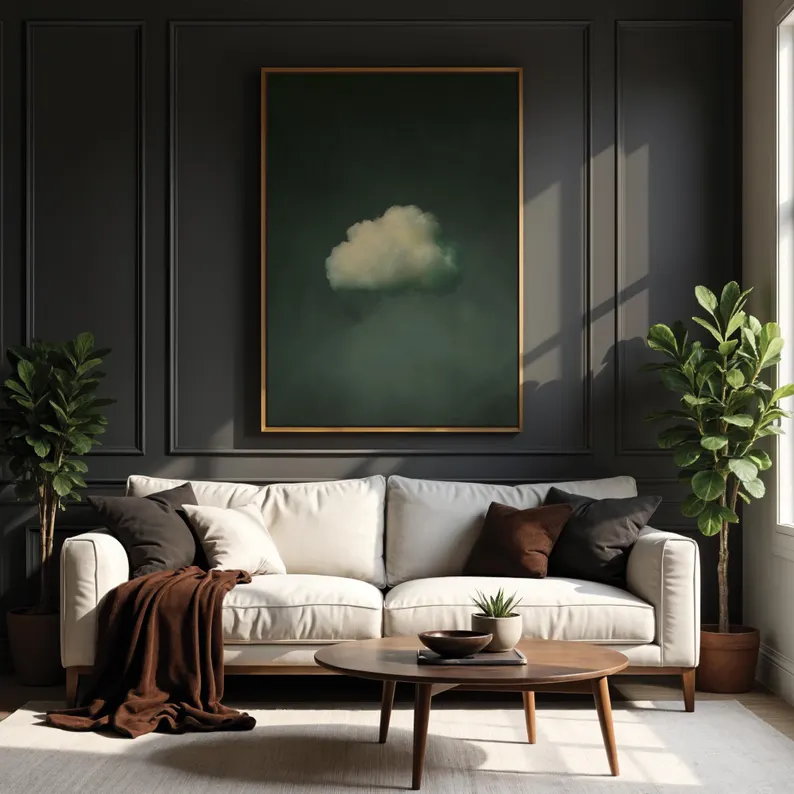
A large horizontal piece flanked by smaller prints spans about two-thirds of the sofa’s width.
The TV Wall
Decorating around a television takes a lighter touch — too much art competing with a screen looks cluttered. Framing the TV with a couple of shelves or a small symmetrical arrangement on either side usually reads as intentional rather than crowded.
Decorating Adjacent Walls Without It Looking Busy
When you’re working on decorate adjacent walls in an open-plan living space, let one wall be the “loud” one and let the wall it meets stay calm — a single mirror, a clock, or nothing more than the paint color. This contrast is what keeps an open room from feeling like every surface is competing for attention.
Ways to Decorate a Wall on a Budget
You don’t need a big budget to make a real difference. Some of the most effective ways to decorate walls cost very little:
- Thrift-store frames repainted in one cohesive color
- A gallery wall built from printed photos instead of purchased art
- Removable wallpaper on just one wall instead of the whole room
- A large piece of fabric stretched over a frame as budget-friendly “art”
- Command strips and adhesive hooks for renters who can’t drill
- Repurposed objects — old windows, woven baskets, or vintage plates — hung as wall decor
None of these require design experience — just a willingness to experiment, which is often the missing ingredient when how to decorate walls on a tight budget starts to feel overwhelming.
How to Style a Wall Like a Designer
Once the basics are in place, a few finishing touches separate an amateur arrangement from one that looks professionally done. These wall decor tips show up again and again in interior design guidance, and they’re often the part of how to decorate walls that beginners skip entirely — usually because they’re focused on finding the “right” art instead of finishing the details around it.
Balance Scale and Spacing
Mixing one large piece with several smaller ones creates visual hierarchy, while a wall full of similarly sized items can look flat. As a general spacing rule, leave two to three inches between framed pieces in a grouping so the arrangement feels connected rather than crowded.
Layering Textures
Combining a flat framed print with something dimensional — a woven hanging, a small shelf, a textured mirror frame — adds depth that a wall of only flat art can’t achieve on its own.
Lighting the Wall
A picture light or a few well-placed sconces can make even a modest piece of art look gallery-worthy after dark. Natural light during the day and warm, directional light at night both change how color and texture on a wall actually read.
Gallery Walls: Dressing Walls With a Curated Collection
Dressing walls with a gallery arrangement is one of the most popular ways to display a personal collection, but it’s also where a lot of people lose their nerve halfway through. Of every approach covered here, a gallery wall is probably the one people search for most when trying to nail down how to decorate walls in a way that feels personal rather than purchased off a showroom floor.
Grid Layout
Identical frame sizes arranged in even rows and columns create a clean, modern grid — a strong choice for symmetrical rooms or when you want the decoration on the walls to feel orderly rather than eclectic.
Salon-Style Layout
Mixing frame sizes, shapes, and even a few non-frame objects in an asymmetrical cluster creates a “salon style” look that feels collected over time rather than bought all at once. Laying the pieces out on the floor first — or tracing paper templates and taping them to the wall — avoids extra nail holes from trial and error.
Common Mistakes When Decorating Walls
A few patterns show up again and again on poorly decorated walls, and most of them are easy to fix once you know to look for them:
- Hanging too high. Art floating near the ceiling rather than at eye level is one of the most common errors.
- Going too small. A single small frame on a large wall gets visually swallowed; scale up, or group several pieces together.
- Ignoring the furniture below. Art should generally relate in width to the furniture beneath it, not float independently in space.
- Mixing too many styles without a unifying color. Eclectic can work beautifully, but it needs at least one repeated color or material to tie it together.
- Forgetting the empty wall. Not every wall needs decor — a quiet wall gives the eye somewhere to rest.
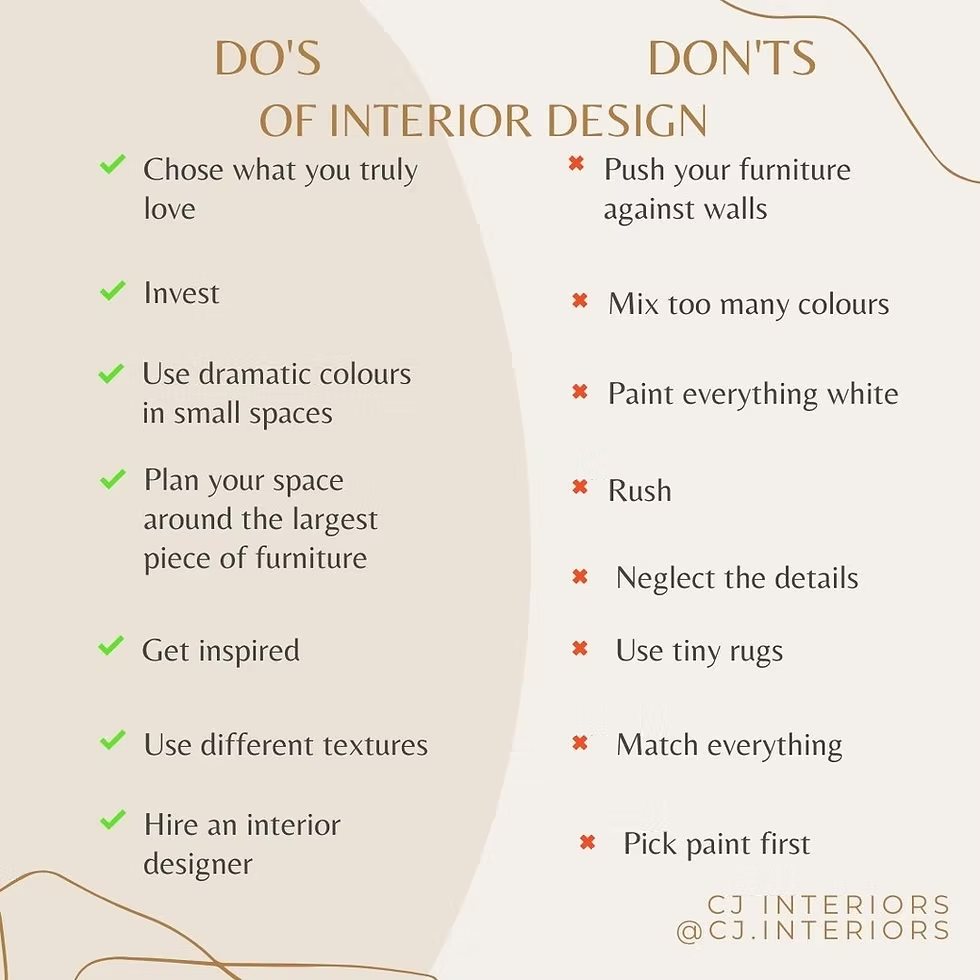
5 wall decorating mistakes to avoid — at a glance.
Most of these mistakes aren’t really about taste — they’re about skipping a step. Slow down even slightly and how to decorate walls stops being intimidating and starts being almost mechanical: measure, anchor, balance, repeat.
Frequently Asked Questions
How do I know how to decorate walls if I’m a complete beginner?
Start with one focal wall, measure to hang art at roughly eye level, and pull two or three colors from existing furniture or textiles to guide your choices. Mastering one wall well is more effective than spreading thin attempts across an entire room at once. If you’re still hunting for ideas for decorating walls, browsing a handful of decorating walls ideas boards and picking just one direction to commit to is usually more useful than trying to combine five different styles.
How to decorate a living room wall without spending much money?
Thrifted frames, printed photographs, and a single roll of removable wallpaper go a long way. Many of the most complimented gallery walls are built almost entirely from inexpensive or repurposed pieces rather than expensive original art.
What to decorate walls with if I rent and can’t drill holes?
Adhesive hooks, tension rods, washi tape frames, and peel-and-stick wallpaper all work without damaging walls. Lightweight textiles and woven hangings are also among the easiest things to put on wall surfaces when you need to remove everything cleanly at move-out, and they double as good answers if you’re wondering what to put on my walls without committing to anything permanent.
How to decorate your room wall above the bed specifically?
Center the artwork or arrangement above the headboard, keeping the overall width close to that of the bed frame itself. A single oversized piece or a symmetrical pair on either side of the headboard both tend to work well in this spot.
How many pieces should go into a gallery wall arrangement?
There’s no fixed number, but most successful arrangements use somewhere between five and nine pieces, mixing at least one larger anchor piece with several smaller ones. Laying everything out on the floor first helps confirm the count feels balanced before any nails go in.
How to decorate adjacent walls in an open floor plan?
Pick one wall to be the visual highlight and keep the wall it meets at the corner noticeably simpler — a mirror, a clock, or just the paint color. This contrast prevents the corner from feeling like two competing focal points.
How to decorate a living room wall with a large TV?
Keep decor near the television minimal and symmetrical, using narrow shelves or small matching pieces on either side rather than a busy gallery wall. Save bolder, more layered arrangements for a separate wall that isn’t competing with a screen, and avoid hanging anything directly above the screen that draws more attention than the TV itself.
What to put on wall space in a narrow hallway?
Hallways suit a single horizontal row of evenly spaced, similarly sized frames, since the eye moves through the space rather than lingering in one spot. A runner-style gallery — long and narrow rather than wide and clustered — tends to suit hallway proportions best.
How to decorate a wall if the room already has a lot of pattern?
When a room already has a patterned rug or bold furniture, simpler wall decor — a few solid-color frames, a single mirror, or minimal shelving — keeps the space from feeling overloaded. Save more elaborate gallery walls for rooms with quieter furnishings, and let the pattern that’s already in the room do most of the visual work.
How often should wall decor be refreshed or rearranged?
There’s no strict rule, but many designers suggest revisiting wall arrangements whenever furniture changes significantly, or roughly every couple of years to keep a space feeling current. Swapping a few pieces is often enough — a full redo usually isn’t necessary unless the room’s whole layout has changed.
Final Thoughts
Bare walls aren’t a problem to solve once and forget about — they’re one of the easiest parts of a home to keep adjusting as taste, budget, and life change. Whether the question is how to decorate your walls in a first apartment or how to decorate my walls after years in the same house, the answer rarely changes: start with one wall, get the basics of scale and placement right, and let the rest of the room follow from there.
There’s no single correct way to handle how to decorate the wall that’s been bothering you the longest — only the version that fits how you actually live in the room. The goal was never to fill every inch of space; it’s to make the walls feel like they belong to the room, and to the people living in it.