

Introduction
Ever sat down at a beautifully arranged table and wondered why your own dinner table never looks quite that put-together? You’re not alone. Learning how to set table correctly is one of those small skills that quietly makes a big difference — it changes how a meal feels before anyone even takes a bite. Whether you’re hosting a holiday dinner, setting up for a quiet weeknight meal, or just trying to make your kitchen table feel a little more special, getting the details right matters more than most people realize.
A lot of us grew up watching our parents or grandparents lay out plates and forks without ever really learning the “why” behind it. Maybe the napkin always went on the left, or the water glass sat at a certain angle, but nobody explained the logic. That’s exactly what this guide is for. We’re going to walk through everything — from the basics of how to set a table for dinner to the finer points of how to set a proper table for formal occasions, restaurant-style service, and everyday family meals.
By the end, you’ll not only know the proper way to set a table, you’ll understand why each piece goes where it does, and you’ll be able to do it confidently without second-guessing yourself. Let’s get into it.
Why Table Setting Importance Goes Beyond Just Looking Nice
Before jumping into the steps, it’s worth pausing on table setting importance. A lot of people assume this is purely about aesthetics — making things look pretty for photos or impressing guests. That’s part of it, sure, but there’s more going on beneath the surface.
Food researchers and hospitality experts have long pointed out that presentation affects perception of taste. Studies in sensory science — including well-known plating research from Oxford University’s Crossmodal Research Laboratory — have shown that the way food is arranged and presented can actually shift how people perceive flavor intensity and quality. A table that’s organized and intentional sends a signal to your brain before the first bite even happens: this meal matters.
There’s also a practical layer. Setting a table properly means everyone has what they need within easy reach — no awkward reaching across the table for a fork, no confusion about which glass belongs to whom. It keeps the meal flowing smoothly, especially when you’ve got multiple courses or a full table of guests.
And then there’s the emotional side. A properly set table signals care. It tells the people sitting down that you thought about their comfort before they even arrived. That’s true whether it’s a five-course dinner party or a Tuesday night taco dinner with the kids.
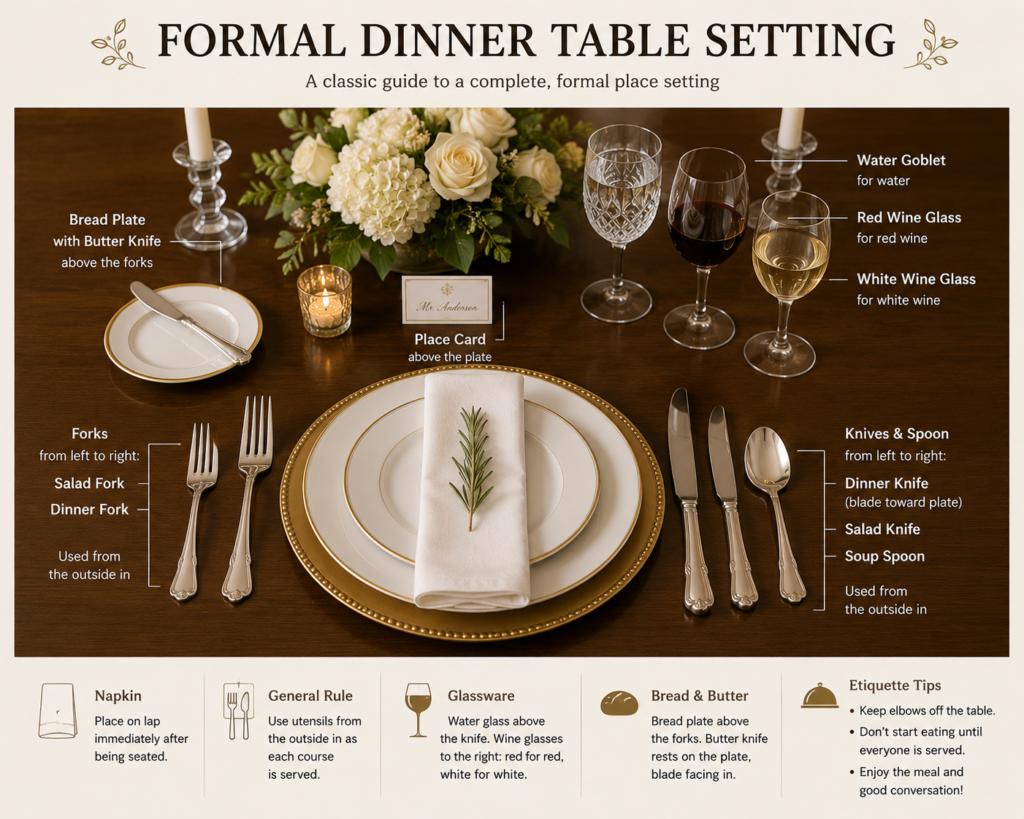
Formal Dinner Table setting
The Basic Tools You’ll Need Before You Start
You don’t need a butler’s training to get this right. Here’s what you’ll typically be working with for most table settings:
- Dinner plate (and salad or bread plate, if using one)
- Dinner fork and salad fork
- Dinner knife and butter knife
- Soup spoon or teaspoon (if needed)
- Napkin
- Water glass and wine glass (if serving wine)
- Bread plate (optional, for formal settings)
Once you have these basics gathered, the actual process of how to set the table becomes much easier to visualize. Think of it less like a strict rulebook and more like a logical system: utensils go in the order you’ll use them, working from the outside in.
How to Set a Table for Dinner: The Everyday Version
Let’s start with the most common scenario — a regular family dinner. This is the version most people need on a daily basis, and once you’ve got it down, the fancier versions are just small additions.
Step 1: Place the Dinner Plate
Center the dinner plate where each person will sit, about an inch from the edge of the table. This becomes your anchor point — everything else gets arranged around it.
Step 2: Add the Fork on the Left
The dinner fork goes to the left of the plate. If you’re using a salad fork too, it goes to the far left, with the dinner fork closer to the plate. Remember: utensils are arranged in the order they’re used, from the outside moving inward.
Step 3: Add the Knife and Spoon on the Right
The dinner knife sits to the right of the plate, blade facing inward toward the food. The spoon (if you’re serving soup or need one for dessert) goes to the right of the knife.
Step 4: Place the Napkin
The napkin can go either folded under the fork on the left or placed neatly on top of the plate. Both are acceptable for casual settings.
Step 5: Add the Glass
Place the water glass above the knife, slightly to the right. If you’re also serving wine, the wine glass goes just to the right of the water glass, slightly lower.
That’s genuinely it for a casual setup. This basic structure answers how to set table for dinner in the vast majority of everyday situations, and it takes less than two minutes once it becomes habit.
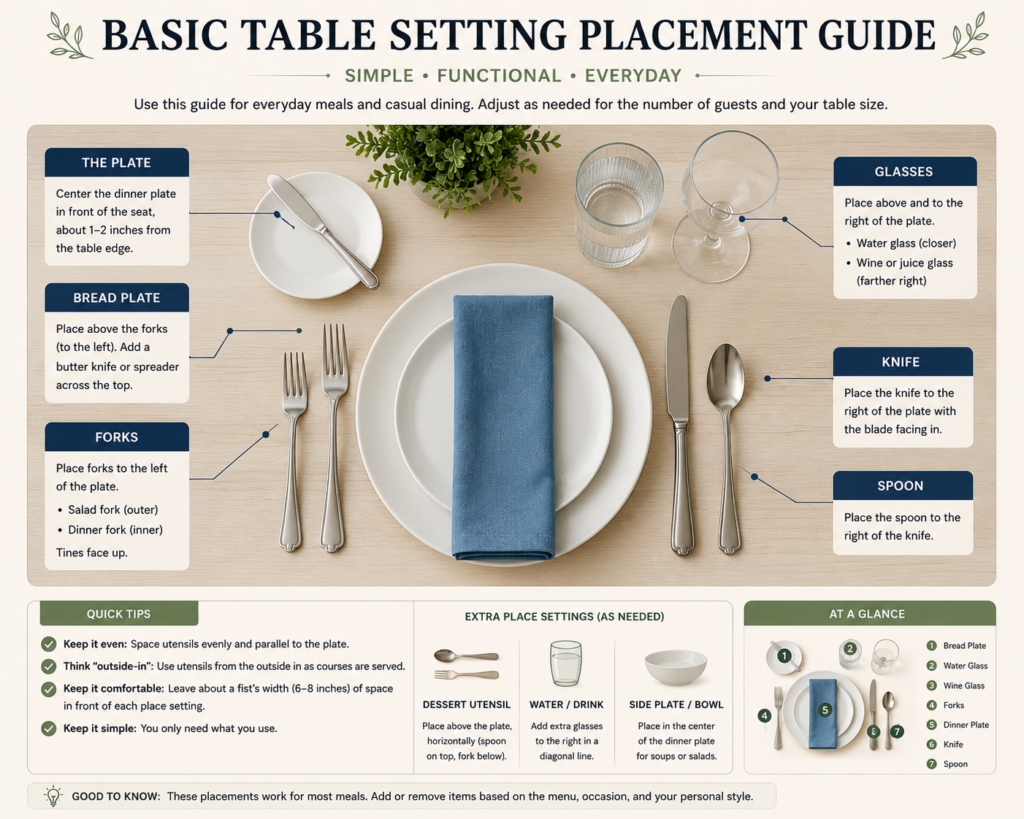
Basic Table Setting Placement Guide
How to Set a Proper Table for Formal Occasions
Now let’s level up. How to set a proper table for something more formal — a holiday meal, a dinner party, an anniversary celebration — involves a few more pieces, but the underlying logic stays the same.
Understanding the Formal Layout
In how to set a dinner table properly for formal settings, you’re typically dealing with multiple courses, which means more utensils and more precision. Here’s the breakdown:
From left to right: napkin, salad fork, dinner fork, dinner plate, dinner knife, soup spoon, then the bread plate positioned above the forks.
Glassware, from left to right above the knife: water glass, red wine glass, white wine glass (if serving multiple wines).
Dessert Utensils
For a formal multi-course meal, dessert spoons and forks are often placed horizontally above the plate, with the fork facing right (handle pointing right) and the spoon facing left (handle pointing left). This way, guests can pull them down to the sides once dessert is served, without needing the table reset mid-meal.
The Charger Plate
Many formal settings use a charger — a larger decorative plate that sits beneath the dinner plate purely for visual effect. It’s removed before the main course is served and isn’t eaten from directly.
This level of detail is what separates a casual dinner from setting a table properly in the traditional, etiquette-school sense. It might feel like a lot at first, but most hosts only need this for special occasions a few times a year.
How to Set a Dining Table for Different Meal Types
Not every dinner table setup looks the same, and that’s by design. How to set a dining table changes slightly depending on what’s being served.
Breakfast or Brunch Settings
Keep it light: a smaller plate, a single fork, a butter knife, a coffee cup with saucer, and a juice or water glass. Napkins are often placed to the left or directly on the plate.
Casual Weeknight Dinners
Stick to the basics — fork, knife, plate, napkin, glass. No need for multiple utensils unless the meal genuinely calls for it (like soup or a multi-part dish).
Holiday or Celebration Dinners
This is where the full formal setup comes into play, often with place cards, multiple glasses, and sometimes a small bread plate with its own butter knife resting across the top edge.
Buffet-Style Settings
For buffet dinners, utensils are often wrapped in a napkin or placed in a holder at the start of the serving line rather than pre-set at each seat, since guests are filling their own plates.
Knowing how to set dinner table styles for these different scenarios means you’re never caught off guard, whether it’s a quick Tuesday meal or a big family gathering.
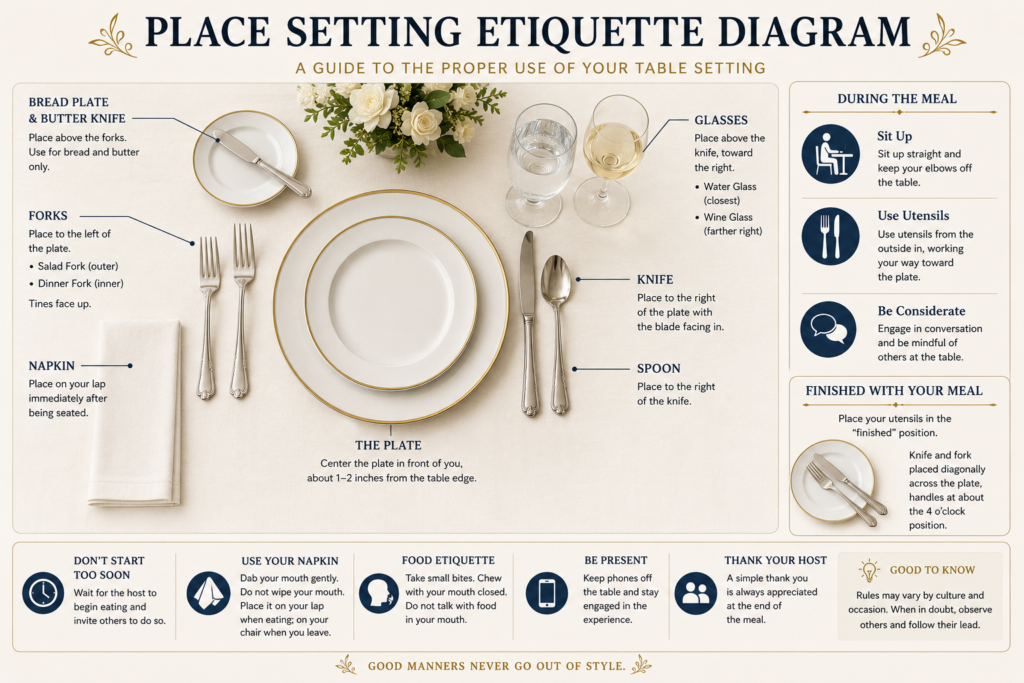
Place Setting Etiquette Diagram
How to Set a Table in a Restaurant: What the Pros Do Differently
If you’ve ever wondered why restaurant tables always look so crisp and uniform, there’s actual method behind it. How to set a table in a restaurant follows strict consistency standards because servers need to set dozens of tables quickly, and guests expect a certain predictable experience.
Precision and Symmetry
Restaurants typically measure spacing between utensils and plates using set distances — often an inch from the table edge for plates, and consistent gaps between forks, knives, and glasses. This isn’t fussiness for its own sake; it’s about creating a visual rhythm across an entire dining room.
Pre-Set vs. Course-by-Course Setting
Fine dining restaurants often only place the utensils needed for the first course, then bring out additional silverware with each new course. This keeps the table from looking cluttered and signals attentive, paced service. Casual restaurants, by contrast, often pre-set everything needed for the whole meal upfront.
Glassware Standards
In professional settings, glasses are typically polished and inspected for spots or smudges before placement — a detail many home cooks overlook but that instantly elevates a table’s appearance.
Borrowing even a couple of these restaurant habits — spacing things evenly, polishing glassware, keeping the surface uncluttered — can make a home dinner feel noticeably more polished without much extra effort.
How to Properly Set a Table: Common Mistakes to Avoid
Even people who think they know how to properly set a table sometimes make small errors that throw off the whole presentation. Here are the most common ones:
- Knife blade facing the wrong way. The blade should always face inward, toward the plate, never outward toward the next guest.
- Forks on the wrong side. Forks go on the left, knives and spoons on the right — it’s easy to mix this up when you’re moving fast.
- Overcrowding the table. Too many unnecessary items (extra napkins, condiment bottles, clutter) can make even a well-set table look messy.
- Mismatched glassware or plates. Consistency matters more than having expensive pieces — a uniform look reads as more intentional than mismatched “nice” items.
- Forgetting napkin placement. A bare table without a napkin in sight feels unfinished, even if everything else is correct.
- Placing glasses too far from reach. Glasses should sit close enough that guests don’t have to stretch awkwardly.
Avoiding these small missteps is really the difference between a table that looks “fine” and one that looks genuinely thoughtful.
Table Tips for Making Any Setting Look More Polished
Here are some practical table tips that go beyond the basic rules and help any table — casual or formal — look more put-together:
- Use a tablecloth or runner to anchor the look, even for casual meals. It instantly makes the table feel more intentional.
- Add a simple centerpiece — flowers, candles, or even a bowl of fruit — to fill empty visual space without overwhelming the table.
- Fold napkins neatly instead of just tossing them down; even a basic fold looks more deliberate.
- Match your plate colors to keep things visually clean, especially for larger groups.
- Light candles for evening meals — warm lighting changes the entire mood of a dinner table.
- Keep place settings evenly spaced so the table doesn’t look lopsided, especially with uneven numbers of guests.
- Pre-chill water and wine glasses for warm-weather dinners; condensation on a properly chilled glass actually reads as more refreshing.
These small additions are often what people remember about a meal, even more than the food itself.
Step-by-Step Recap: Setting a Dining Table Properly
For a quick, practical walkthrough of setting a dining table properly, here’s the sequence one more time, simplified:
- Lay the placemat or runner down first, if using one.
- Center the dinner plate.
- Place the napkin — either folded on the plate or to the left.
- Add forks to the left (salad fork outside, dinner fork inside).
- Add the knife to the right, blade facing the plate.
- Add the spoon to the right of the knife.
- Place the water glass above the knife.
- Add the wine glass beside the water glass, if serving wine.
- Add a bread plate above the forks, if using one.
- Step back and check spacing and symmetry before guests arrive.
Following this order consistently means you’ll never have to think twice about how to set a dinner table again — it becomes second nature surprisingly fast.
FAQ Section
What is the correct order for how to set a table?
The general order is: napkin and forks on the left, plate in the center, knife and spoon on the right, with glasses placed above the knife. Utensils are arranged from the outside in, based on the order they’ll be used during the meal.
How to set a table for dinner if I don’t have formal dinnerware?
You don’t need formal dinnerware to set a nice table. Use whatever plates, glasses, and utensils you have, but keep the arrangement consistent — fork left, knife and spoon right, napkin nearby, glass above the knife. Consistency matters more than the materials themselves.
What is the proper way to set a table when serving soup?
Place the soup spoon to the right of the dinner knife, on the outermost right position if other utensils are also present. The soup bowl typically sits on top of a charger or a small plate to catch any spills.
How to set a dining table for a large family gathering?
For bigger gatherings, focus on even spacing between each place setting, use a runner or tablecloth to visually unify the table, and consider placing utensils for each course separately if you’re serving multiple dishes, rather than crowding everything at once.
Does the proper way to set a table change for left-handed guests?
Traditionally, table settings are arranged the same way for everyone, with forks on the left and knives on the right, regardless of handedness. However, for a close family dinner, it’s perfectly fine to flip the setting for a left-handed guest if it makes the meal more comfortable for them.
How to set a table in a restaurant differently from a home setting?
Restaurants prioritize uniformity and speed since servers need to set many tables consistently. Home settings can be more flexible and personalized, but borrowing restaurant habits like even spacing and clean glassware can elevate a home table noticeably.
What’s the difference between casual and formal table setting?
Casual settings use fewer utensils — typically just a fork, knife, and napkin — while formal settings include multiple forks, knives, and glasses arranged by course, often with a charger plate and sometimes dessert utensils placed above the plate.
How to properly set a table for dinner with kids at the table?
Keep it simple and practical — a single fork, a small knife if needed, a napkin, and an unbreakable cup. The core principles of placement still apply, but durability and ease of use matter more than formal precision for younger guests.
Why does table setting importance matter if it’s just a casual meal?
Even casual meals benefit from basic organization. It keeps the meal practical (everyone has what they need within reach) and adds a small sense of care and intention, which can make even a simple weeknight dinner feel more special.
How to set a table properly for dinner parties with mixed courses?
Set out only the utensils needed for the first course, then bring out additional silverware as each new course is served. This avoids overcrowding the table and gives the meal a more paced, intentional feel.
Conclusion
At the end of the day, learning how to set table correctly isn’t about rigid rules or impressing anyone with fancy etiquette. It’s about creating a small moment of care before a meal even begins — making sure everyone at the table feels comfortable, has what they need, and senses that some thought went into the evening. Once you’ve practiced the basic left-fork, right-knife logic a few times, it stops feeling like a checklist and starts feeling like second nature. Whether you’re setting up a quick weeknight dinner or pulling out the good china for a holiday gathering, the same simple principles carry you through. Start with the basics, add formal touches when the occasion calls for it, and don’t be afraid to make the table your own.