

A micro oven and a microwave are the same appliance. “Micro oven” is simply the everyday name used in many countries, especially across South Asia and the Middle East, for a microwave oven.
The real choice isn’t between the two names. It’s between three main types solo, gril,l and convecti n, and the size and power that suit your kitchen.
This guide explains how a microwave works, which type fits the way you cook, how to pick the right capacity and wattage, which containers are safe, and how to keep it clean and running for years.
Microwave oven, microwave, microwave oven: what’s the difference?
There isn’t one. All three names describe a kitchen appliance that heats food using microwave energy.
“Microwave oven” is the full name. “Microwave” is the short form used in most of the world, and “micro oven” is a common local shortening in countries like Pakistan, India, and the Gulf states.
Where people do get confused is between a microwave and a regular electric oven, sometimes called an OTG (oven, toaster, grill). These are genuinely different appliances.
| Feature | Microwave / micro oven | OTG or electric oven |
|---|---|---|
| How it heats | Microwave energy heats water in the food | Heating elements heat the air and the food’s surface |
| Speed | Very fast for reheating and cooking | Slower; needs preheating |
| Browning and crisping | Only in grill or convection models | Yes, naturally |
| Best for | Reheating, defrosting, quick cooking | Baking, roasting, toasting |
A convection microwave sits between the two. It can heat with microwaves and also bake and brown like a small oven.
How a microwave oven actually works
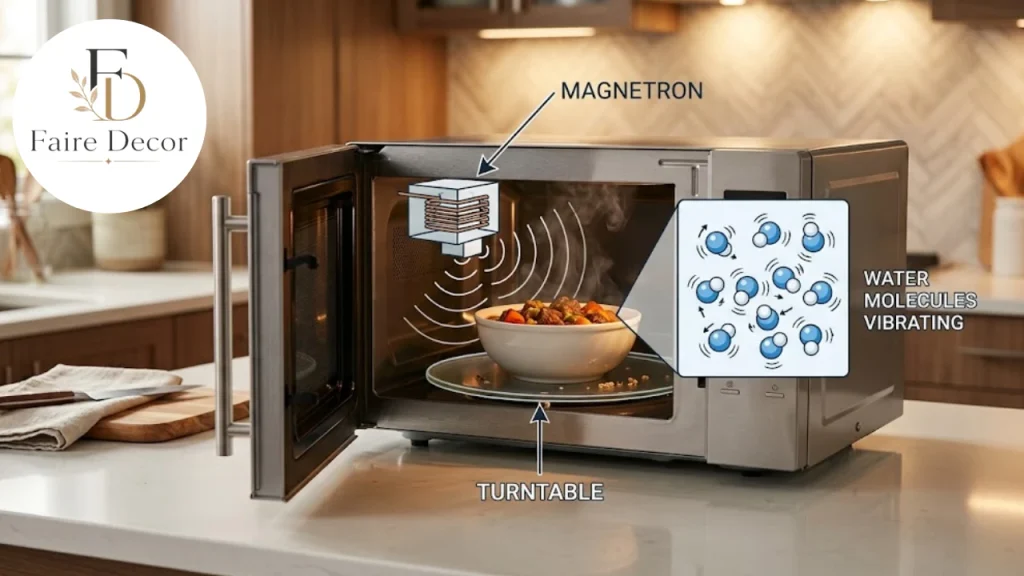
Inside every microwave is a part called a magnetron. It produces microwaves, a form of radio-frequency energy, that bounce around the metal cooking cavity.
Household microwaves typically run at a frequency of about 2.45 gigahertz. At this frequency, the energy makes water molecules in food vibrate rapidly, and that motion produces heat.
That’s why food with more water heats faster, and why dry foods like bread can turn tough if overheated. It also explains why microwaved food can heat unevenly.
The microwaves penetrate only a short distance into food. The rest of the heat travels inward by conduction, which is why the outside of a thick dish can be hot while the middle is still cold.
The turntable, and in some models a rotating stirrer fan, helps spread the energy more evenly. Even so, stirring and resting the food are still important.
The three main types of microwave ovens
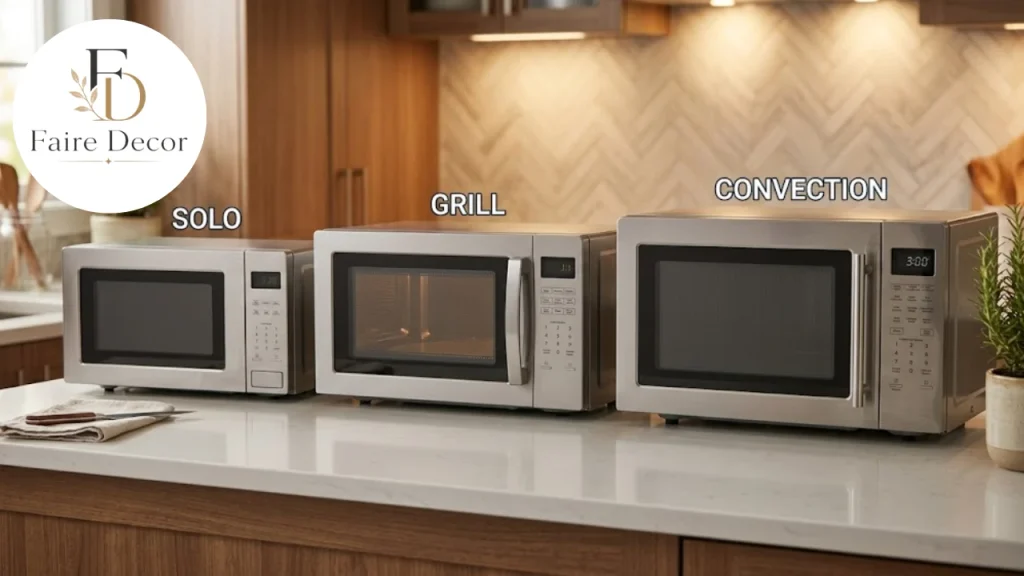
Choosing the right type matters more than choosing the brand. Each one suits a different style of cooking.
| Type | What it does | Best for | Trade-offs |
|---|---|---|---|
| Solo | Microwave heating only | Reheating, defrosting, boiling water, simple cooking | Can’t grill, brown or bake |
| Grill | Microwave plus a heating element on top | Toast, grilled sandwiches, browning, kebabs and tikka | Can’t bake cakes evenly |
| Convection | Microwave plus a heating element and fan | Baking cakes, cookies, pizza, roasting chicken | Higher price; larger size; a little more to learn |
Solo microwave
A solo microwave oven does the basics very well. If you mainly reheat leftovers, warm milk, defrost meat and make quick meals, it’s all you need.
Solo models are usually the cheapest, simplest and most compact. They’re a great choice for students, offices and small households.
Grill microwave
A grill model adds a heating element at the top of the cavity. It can brown the surface of food, make toast, and give a light crisp to sandwiches and snacks.
Many grill models offer combination modes that use microwaves and the grill together. That cooks the inside quickly while browning the outside.
Convection microwave
A convection model adds a heating element and a fan that circulates hot air, just like a small oven. It can bake, roast, and grill, as well as do everything a solo microwave does.
If you want to bake cakes or roast a chicken without a separate oven, convection is the one to buy. It costs more, and it takes a little practice to learn its settings and the right cookware for each mode.
What size microwave do you need?
Capacity is usually listed in liters or cubic feet. Choosing the right size stops you from buying a box too small for your dishes or too large for your counter.
| Capacity | Rough cubic feet | Good for |
|---|---|---|
| 15 to 20 liters | About 0.5 to 0.7 | 1 to 2 people, basic reheating |
| 20 to 25 liters | About 0.7 to 0.9 | Small families; most solo and grill models |
| 25 to 30 liters | About 0.9 to 1.1 | Families of 3 to 5; many convection models |
| 30 liters and up | About 1.1 and up | Large families, big dishes, frequent baking |
One liter is roughly 0.035 cubic feet, so the conversions above are approximate.
Measure your largest dish before you shop. A big biryani tray or casserole won’t fit in a small model, however good it looks. Check the turntable diameter too, since that limits the dishes you can rotate.
Understanding microwave wattage
Wattage tells you how much cooking power the microwave delivers. Higher wattage means faster, more even cooking.
Most home microwaves fall between about 700 and 1,200 watts of cooking power. Many solo models sit around 700 to 900 watts, while larger and convection models are often higher.
Wattage matters for recipes and packaged food instructions. A dish that takes 3 minutes in a 1,000-watt oven may need around 4 minutes or more in a 700-watt model.
Look for the output power on the label or spec sheet, not just the input power. The input figure, the electricity the unit draws, is always higher than its cooking power.
Features worth paying for
Modern microwaves come with plenty of buttons. Some are genuinely useful; others you’ll never touch.
Worth having:
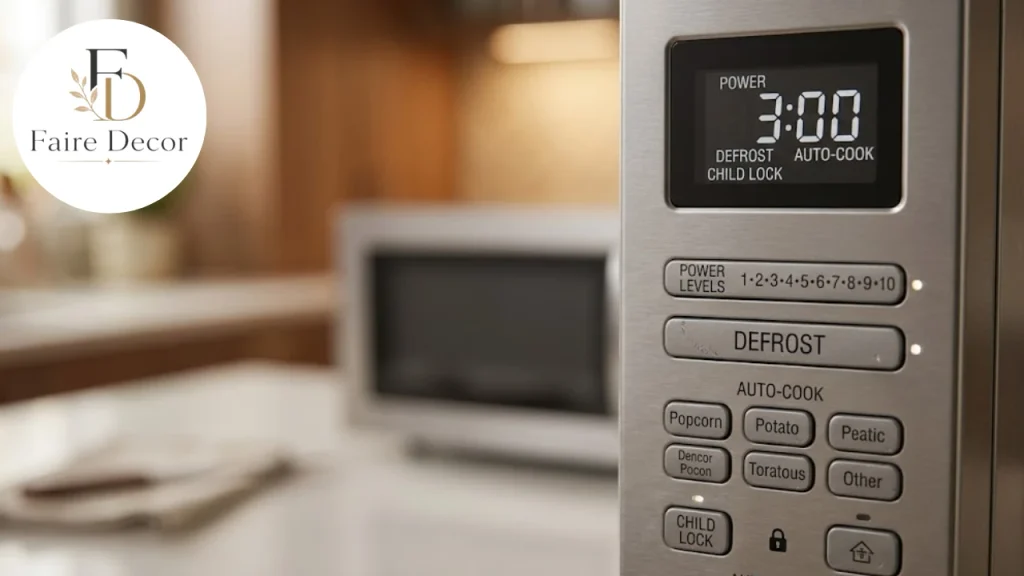
Auto-cook and auto-reheat menus for common dishes, which take the guesswork out of timing.
Weight or time defrost, which adjusts power to thaw evenly without cooking the edges.
Multiple power levels, essential for gentle cooking, melting butter or softening food.
A child lock, if you have young children at home.
Easy-clean interior, such as ceramic or enamel coatings that wipe clean more easily than plain painted steel.
Inverter technology, found in some models, which delivers steady, lower power instead of switching on and off. It can help with even defrosting and gentle cooking.
Nice but optional: sensor cooking, steam functions, Wi-Fi control and large numbers of preset menus.
Countertop, built-in or over-the-range?
Where your microwave goes affects which model you can buy.
Countertop models are the most common and affordable. They need counter space and good ventilation around the sides, top, and back, as specified in the manual.
Built-in models fit into a cabinet or tall unit for a sleek, integrated look. They need a matching trim kit or a model designed for built-in use, plus proper ventilation.
Over-the-range models, common in the US, mount above the cooktop and often double as a range hood. They save counter space but need secure installation and suitable wiring.
If you’re planning or updating a kitchen, decide on the microwave early. It’s much easier to plan a built-in space when you design modern kitchen cabinets than to squeeze one in later.
Reheating tips for everyday foods
Different foods need slightly different handling to come out well.
Rice. Sprinkle a little water over the rice, cover loosely, and reheat until steaming hot all the way through. Fluff it with a fork before serving.
Curries and gravies. Stir halfway through, since the edges heat faster than the middle. Add a splash of water if the sauce has thickened in the fridge.
Bread and rotis. Wrap them in a slightly damp paper towel and heat briefly. Too long makes them chewy and hard.
Pizza. A grill or convection mode gives a crisp base. In a solo model, place a cup of water beside the slice to keep the crust from going rubbery.
Soups. Use a large bowl with room to spare, stir ofte,n and let it stand before eating, since soups can boil over or splash.
What you can cook in a microwave oven
A microwave oven can do far more than warm leftovers. Even a basic solo model handles a surprising range of everyday cooking.
Vegetables. Microwaving with a splash of water in a covered dish steams vegetables quickly. Broccoli, carrots, peas, and spinach keep their color and bite when cooked briefly.
Rice and porridge. Use a large, deep bowl to stop boiling over, and cook on medium power. Stir halfway, and let the dish stand before serving.
Eggs. Scrambled eggs and simple egg dishes cook in a minute or two. Never microwave eggs in their shells, which can burst.
Potatoes. Pierce whole potatoes several times and cook until tender. They’re a quick base for a fast meal.
Snacks and desserts. Popcorn, mug cakes and melted chocolate are easy wins. Melt chocolate on low power in short bursts, stirring between each.
With grill and convection models, the list grows to include toasted sandwiches, tikka, pizza, cakes, cookies and roast chicken.
Microwave-safe containers: what to use and avoid
Using the wrong container is one of the most common microwave mistakes. It can damage the dish, the oven, or the food.
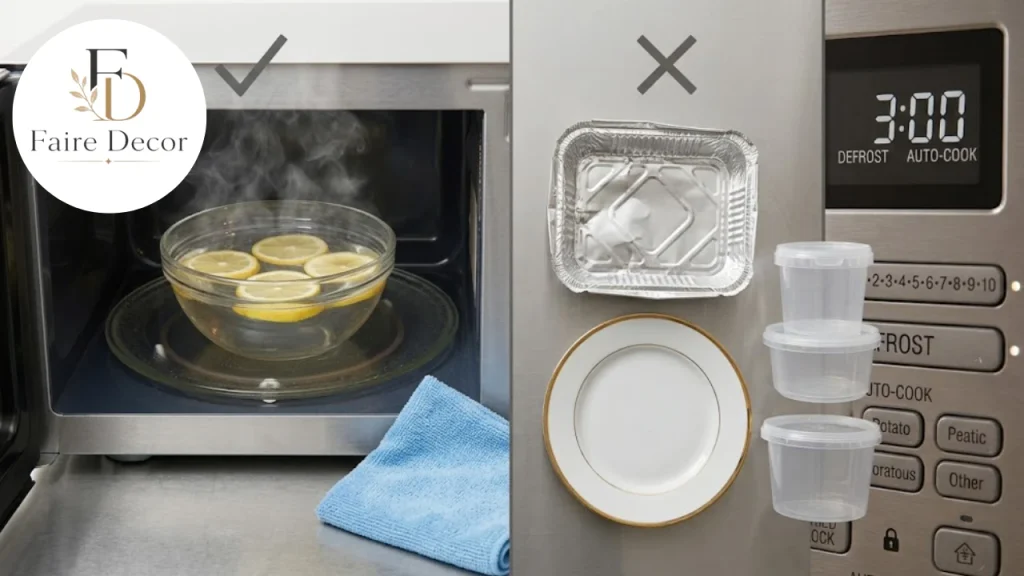
The Clemson University Cooperative Extension lists these as generally safe and unsafe (Clemson HGIC).
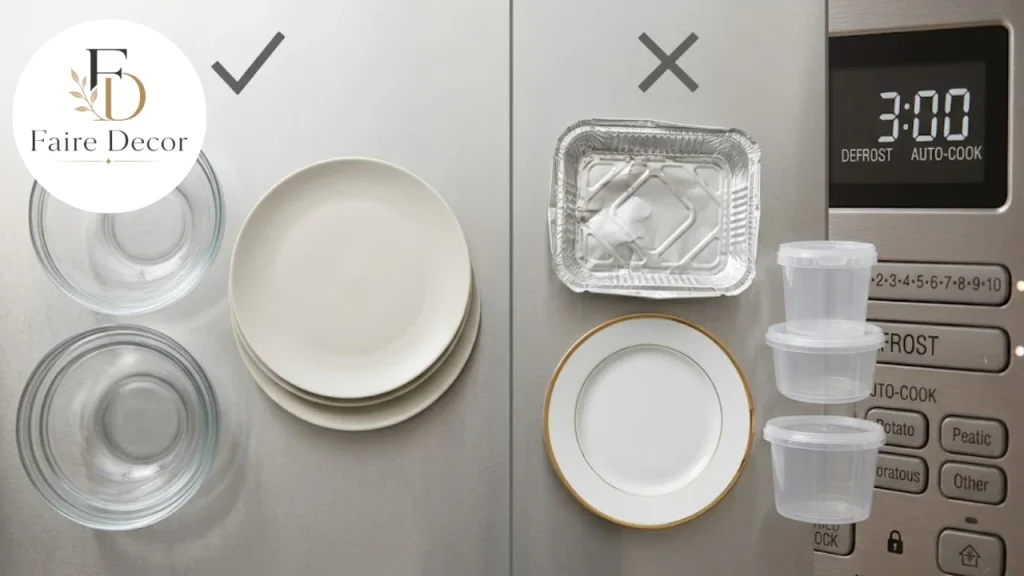
| Safe to use | Avoid |
|---|---|
| Glass and glass-ceramic cookware | Metal pans and aluminum foil containers, unless the maker approves |
| Plastic containers labeled microwave-safe | Thin plastic bags and grocery bags |
| Ceramic dishes without metallic trim | Margarine tubs, yogurt cups and takeaway tubs not labeled microwave-safe |
| Wax paper, parchment and microwave-safe paper towels | Brown paper bags and newspaper |
| Microwave cooking bags | Dishes with gold or silver trim |
A quick test for unlabeled dishes
Clemson suggests a simple check. Place the empty dish in the microwave next to a cup of water in a glass measuring cup, and heat on high for 1 minute.
If the dish stays cool, it’s safe to use. If it gets hot, don’t use it for microwaving.
Metal and sparks
Metal reflects microwaves and can cause sparking, called arcing, which can damage the oven. Avoid forks, spoons, foil, and dishes with metallic paint or trim.
The exception is in convection or grill mode. Some manufacturers allow metal baking tins in those modes, so follow your own model’s manual.
How to use your microwave oven safely
Microwaves are very safe when used as designed. A few habits make them safer still.
Cover food loosely. Clemson advises covering food loosely when reheating, which holds in moisture and helps heat evenly. Leave a gap so steam can escape.
Stir and turn. Stir or rotate food halfway through, and turn large items over. This reduces cold spots where bacteria can survive.
Let it stand. Leave food for a few minutes after heating, so heat spreads through the whole dish.
Check temperatures. For meat, poultry, and leftovers, use a food thermometer in several places. Clemson lists 165°F (74°C) for poultry and leftovers, and 160°F (71°C) for ground meat.
Pierce foods with skins. Prick potatoes, sausages, and hot dogs before cooking so they don’t burst.
Never run it empty. Running a microwave with nothing inside can damage the magnetron.
Take care with water. Water heated in a very smooth cup can occasionally overheat without bubbling, then boil suddenly when moved. Heat in short bursts, and add a wooden stir stick or let it stand briefly before lifting the cup.
Test food for babies carefully. Microwaves create hot spots, so stir baby food well, shake bottles, and always test the temperature before feeding.
Is microwave cooking safe?
This is one of the most common worries, and the short answer is yes, when the oven is in good condition.
Microwave energy heats food but doesn’t make it radioactive. The energy stops the moment the oven turns off, and the metal cavity and door screen keep it inside.
The main safety concern is a damaged oven. Stop using any microwave with a door that doesn’t close properly, broken hinges, a damaged seal, or a dented cavity, and have it checked or replaced.
On nutrition, microwaving can actually be gentle. Short cooking times and little water mean fewer water-soluble vitamins are lost than with long boiling.
Common microwave myths
Microwaves attract a lot of worry and misinformation. Here are a few common beliefs, and what’s actually true.
“Microwaves make food radioactive.” They don’t. Microwave energy only heats the food, and it stops the moment the oven switches off.
“Microwaving destroys all the nutrients.” All cooking changes food somewhat. Because microwaving is fast and uses little water, it often preserves water-soluble vitamins better than long boiling.
“Standing in front of a microwave is dangerous.” An oven in good condition keeps the energy inside. The concern is damaged doors, seals, or hinges, which is why a broken oven shouldn’t be used.
“Any plastic is fine if it doesn’t melt.” Not every plastic is designed for heat. Use containers labeled microwave-safe, and avoid takeaway tubs and thin bags.
“Microwaves cook food from the inside out.” They don’t. Microwaves heat the outer layers first, and the heat moves inward from there. That’s why thick foods need resting time.
How to clean a microwave oven
Regular cleaning keeps your microwave hygienic, prevents smells, and stops food splatter from baking on.
The steam method
Fill a microwave-safe bowl with about a cup of water. Add a few slices of lemon or a spoonful of vinegar.
Heat on high for 3 to 5 minutes, until the window steams up.
Leave the door closed for a few minutes so the steam can soften the grime.
Wipe the inside with a soft cloth or sponge. Remove the turntable and wash it in warm, soapy water.
Dry everything and leave the door open briefly to air out.
Everyday care
- Cover food to reduce splatters.
- Wipe spills straight away, while they’re still soft.
- Clean the door seal and the outside with a damp cloth.
- Avoid abrasive pads and harsh chemicals, which can scratch the interior coating.
- Keep the vents clear of dust and grease.
Common microwave problems and quick fixes
Most problems are minor. Always unplug the microwave before checking anything, and never open the outer casing yourself.
| Problem | Likely cause | What to do |
|---|---|---|
| Food heats unevenly | Thick or dense food, no stirring | Stir halfway, spread food out, use medium power for longer |
| Turntable doesn’t turn | Tray or roller ring out of place | Reseat the tray and ring; clean the track |
| Sparks inside | Metal, foil or metallic trim, or a damaged cavity cover | Stop immediately; remove metal; have it checked if sparks continue |
| Unit runs but doesn’t heat | Possible internal fault | Stop using it and contact a qualified technician |
| Bad smell | Food residue or burnt splatter | Steam clean with lemon or vinegar |
| Door doesn’t close properly | Damaged latch or hinge | Stop using it until it’s repaired |
Microwaves contain a high-voltage capacitor that can hold a dangerous charge even when unplugged. Internal repairs should always be left to qualified technicians.
How long does a microwave last, and when should you replace it?
With normal use and good care, many microwaves last for several years, often around a decade. Heavy daily use, voltage problems, and poor cleaning can shorten that.
Consider replacing your microwave oven if you notice any of these:
- The door no longer closes or seals properly.
- It sparks with nothing metal inside.
- Food takes much longer to heat than it used to.
- It makes unusual buzzing, grinding, or burning smells.
- The control panel stops responding reliably.
For an older or inexpensive model, a major repair often costs close to the price of a new one. A newer, more efficient microwave may also heat more evenly and use less energy.
When you replace it, dispose of the old one responsibly. Many areas treat microwaves as electronic waste, and some retailers take old appliances back.
Energy use and running costs
Microwaves are among the most energy-efficient ways to heat small amounts of food. They heat the food directly rather than a large oven cavity or a pot of water.
For reheating a single plate or a cup of tea, a microwave usually uses far less energy than a full-size oven or stove. That can make a real difference in households trying to reduce electricity bills.
To save more, match the cooking time to the amount of food, keep the interior clean so it heats efficiently, and unplug or switch off at the wall if your model uses standby power for a clock display.
Choosing the right microwave oven for your home
Before buying, answer these questions to narrow your choice quickly.
What will you cook most? Reheating and defrosting point to solo; snacks and grilled food to grill; baking to convection.
How many people are you cooking for? Use the size table to choose capacity.
Where will it go? Measure your counter or cabinet space, including the clearance the manual requires for ventilation.
What’s your power supply like? In areas with unstable voltage, a voltage stabilizer can help protect electronics, and some buyers prefer models designed to handle fluctuations.
What’s your budget? Solo models are the cheapest; convection models cost more but can replace a small oven.
Is service available nearby? A good local service network matters as much as the brand name.
Making the microwave fit your kitchen design
A microwave is often the largest appliance on the counter, so it shapes how a kitchen looks.
For a clean, modern look, a built-in model or a dedicated appliance shelf keeps it out of sight. In a bright, relaxed coastal kitchen, a white or stainless finish blends in easily.
If you love a traditional look, like a Victorian-style kitchen, retro-style microwaves in cream or pastel colors can suit the room better than a plain black box.
FAQs:
Is a micro oven the same as a microwave?
Yes. “Micro oven” is a common local name, especially in South Asia and the Middle East, for a microwave oven.
Which is better: solo, grill, or convection microwave?
It depends on how you cook. Solo suits reheating and defrosting, grill adds browning and toasting, and convection can also bake cakes and roast chicken.
What size microwave oven is best for a family?
For a family of three to five, around 25 to 30 liters suits most needs. Smaller households can manage with 20 to 25 liters.
Is it safe to stand near a microwave while it’s running?
Yes, when the oven is in good condition. Don’t use a microwave with a damaged door, hinge, or seal.
How do I clean the inside of a micro oven?
Heat a bowl of water with lemon or vinegar for 3 to 5 minutes, leave the door closed for a few minutes, then wipe the softened grime away.
How long does a microwave last?
With normal use and care, many microwaves last around a decade. Replace one that sparks, heats poorly, or has a door that won’t seal.