

A no-soliciting sign is the cheapest piece of home security most people ever buy, and also the most misunderstood. Some homeowners treat it like a legal force field. Others assume it is just decoration that salespeople ignore.
The truth sits in the middle, and it changes from one town to the next. In some places, a sign carries real weight. In others, it is a polite request with no legal force at all.
This guide explains what the sign can and cannot do, how to check the rules where you live, which wording works, where to mount it, and what to do when someone knocks anyway.
It also covers the federal three-day cancellation rule for sales made at your door, because that is the protection that matters most if you do end up buying something.
One caution first. This is general information, not legal advice. Local ordinances differ, so confirm anything important with your city or county office or a local attorney.
Who Is Actually Knocking
Not everyone who rings your bell is selling the same thing. Knowing the types helps you decide what wording to use and how to respond.
Commercial sellers come first: home-improvement and roofing crews, alarm and internet providers, solar and energy-plan sellers, and magazine or product sales. These are the visits the Federal Trade Commission rule covers.
Charities and nonprofits knock for donations. Political campaigns and canvassers ask for votes or signatures. Religious groups visit to share their faith. Legal treatment of these groups is often different from commercial selling, as the next section explains.
Then there are the visits that are not solicitation at all: delivery drivers, utility workers with a real work order, neighbors, and census or survey workers. A sign aimed at salespeople may or may not apply to them, and that is worth thinking about before you pick the wording.
Finally, there are scammers who pose as any of the above. They may claim to be from the utility company, a roofing crew “in the neighborhood,” or a charity. A sign will not stop a determined scammer, which is why the safety habits later in this guide matter more than the sign itself.
Does a No Soliciting Sign Actually Work?
Sometimes. It depends on where you live, who is knocking, and how the local law is written.
Start with the history. Green River, Wyoming, passed the first ordinance banning door-to-door sales in 1931. According to Wikipedia’s entry on Green River ordinances, the Fuller Brush Company challenged it in 1932 and lost.
Ordinances like it are now called Green River ordinances. In broader versions, no organization may solicit a household that has said in writing it does not want visitors. Households typically show this with a “No Solicitation” or “No Trespassing” sign.
So in a town with that kind of law, a no soliciting sign can be exactly the written notice the ordinance requires. Ignoring it can then be a violation.
In other places, the sign has no legal weight by itself. A Willamette Week column on the question reports that in Portland, Oregon, going door to door is legal and the city code is silent on residential solicitation, so a sign there is only a request. The same column notes that nearby Hillsboro has an ordinance excluding solicitors from any property with a “No Soliciting” sign.
That contrast is the whole story. Two towns twenty minutes apart can treat the same sign in opposite ways.
There is also a constitutional limit. The column notes that courts generally protect solicitors’ free-speech rights, especially for religious or political speech, and that many Green River laws that cast too wide a net were struck down. Some ordinances therefore apply only to commercial sellers.
What does that mean for you? Treat your sign as a strong, polite request that is backed by law in some towns and not in others. Check your local rules before you assume either way.
How to Check the Rules Where You Live
You do not need a lawyer to find out. A few minutes of searching usually answers it.
Search your city or county’s online code of ordinances for the words solicitor, peddler, canvasser, or door-to-door. Many municipal codes are posted free online.
Look for three things: whether a permit or license is required, whether residents can opt out with a posted sign, and whether certain groups (charities, political or religious canvassers) are treated differently.
If the code is hard to read, call the city clerk or the police non-emergency line and ask a simple question: “Does the city have a solicitation ordinance, and does a posted sign have any effect?”
If you live in a homeowners association or an apartment building, read the community rules too. Many HOAs and building managers set their own policies on solicitors, and some ban them on common property. This is general practice, so check your own documents.
Write down what you learn. If a solicitor ignores a sign in a town where it is enforceable, you will know whom to call and what to say.
No Soliciting vs. No Trespassing
These two signs are not interchangeable, and the difference is worth understanding.
A solicitation sign tells sellers and canvassers you do not want their pitch. Its legal force depends on the local ordinance, as above.
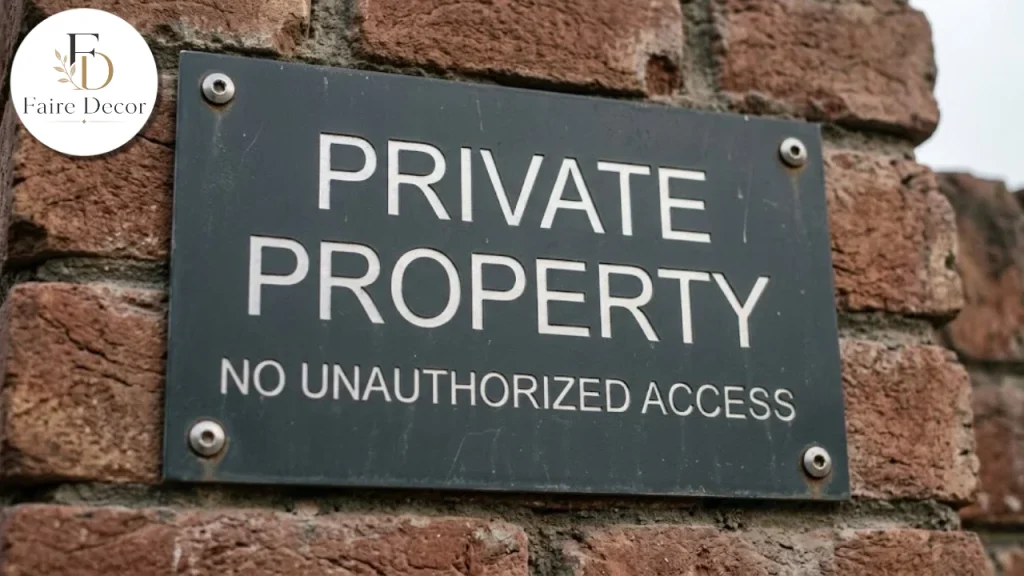
A trespassing sign is aimed at anyone who enters your property without permission. The Willamette Week column passes along an anecdotal suggestion that a “No Trespassing” sign can work better than a “No Soliciting” sign, because trespassing is actually against the law. It presents that as an anecdote, not legal advice.
The catch is that trespass law varies by state. In many places, a person may approach a front door that a visitor would normally use, unless notice has been given not to. The details are for your local law to say.
A practical approach is to choose the wording that matches your goal. If you only want to avoid sales and donation pitches, a solicitation sign is fitting. If you want to keep all uninvited people off your land, a trespassing notice sends a stronger message, but it also applies to neighbors and friends who drop by.
Whichever you use, keep the sign clear and visible. A notice nobody can see does not help anyone.
What Your Sign Should Say
Short beats clever. People glance at a sign for a second or two, so the message needs to land fast.
| Wording | Best for | Note |
|---|---|---|
| No Soliciting | Most homes | Clear and widely understood |
| No Soliciting or Peddling | Towns whose code uses “peddler” | Matches ordinance language |
| No Solicitors, No Canvassers | Blocking donation and survey requests | Broader reach |
| No Trespassing | Larger lots and rural property | Stronger notice, applies to everyone |
| Please Do Not Knock | Sleeping babies, night-shift workers | Politeness, not a legal notice |
If your ordinance names specific words, such as “solicitors” or “peddlers,” match them. A sign that mirrors the code is easier to point to later.
Humor is fine if you only want a smile and a retreat, but it carries less weight if you ever need to rely on the sign. A plain message is better where a local law may apply.
Add a short line for deliveries if you want them: “Packages welcome” or “Deliveries at side door.” This keeps the sign from blocking people you do want to see.
If your community has many languages, consider a bilingual sign. This is general design advice, not a legal requirement.
Where to Put It
Placement matters as much as wording. The sign should be seen before the person reaches your door.
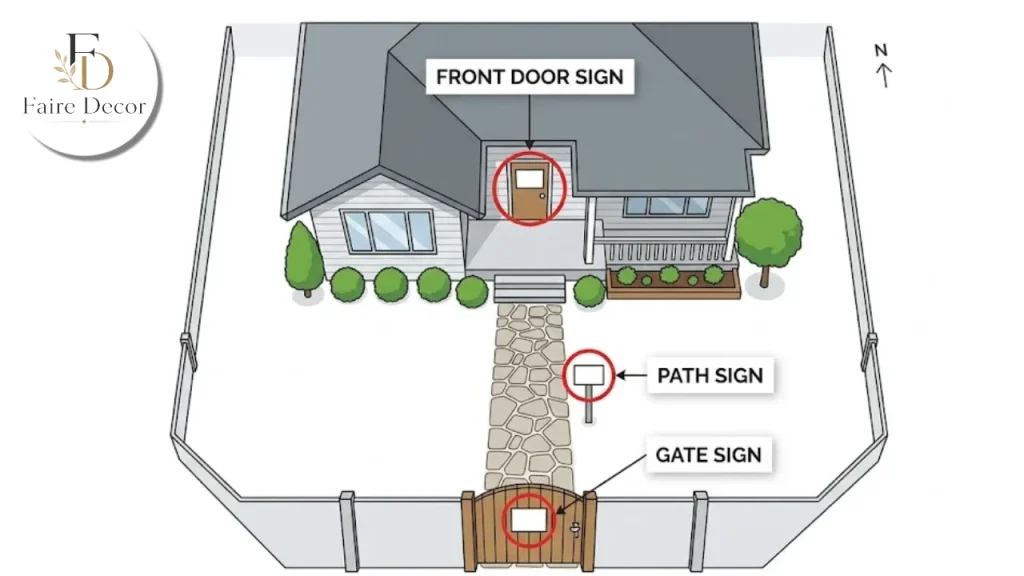
Put your no soliciting sign at eye level near the entrance path, not hidden behind a wreath or a plant. Roughly 5 feet from the ground is a common height, though that is a rule of thumb, not a sourced standard.
A sign on the front door itself works for most callers. For a gate, fence, or gravel path, mount a second one at the point where people first enter your property, so the notice comes before the knock.
Make sure it is well lit. A porch light or a small solar lamp makes the sign readable after dark, which is when many unwanted visits happen.
In an apartment, put the sign on your unit door and check with building management about the lobby or the intercom panel. A balcony railing can hold a sign too, but only if your lease allows it and it is not visible as a safety hazard.
Think about the whole approach, not just one spot. If you have a welcoming front porch, a sign mounted to a post or hung at the steps tells visitors where the invitation ends.
Check the sign every season. Sun fades ink, rain peels vinyl, and a sign that reads as a blur does not do its job.
Design: Making It Look Good, Not Like a Warning
Many homeowners resist a no soliciting sign because they think it looks harsh. It does not have to.
The easiest fix is material. A painted wood sign, a slim metal plate or an engraved plaque feels like part of the house. A flimsy plastic sheet taped to glass feels like an afterthought.
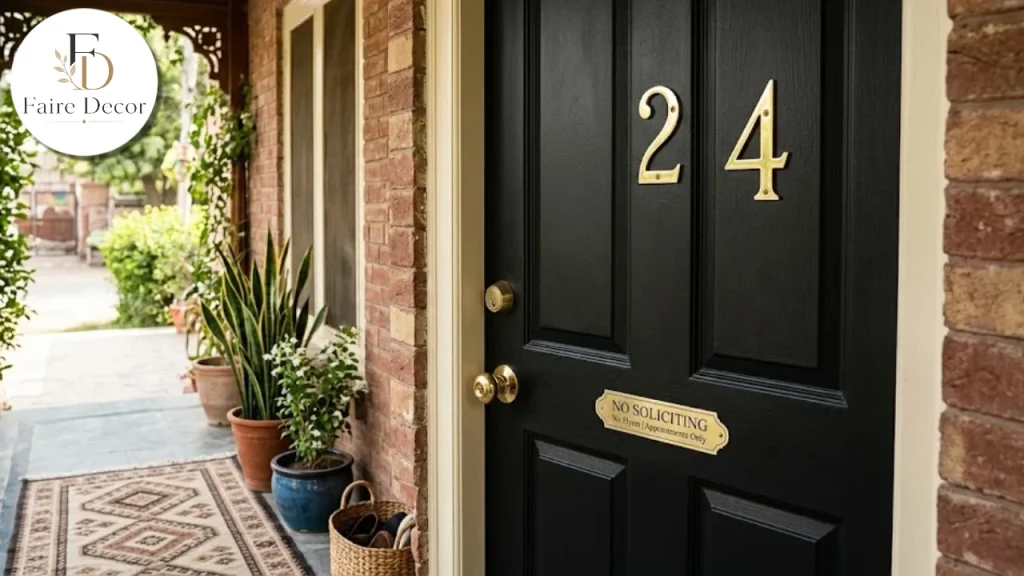
Match the finish to your hardware. If your door has black handles and a matte black house number, a black-and-white metal sign repeats the palette. Brass numbers pair well with a small brass-edged plaque.
Size is a balance between readable and discreet. Choose letters large enough to read from the walkway, then keep the border simple. This is a design judgement, not a rule.
Think about the whole entry. A front door and entryway already has a lot going on: a mat, a wreath, house numbers, lighting. The sign should sit within that composition, not fight it.
Contrast does the real work. Dark text on a light plate is the easiest to read in all weather. Low-contrast designs, like gray on beige, look elegant on a screen and disappear on a porch.
For ideas on blending small functional items into your overall style, look at these home decor ideas that actually work. The principle carries over: a useful object looks better when it matches the room it lives in.
Materials and Weatherproofing
An outdoor sign lives a hard life. It faces sun, rain, wind, and temperature swings, and the wrong material fails within a season. These are general observations rather than tested figures.
Aluminum and powder-coated metal resist rust and hold their color well. Painted or engraved wood looks warm but needs a sealer and a recoat every year or two. Plain vinyl stickers curl at the edges and fade fast in direct sun.
Acrylic and plastic plates are cheap, but some yellow or crack after long exposure. If you pick one, choose a product that says it is rated for outdoor use.
For mounting, use screws or hardware rated for the surface: masonry anchors for brick, wood screws for a post or door frame. Strong exterior mounting tape works on smooth surfaces and is the safer choice when you cannot drill.
Check the sign after storms and at the change of each season. A sign that has slipped, tilted,d or lost its lettering needs replacing.
Build a Layered System, Not Just a Sign
A sign is one layer. A few more make it work better.
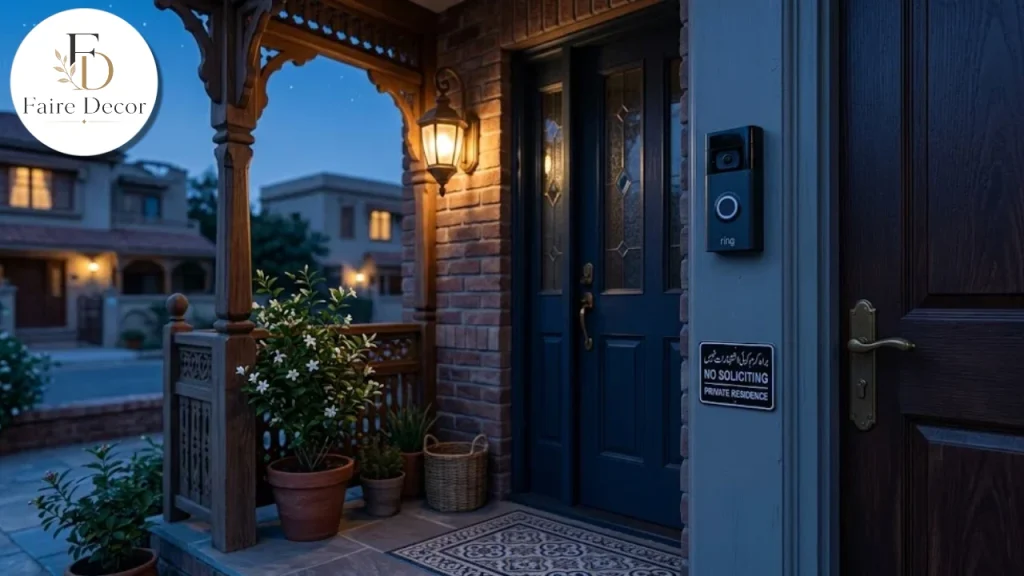
Doorbell cameras and video intercoms let you see who is there without opening the door. You can speak through the speaker, or simply not answer. This is general practice, and the right model depends on your budget and wiring.
If you are building out a smarter entry, these guides on smart home design and a smart home device overview can help you plan, though you should confirm any product details yourself.
A visible dog or a sign about one deters some callers. If you have pets, read these tips on keeping your yard looking good with dogs so the front of your house stays tidy and safe.
Good lighting helps too. A porch light on a timer or motion sensor makes the entrance feel watched, which is a deterrent in itself.
Finally, tell the people you live with the plan. A household that answers the door the same way every time is harder to pressure than one that does not agree.
Renters, HOAs and Apartments
If you rent, check your lease before you drill or glue anything. Many landlords allow a small door sign, and removable adhesive hooks or a hanging plate avoid damage. A no-soliciting sign in a rental is only as strong as the building’s own policy, so ask management whether they ban solicitors from the property.
In a homeowners association, look for rules on sign size, color, and placement. Some HOAs restrict anything visible from the street. A small sign on the door itself usually draws the fewest objections, though this varies by community.
In a condo or apartment building, the front entrance and lobby are common areas. Report repeat solicitors to management, because they can often remove the visitor, which a resident cannot do alone.
Whatever your housing, keep a copy of any rule that backs your sign. If a problem comes up, a clause in writing beats a memory.
The Federal Cooling-Off Rule
If someone does sell you something at your door, a federal rule gives you a way out. The Federal Trade Commission calls it the Cooling-Off Rule.
According to the FTC’s rule text (16 CFR Part 429), it covers door-to-door sales of $25 or more at your home, and $130 or more at other locations such as hotel rooms, convention centers,s or workplaces.
You may cancel until midnight of the third business day after the sale. Sundays and federal holidays do not count as business days.
The seller has to give you specific paperwork. That includes a complete receipt or contract in the same language as the sales pitch, stating your cancellation right in bold type, plus two copies of a Notice of Cancellation form. They must also tell you about the right out loud.
Once you cancel, the seller must refund your payments, return trade-ins,ns and release any security interest within 10 business days. They cannot transfer your debt to a third party before midnight of the fifth business day.
| Sale type | Covered by the rule? |
|---|---|
| Door-to-door sale at your home, $25 or more | Yes |
| Sale at a hotel, fairground or workplace, $130 or more | Yes |
| Emergency repair you requested, with a signed waiver | No |
| Repairs or maintenance you asked for (extra goods sold during the visit are different) | Mostly no |
| Real estate, insurance, certain securities | No |
| Sales by mail or phone only, with no earlier contact | No |
The table is summarized from the rule text. Read the full rule if you are relying on an exemption.
If you want to cancel, do it in writing, keep a copy, and send it by a method with proof of delivery. This is common consumer advice, not a quote from the rule.
The FTC’s own summary page also lists the rule and links to the full text, so you can check the current thresholds before you act.
Safety Habits That Matter More Than Any Sign
These habits are general practice. They are not a sourced standard, but they are widely recommended by consumer groups.
Do not open the door if you feel uneasy. You can talk through the door or a camera, and you do not owe anyone an explanation.
Ask for identification and a permit if your town requires one. A real seller will not mind. A fake one often leaves.
Never pay cash up front for work you did not request. Be careful with anyone who says an offer expires today or who pressures you to sign now. That pressure is the point of the pitch.
If a visitor claims to be from your utility, call the number on your bill, not a number they give you. Real workers have no problem with a verification call.
Do not let anyone inside to “just check” something. If you need an inspection, schedule it on your own terms with a company you chose.
Report suspicious visitors to the police non-emergency line, and tell your neighbors. Scammers often work a street at a time.
What to Say When Someone Knocks Anyway
Ignoring the knock is fine. But if you do answer, a short script saves time.
“No, thank you, I’m not interested” is enough. You do not have to explain, and every extra reason gives a salesperson something to argue with.
If they persist, say, “Please leave my property,” and close the door. If they do not leave, call the non-emergency line.
For charities, “We give through our own channels, thank you” is polite and final. For a pushy contractor, “I already have someone” works even if you are only planning to find one.
Keep your tone calm. A friendly, firm voice is hard to argue with, and it keeps the encounter safe.
If a Solicitor Ignores Your Sign
It will happen eventually. Some visitors do not read signs, and some choose not to.
Stay calm and keep the door closed or the chain on if you feel unsure. Say once, politely, that you are not interested and that you would like them to leave.
If they stay, note the time, what they looked like, any company name they gave, and a vehicle plate if you can see one. A short written note made right away is far more useful than a memory a week later.
Take a photo of your sign in place. If your town enforces solicitation rules, that photo shows the notice was visible.
Then call the police non-emergency line or your city’s code enforcement office, depending on how your town handles it. Call emergency services only if you feel threatened.
Do not argue, chase, or confront. A sign is a tool for avoiding conflict, not for starting one.
Common Mistakes
Putting the sign where nobody can see it, behind a plant or on the side of the door.
Assuming the sign is enforceable everywhere. Check your local code.
Using a faded or damaged sign. It signals that you might not care about enforcing it.
Skipping the doorbell camera or lighting and relying on a sign alone.
Letting a salesperson inside. A no soliciting sign does not protect you once you open the door.
Signing an agreement on the spot. Use the three-day right if you do.
Buying a sign that clashes with your entry. An ugly sign gets taken down, and a sign that is taken down protects no one.
Quick Answers
Is a no soliciting sign legally binding? Sometimes. In towns with a Green River-style ordinance, it can be, and in others it is only a polite request.
Does it stop scammers? No. Treat it as a first filter and use the safety habits above.
Can I cancel a door-to-door sale? Often yes. The FTC rule gives three business days for most sales of $25 or more at your home.
Where should I put it? At eye level near the entrance, with a second one at the gate or path if you have one.
Pick clear wording, mount it where people can see it, and pair it with a camera and good lighting. Together they do far more than the sign alone.
FAQs:
Is a no soliciting sign legally binding?
It depends on your town. Where a Green River-style ordinance lets residents opt out with a posted sign, ignoring it can be a violation. Elsewhere, it is only a polite request. Check your city or county code.
Do no soliciting signs work on scammers?
Not reliably. A determined scammer will ignore a sign, so pair it with a doorbell camera, good lighting and the habit of not opening the door to unexpected visitors.
Can I cancel something I bought at my door?
Often yes. The FTC Cooling-Off Rule lets you cancel most door-to-door sales of $25 or more made at your home until midnight of the third business day.
What is a Green River ordinance?
A local law that restricts door-to-door solicitation. The name comes from Green River, Wyoming, which passed the first one in 1931.
Should I use “No Soliciting” or “No Trespassing”?
A solicitation sign is enough if you only want to avoid sales and donation pitches. A trespassing notice is stronger and applies to everyone, including neighbors who drop by. Local law decides how each is treated.
Where is the best place to put the sign?
At eye level near the entrance, on the door, with a second sign at the gate or path if you have one. Keep it lit and readable.