

A swivel chair turns on a central post so you can rotate without moving the whole chair. It sounds like a small thing, but that turn changes how a room works. At a desk, it lets you reach a printer or a drawer without twisting your back. In a living room, it lets you face the TV, the window, or the conversation, whichever matters most at the time.
This guide covers where the swivel chair came from, the main types for home and office, what to look for in an ergonomic desk chair, how to style swivel accent chairs, and how to care for and fix one when something goes wrong.
What is a swivel chair?
Wikipedia defines a swivel chair as a chair with a single central leg that lets the seat rotate 360 degrees (Wikipedia: Swivel chair). You may also hear it called a revolving chair or a spinning chair.
Most swivel chairs share three basic parts:
The seat and back, which can be anything from a mesh office back to a plush barrel shape.
The swivel mechanism, a bearing or plate that lets the seat turn smoothly.
The base, which may be a star base with casters, a fixed pedestal, a round disc,c or a set of legs.
Some also include height adjustment, tilt, recline, or a glide that rocks gently back and forth.
A short history of the swivel chair
The idea is older than most people think.
Wikipedia describes a rotating chair with swivel casters illustrated in 1505 by Martin Löffelholz von Kolberg, a Nuremberg nobleman, in a manuscript known as the Codex Löffelholz.
The most famous early example belongs to Thomas Jefferson. According to Monticello, Jefferson’s revolving Windsor armchair was made around 1775 in Philadelphia by an unknown craftsman, probably to Jefferson’s own specifications (Monticello).
Monticello describes a comb-back Windsor with two round seats that rotate on a central iron spindle, using window sash pulleys as rollers. Jefferson brought the chair back to Monticello in 1776, and it is said to have been used “at Philadelphia while preparing the Declaration of Independence.”
The writing paddle on its arm was probably added later. The chair now belongs to the American Philosophical Society in Philadelphia, which has held it since the 1830s.
In the 19th and 20th centuries, swivel and tilt mechanisms became standard on office chairs. Wikipedia mentions the Conrades Manufacturing Company of St. Louis among the makers of desk chairs with swivel and tilt. The gas-lift height adjustment, casters,rs and ergonomic controls that most office chairs have today came later.

How a swivel mechanism works
The rotating part of a swivel chair is simpler than it looks.
Ball-bearing swivel plates are the most common in accent chairs. Two metal plates sit on a ring of small steel balls, so one plate turns smoothly over the other. The top plate bolts to the seat, and the bottom plate bolts to the base.
Gas-lift columns do double duty in office chairs. The column is a sealed cylinder with pressurized gas that lets you raise and lower the seat with a lever. The column also acts as the pivot, so the chair turns on it.
Glide mechanisms in swivel gliders sit between the swivel plate and the seat, letting the chair rock gently forward and back as well as rotate.
Return swivels are found in some bar stools and dining chairs. A spring mechanism turns the seat back to face forward when you stand up, which keeps a row of stools or a dining table looking tidy.
Main types of swivel chairs
Today there’s a swivel chair for almost every room. Here’s how the main types compare.
| Type | Base | Best for | Key features |
|---|---|---|---|
| Office or task chair | Five-star base with casters | Desks, home offices | Height adjustment, lumbar support, tilt |
| Executive chair | Five-star base with casters | Long desk sessions, formal offices | High back, padded arms, recline |
| Gaming chair | Five-star base with casters | Gaming setups, desks | High back, headrest, bold styling |
| Drafting chair | Tall base, often with foot ring | Standing-height counters and drawing tables | Extra height, foot support |
| Swivel accent chair | Round disc or pedestal | Living rooms, bedrooms, reading nooks | Upholstered, decorative, no wheels |
| Swivel barrel chair | Round or hidden base | Living rooms, conversation areas | Curved, enveloping back |
| Swivel glider or rocker | Glide mechanism | Nurseries, reading corners | Smooth rocking plus rotation |
| Swivel bar stool | Fixed pedestal or legs | Kitchen islands, home bars | Counter or bar height |
| Swivel dining chair | Pedestal or legs | Casual dining areas | Easy entry, conversation-friendly |
Wikipedia also lists swivel seats in cars, aircraft and stairlifts, and the classic barber chair, as members of the same family.
Swivel chairs for the office
If you’re buying a chair for work, comfort and support matter more than looks. The US Occupational Safety and Health Administration (OSHA) has a computer workstation guide with clear advice on chairs (OSHA).
What OSHA recommends
Backrest and lumbar support. OSHA advises a backrest with height-adjustable lumbar support that fits the curve of your lower back. It also suggests a recline of at least 15 degrees from vertical that you can lock or adjust for tension.
Seat height. Your feet should rest flat on the floor. OSHA says the height is right “when the entire sole of the foot can rest on the floor,” with the back of the knee slightly above the seat. If your desk forces the chair too high, use a footrest.
Seat depth. The seat should support most of your thigh without pressing into the back of your knee. A depth-adjustable seat pan helps different body sizes.
Seat width and padding. Choose a seat wide enough for your hips, with padding and a rounded “waterfall” front edge.
Armrests. They’re optional. If you use them, they should support your lower arms with your shoulders relaxed and upper arms close to your body. Armrests that are too high, too low,w or too wide can strain your neck and shoulders.
Base and casters. OSHA recommends a strong five-leg bae, because chairs with four or fewer legs are more likely to tip. Choose casters that suit your floor.
Office chair checklist
| Feature | Why it matters |
|---|---|
| Gas-lift height adjustment | Lets feet rest flat and arms sit level with the desk |
| Adjustable lumbar support | Supports the natural curve of the lower back |
| Tilt and recline with lock | Allows posture changes through the day |
| Adjustable seat depth | Fits shorter and taller users |
| Adjustable or removable armrests | Prevents shoulder and neck strain |
| Five-point base | Stability and tip resistance |
| Breathable material | Comfort during long sessions |
| Smooth 360-degree swivel | Reach without twisting your spine |
Setting up your swivel office chair
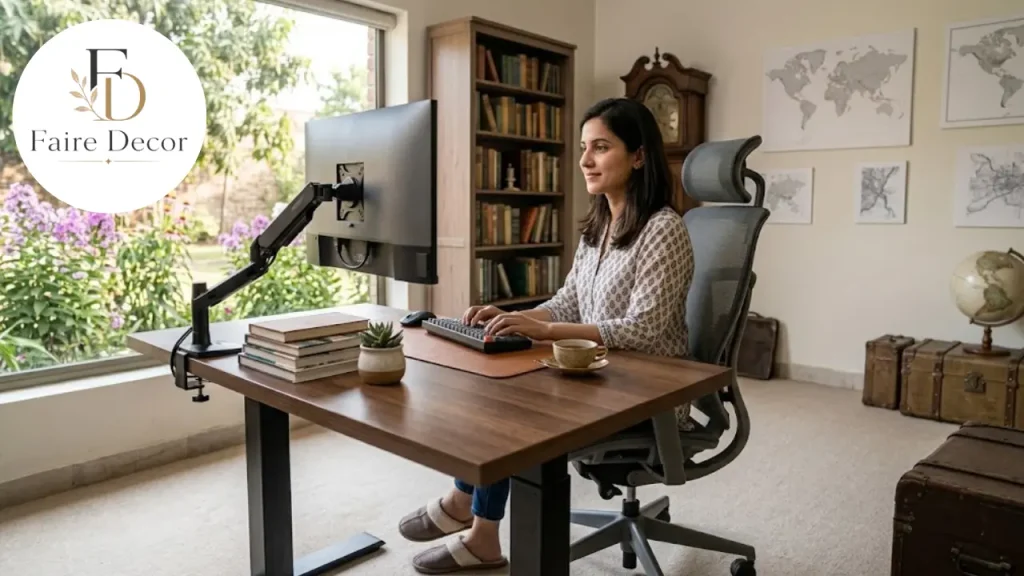
Adjust the height first. Sit with feet flat and thighs roughly parallel to the floor.
Set the lumbar support so it sits in the curve of your lower back.
Check seat depth. Leave a small gap between the seat edge and the back of your knees.
Adjust armrests so your shoulders stay relaxed.
Position the desk and screen. OSHA notes that a chair should be adjusted together with the keyboard, monitor, and desk, not on its own.
Use the swivel. Turn your whole body to reach things instead of twisting at the waist.
Home office tips
A home office often has to share space with other uses. A compact task chair with a small footprint works well in a corner or a bedroom, and a chair in a calm, neutral colour blends into living spaces more easily.
If you’re setting up a desk in a student room, our dorm room ideas for guys include small-space layouts where a compact swivel chair earns its place.
Swivel chairs for the living room
The swivel accent chair is one of the most popular pieces in modern living rooms, and for good reason.
Why choose a swivel accent chair?
- Flexibility. Turn toward the TV, the fireplace, a window view, or the person you’re talking to.
- Open-plan friendly. In a room that combines living, dining, and kitchen areas, a swivel chair can face whichever zone is in use.
- Easy in and out. Rotating makes it easier to get up, especially in tight spaces.
- Style. Curved swivel chairs soften the straight lines of sofas and coffee tables.
Popular styles
Barrel swivel chairs have a rounded back that wraps around you. They’re cosy and work well in pairs.
Club swivel chairs are deep and comfortable, often with a low, generous back.
Swivel gliders and rockers combine rotation with a gentle rocking motion. They’re popular in nurseries and reading corners.
Mid-century swivel chairs feature tapered shapes, wooden details and often a matching ottoman.
Bouclé and textured swivel chairs add softness and texture, and they suit modern, Scandinavian, and organic interiors.
Choosing the right size
Measure before you buy. Check:
- The width and depth of the chair, including the space it needs to rotate without hitting a wall, table, or other furniture
- The seat height compared with your sofa, so the room looks balanced
- Doorways and stairs, so the chair will fit through when it’s delivered
Leave enough clearance around the chair to turn freely. If it bumps a side table every time it rotates, the swivel loses its point.

Styling a swivel chair in your home
A swivel chair can be a quiet supporting piece or the star of the room. Here’s how to make it work in different styles.
Modern eclectic. Mix a bold-coloured or patterned swivel chair with vintage finds and art. Our guide to modern eclectic interior design shows how to balance contrasting pieces.
Earthy and natural. Choose a swivel chair in rust, olive, sand or caramel, in a textured fabric like bouclé, linen or leather. Pair it with wood, plants,s and woven textiles. Our earthy bedroom ideas show how this palette creates a calm space, and a swivel reading chair fits right in.
Coastal. Light linen or performance fabric in white, sand, or soft blue keeps the look airy. A swivel chair near a window lets you turn toward the view.
Japanese-inspired and minimal. A low, simple swivel chair in natural tones suits calm, uncluttered rooms. See our Japanese bedroom guide for ideas on low furniture and quiet colour.
Traditional. A tufted or wingback-style swivel chair blends classic shapes with modern function.
Colour and fabric tips
- Neutral fabrics (cream, grey, taupe) are easy to place and to move between rooms.
- Bold colours (emerald, mustard, terracotta) make a swivel chair a focal point.
- Performance fabrics resist stains and suit homes with children or pets.
- Leather and faux leather wipe clean and age well, but can feel cool in winter.
Not sure what works with your walls? Our home color combinations guide can help you choose.
Swivel chairs for small spaces
In a compact flat, dorm room, or studio, every piece of furniture has to work hard. A swivel chair does exactly that.
One chair, two jobs. Place a swivel chair between a desk and a seating area. Turn one way to work and the other way to relax or chat.
Choose a small footprint. Look for armless designs or slim arms, a compact round base, and a seat no wider than you need.
Go visually light. Open frames, slim metal bases,s and light fabrics make a chair feel less bulky.
Use corners. A swivel chair in a corner can face into the room without needing extra space to turn.
Pick multi-use pieces. Some swivel ottomans and small swivel stools can serve as extra seating, footrests,ts or side tables.
Measure the turning circle before you buy. In a small room, even a few centimetres of clearance makes a difference.
Swivel chairs in other rooms
Bedrooms. A swivel chair in a corner creates a reading nook or a spot to put on shoes. It can also double as a desk chair.
Nurseries. A swivel glider makes feeding and settling a baby easier, because you can rock and turn without getting up. Choose one with a locking feature if you want it to stay still.
Kitchens. Swivel bar stools at an island let people turn to chat without dragging the stool across the floor.
Home bar and game rooms. Swivel stools and club chairs make it easy to turn between a table and the conversation.
Dining rooms. Swivel dining chairs suit casual dining spaces and make it easy to get in and out at the table.
Swivel chairs for older adults and limited mobility
For people with stiff hips, knees,es or backs, a swivel seat can make sitting down and standing up easier, because you can turn your body without twisting. That’s why swivel seats appear in cars and stairlifts as well as homes.
When choosing a swivel chair for an older adult or someone with limited mobility:
Avoid casters on chairs used for resting. A chair that rolls away when someone sits can cause falls.
Look for locking swivels that keep the chair still when needed.
Choose firm, supportive cushions at a comfortable seat height, so getting up takes less effort.
Pick sturdy arms that help with pushing up to stand.
Ask a professional. An occupational therapist can recommend seating for specific needs.
Office swivel chair vs swivel accent chair
| Feature | Office swivel chair | Swivel accent chair |
|---|---|---|
| Main purpose | Working at a desk | Relaxing, conversation, style |
| Base | Five-star base with casters | Disc, pedestal or hidden base; usually no wheels |
| Adjustability | Height, tilt, lumbar, arms | Usually none, sometimes glide or rock |
| Upholstery | Mesh, fabric or leather | Decorative fabrics, bouclé, velvet, leather |
| Ergonomic focus | High | Comfort-focused rather than posture-focused |
| Best rooms | Office, study, bedroom desk | Living room, bedroom, nursery |
Can a swivel accent chair work at a desk? For short tasks, yes. For full working days, a properly adjustable office chair is the better choice.
Protecting your floors
Wheels and swivel bases can mark floors over time, especially hardwood.
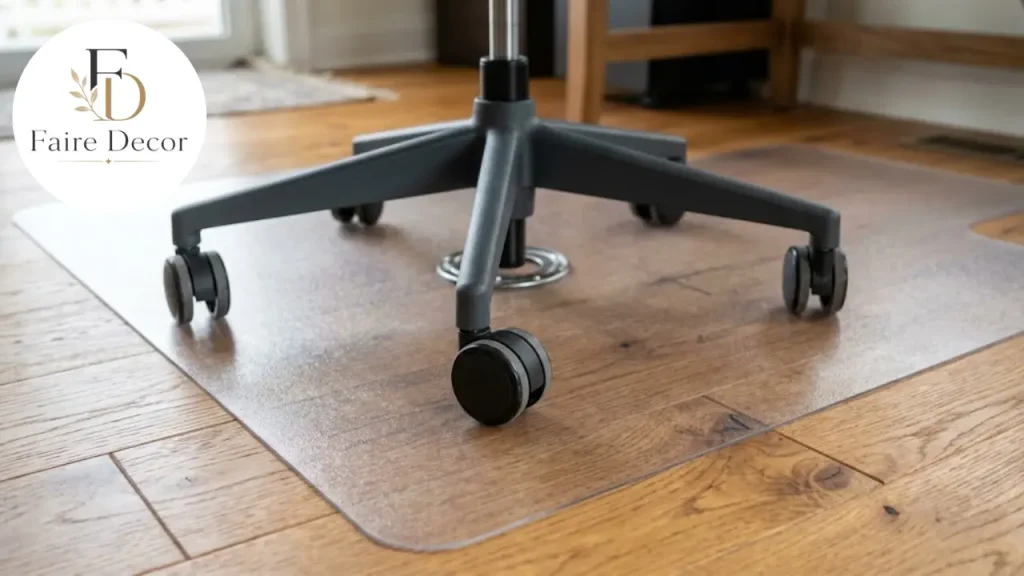
Use a chair mat under office chairs on hardwood, laminate, or carpet. Choose a clear or low-profile mat for hard floors.
Pick the right casters. Softer rubber or polyurethane casters suit hard floors, while harder casters roll better on carpet. OSHA also advises matching casters to the floor surface.
Add felt pads under fixed bases and the feet of accent chairs.
Clean regularly. Grit trapped under casters can scratch. Our guide on how to clean hardwood floors covers safe routines.
How to care for a swivel chair
A little care keeps a swivel chair turning smoothly for years.
Upholstery. Vacuum fabric regularly with an upholstery attachment. Treat spills quickly, and follow the manufacturer’s cleaning code (often marked W for water-based cleaners, S for solvent, WS for either, or X for vacuum only).
Leather. Wipe with a damp cloth and condition occasionally with a product meant for leather.
Mesh. Vacuum or wipe with a mild soap solution.
Casters. Pull out hair and fluff that wraps around the wheels. Most casters pop out for cleaning.
Swivel mechanism. Tighten loose bolts under the seat every few months. If the swivel squeaks, check the manufacturer’s instructions before adding a suitable lubricant to the right point.
Base. Wipe metal and wood bases with a damp cloth and dry them.
Troubleshooting common swivel chair problems
| Problem | Likely cause | What to try |
|---|---|---|
| Chair slowly sinks | Worn gas cylinder | Replace the gas cylinder or the chair; follow the maker’s guidance |
| Squeaking | Loose bolts or dry mechanism | Tighten bolts; lubricate as the maker advises |
| Wobbling | Loose base or seat plate | Tighten fittings; check for cracks |
| Stiff swivel | Debris or worn bearing | Clean around the mechanism; contact the maker if worn |
| Casters not rolling | Hair and debris, wrong caster type | Clean casters; switch to floor-appropriate casters |
| Leaning to one side | Bent base or damaged mechanism | Inspect and replace damaged parts |
A safety note: gas cylinders are pressurized parts. If one fails, replace it with a compatible part following the manufacturer’s instructions, or get professional help. Don’t try to take a cylinder apart. If a chair base or mechanism is cracked, stop using it.
Buying tips for any swivel chair
Sit before you buy if you can. OSHA recommends testing chairs before purchase.
Check the weight capacity against the people who will use it.
Look for quality standards. Office chairs tested to recognized standards, such as BIFMA in North America or EN 1335 in Europe, have been checked for durability and safety.
Read the warranty, especially for gas lifts and mechanisms.
Check the swivel. It should turn smoothly and quietly, without grinding or wobbling.
Think about the floor. Choose casters or bases that won’t damage your flooring.
Consider who’ll use it. Shared chairs need more adjustability.
Plan for children. A spinning chair can be a toy. Teach kids not to stand on it, especially chairs with casters.
Common myths about swivel chairs
“Swivel chairs are only for offices.” Not anymore. Swivel accent chairs, gliders,s and bar stools are now common in living rooms, bedrooms, and kitchens.
“An expensive chair is automatically ergonomic.” Price doesn’t guarantee fit. A chair is only ergonomic if it adjusts to your body and your desk.
“Armrests are always necessary.” OSHA treats them as optional. Poorly adjusted armrests can do more harm than good.
“Spinning chairs wear out quickly.” A well-made swivel mechanism should last for years with basic care.
FAQs:
What is a swivel chair?
A chair with a central post or mechanism that lets the seat rotate 360 degrees. Types include office chairs, swivel accent chairs, barrel chairs, gliders, and bar stools.
Who invented the swivel chair?
Rotating chairs appear in a 1505 illustration from Nuremberg. Thomas Jefferson’s revolving Windsor armchair, made around 1775 in Philadelphia, is the most famous early example.
Are swivel chairs good for your back?
An adjustable office swivel chair with good lumbar support, correct seat height,t and seat depth can support healthy posture. Swiveling also lets you turn your whole body instead of twisting your spine.
How high should my office chair be?
OSHA says the height is right when the entire sole of your foot rests on the floor, with the back of the knee slightly above the seat. Use a footrest if the desk forces the chair higher.
Are swivel chairs good for living rooms?
Yes. Swivel accent and barrel chairs let you face the TV, a view,ew or the conversation, and they work especially well in open-plan spaces.
Why does my swivel chair keep sinking?
Usually the gas-lift cylinder is worn. Replace it with a compatible part following the manufacturer’s instructions, or replace the chair.
How do I stop a swivel chair from squeaking?
Tighten the bolts under the seat and check the mechanism. If it still squeaks, lubricate it as the manufacturer recommends.
Will a swivel office chair damage hardwood floors?
It can over time. Use a chair mat and soft casters made for hard floors, and keep the floor free of grit.