

Most Texas homeowners never think about termites until a winged swarm shows up on a windowsill or a contractor taps a baseboard and it sounds hollow.
By then, the damage may have been building for a long time. Texas is a warm, humid state with plenty of wood-framed housing, and that combination suits the insects very well.
This guide covers the main species, when and where they swarm, what an infestation looks like, how to make your home a harder target, and what to ask before you hire anyone. Termites in Texas are a statewide issue, but the details change by region, so I note where sources disagree. Every figure is attributed.
How big is the problem?
Texas A&M AgriLife Extension publication E-368, written by Roger Gold, Kimberly Schofield, Elizabeth Brown,n and Molly Keck, says subterranean termites cause about $500 million in damage in Texas each year.
It also says unprotected homes have about a 70 percent probability of termite damage within 25 years. The publication does not state a date, so treat those as the authors’ figures rather than a current measurement.
The same publication notes that populations are concentrated in coastal areas, though several problem species are moving north. It adds that infested landscaping timbers and retaining walls can spread them. That is one reason a yard project can matter for the house next to it.
If you are comparing risk across the state, the practical takeaway is simple. Termites in Texas are present nearly everywhere, but coastal and eastern areas generally see the heaviest pressure, according to Texas A&M’s field guide.
The three kinds of termites you may meet
Texas A&M’s field guide to common insects, last modified October 8, 2018, lists three groups: drywood, subterranean, and Formosan. They behave differently, show different signs,gns and need different treatments, so identification matters.
Native subterranean termites
These live in soil and build mud tubes to reach wood. The field guide names two species, Reticulitermes virginicus and R. hageni, while AgriLife publication E-368 names Reticulitermes flavipes as the main native species. Together,ther they occur throughout Texas and are more prevalent in coastal regions.
Colony size depends on the source. The field guide says mature subterranean colonies reach 21,000 to 365,000 termites in 2 to 4 years. E-368 says colonies mature in 3 to 5 years, often with about 250,000 workers. Both can be true for different species and conditions, but the numbers do not match, so I show both.
E-368 adds that termites need moisture. They can stray from the soil for long periods if other moisture sources, such as leaks, are available.
Formosan subterranean termites
The Formosan termite is a larger, more aggressive subterranean species. A Texas A&M Urban and Structural Entomology page, last modified May 17, 2022, says the first Texas infestations were found in 1956 near the Houston Ship Channel in Pasadena, Harris County.
It says the termites likely arrived in shoring timbers from the Far East and that reused timbers and railroad ties are the main way they spread within Texas.
The page says a typical colony may exceed 1 million insects. It also says Formosan colonies attack more wood, and attack it faster, than native colonies. They often build aerial nests above ground inside structures, and they eat some non-cellulose materials, including soft metals, plastics, and rubber.
Where they live is another place sources differ. The same page says infestations have been reported in all the major Texas metro areas, while the field guide says they are found mainly in the greater Houston-Galveston and Beaumont-Port Arthur areas.
The page also says they have been detected in 31 counties but lists 32 names. If you live outside southeast Texas, ask a licensed inspector what is actually documented near you.
Drywood termites
Drywood termites do not need contact with soil. According to Texas A&M, they live in sound, dry wood above ground and get moisture from the wood they digest. In structures,ures they tend to nest under wooden roof shingles, eaves, or siding.
The Urban Entomology page says they are found throughout Texas, with the greatest concentrations on the Gulf Coast.
The field guide describes coastal counties with spot infestations in Uvalde and San Antonio and northward to Collin County. It also says drywood infestations need a different and more costly treatment approach than subterranean termites.
| Type | Where Texas A&M says they occur | Nest | Tell-tale sign |
|---|---|---|---|
| Native subterranean | Throughout Texas, more prevalent on the coast | Soil | Mud tubes; soil in galleries |
| Formosan | Mainly Houston-Galveston and Beaumont-Port Arthur per the field guide; other pages say all major metros | Soil, plus aerial nests in structures | Large swarms at night; no fecal pellets |
| Drywood | Statewide, heaviest on the Gulf Coast | Dry wood above ground | Tiny fecal pellets, about 1/32 inch |
When and where termites swarm
Swarmers are the winged reproductives that leave the colony to start new ones. Seeing them is often the first alarm, but timing varies by species and region.
E-368 says swarming starts in January or February in South Texas and in April or May in the Panhandle, triggered by heat, day length, and moisture. The field guide says subterranean termites swarm in spring, usually after rain, and drywood termites swarm in late summer and early fall.
The Formosan page says winged reproductives swarm at night, in late May and early June, and are drawn to lights.
An Austin-area guide gives local detail: subterranean swarms typically appear in February and March, and Formosan swarms in May, in the evening.
The guide does not name its publisher or date, so I treat it as a local example rather than a rule. All of this points the same way: if you see wings outside your season, do not assume they are harmless.
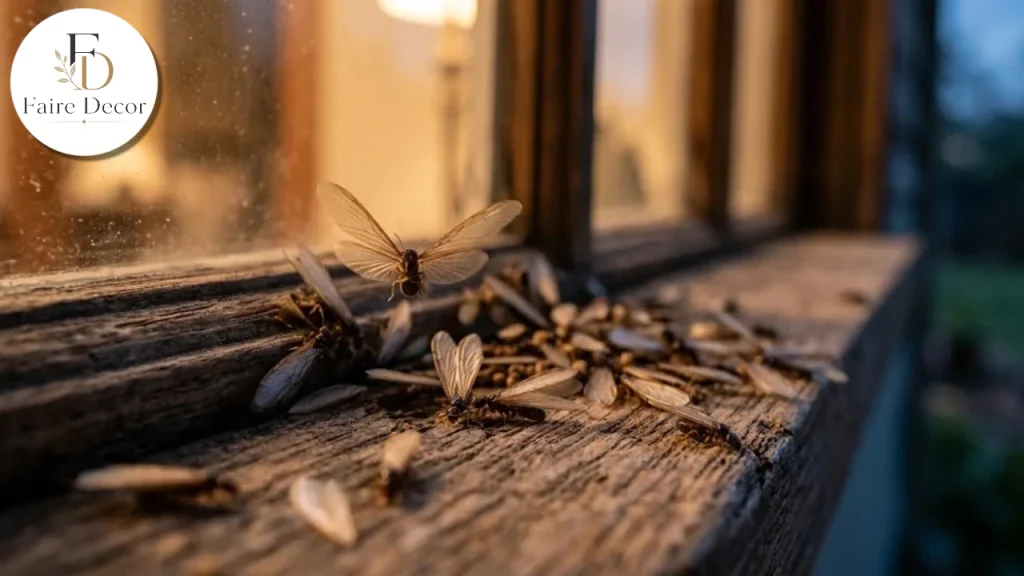
Termite or flying ant?
People often confuse swarmers with winged ants. E-368 gives a clear comparison. Termite swarmers have two pairs of wings of the same size and shape, a broad middle body, and straight antennae. Ants have elbowed antennae, a very narrow waist , and unequal wings.
The same publication puts swarmers at about 3/8 inch long. If you can catch one in a jar, a magnifying glass is enough to check the wings and waist. A photo sent to a licensed professional or your county extension office can settle it quickly.
Swarmers indoors usually indicate an active infestation, according to E-368. Swarmers outdoors may mean a nearby colony instead. Either way, collect a few for identification.
Signs of an infestation
Termites work out of sight, so you are looking for secondary evidence. E-368 lists the main signs.
Swarmers or discarded wings on windowsills, in spider web , or near lights.
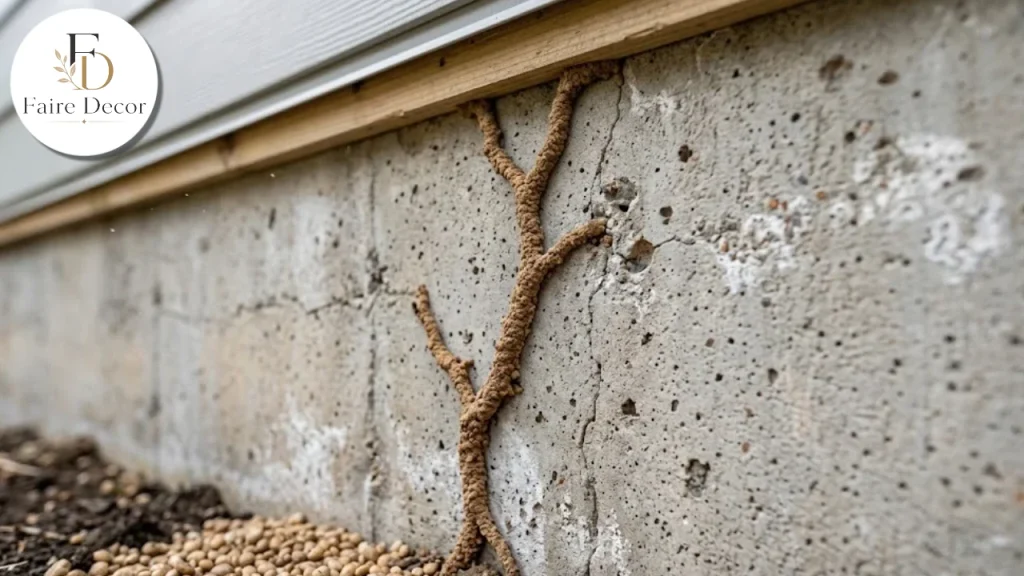
Mud shelter tubes on foundations, piers and utility openings. Breaking one open can reveal live termites.
Damaged wood. Tapping gives a dull, thudding sound, and damage follows the grain and is often lined with mud.
E-368 also says the age of the damage is virtually impossible to determine. That matters if you are buying a house or arguing about who should pay.
For drywood termites, look for fecal pellets instead. The Texas A&M drywood page says piles of pellets appear near infested wood, are about 1/32 inch long, and usually match the color of the wood being eaten.
The field guide says drywood pellets are expelled through small “kick” holes. Subterranean termites leave soil in their galleries, and Formosan termites leave no fecal pellets, which helps tell them apart.
Check the places termites like
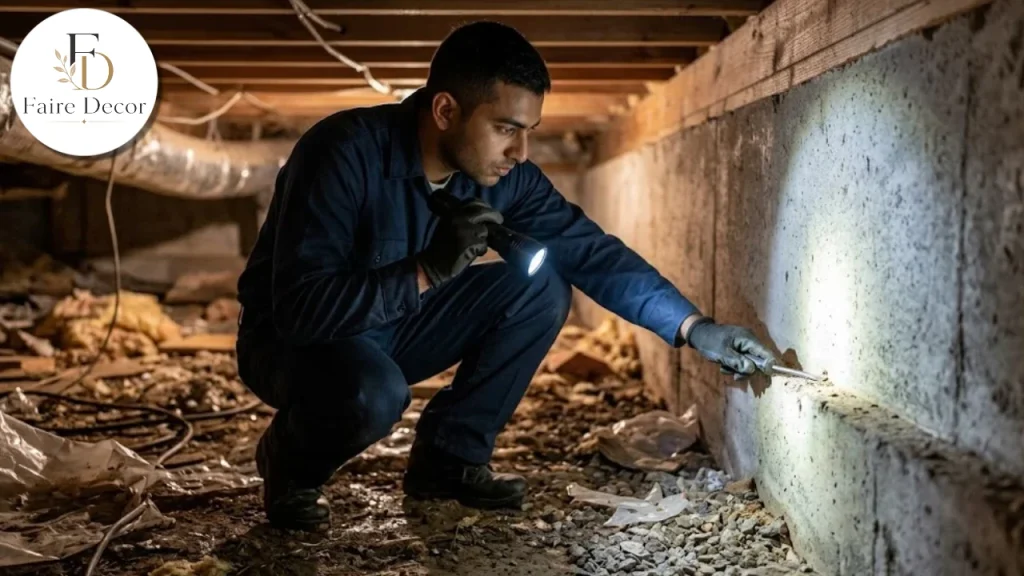
A quarterly look for termites in Texas is a reasonable habit. The Austin-area guide suggests checking the foundation regularly, such as quarterly, for mud tubes, and looking for termites near windowsills or indoor lights.
Start with these spots:
- Foundation perimeter and any piers, for mud tubes.
- Crawl space, if you have one, for moisture and tubes.
- Garage and utility openings where pipes pass through walls.
- Wood fences, ,tair posts, and trellises touching soil.
- Eaves and roofline, where leaks and rot can start.
- Attic, where moisture and wood meet.
If water is the underlying cause, fix that first. Our guide to roof leaks shows how small leaks travel through framing, and our attic insulation post explains why trapped moisture in that space is worth taking seriously. For an upstairs conversion, see our attic window renovation article.
Why moisture is the common thread
Every species leans on moisture, though in different ways. E-368 says termites need it. The Austin-area guide names soil, le,aky plumbing, and AC condensers as sources, and advises checking roof eaves and gutters for leaks and wood rot.
That makes drainage a termite issue, not just a landscaping one. If you are weighing gutter work, our gutter installation cost calculator post covers an upgrade that moves water away from the foundation.
The Austin-area guide also recommends sealing and caulking foundation openings for plumbing and utilities, and grading soil to slope away from the house. Those are cheap steps compared with a repair bill.
General information only, not pest-control or legal advice. Confirm speci,es, treatment and licensing with a licensed Texas professional.
Prevention: what you can control
Prevention is mostly about removing easy paths and easy food. E-368 lists these steps.
Eliminate wood-to-soil contact, such as fence posts, stair carriages and trellises. Set these on masonry blocks or use pressure-treated wood.
Keep soil at least 6 to 8 inches below the top of the foundation or wall covering.
Cover at least 70 percent of crawl space soil with a 6-mil polyethylene barrier, and provide 1 square foot of vent area per 150 square feet of crawl space.
Grade soil to slope away from the structure and avoid dense shrubbery against the house.
The Austin-area guide adds a few more: keep stacked wood and debris away from the foundation, and before pouring a new foundation, remove form stakes, wood scraps, and stumps. For new construction, it says stainless steel or polyethylene barriers are an option that can provide excellent termite protection.
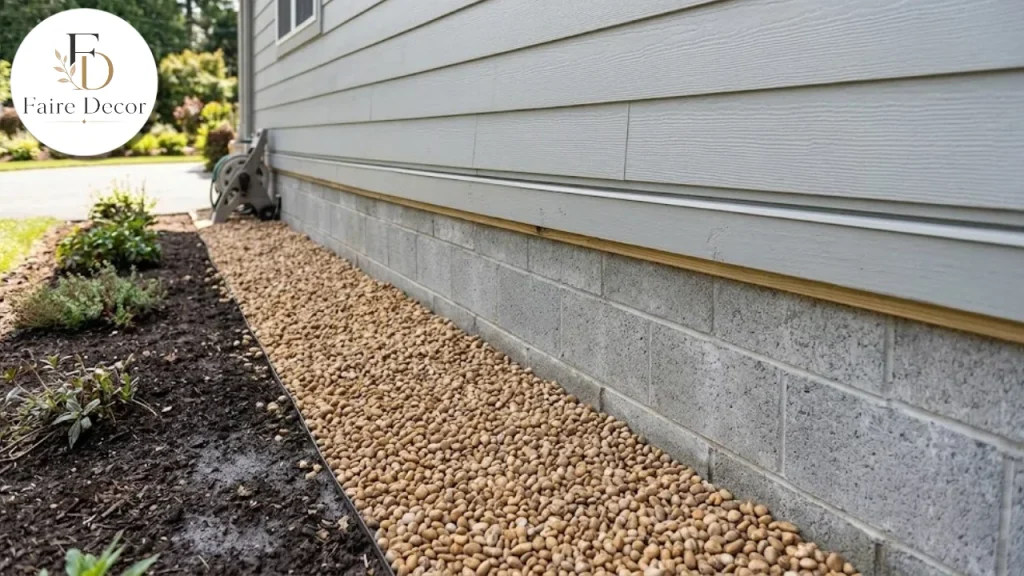
Yard and landscaping choices
Your yard sits right at the point where termites reach the house. E-368 says infested landscaping timbers and retaining walls can spread termites, and the Formosan pag.
warns that creosote treatment by itself is not a guarantee against Formosan termites because it often does not reach the timber core. It adds that timbers should be properly fumigated.
In practice, that means being picky about used railroad ties and landscape timbers, and keeping wood mulch from piling against siding. I did not find a Texas source that sets a mulch depth, so I am not quoting one.
For ideas that keep planting beds and foundations on good terms, our low-maintenance backyard guide is a good start, and our post on keeping a yard looking good with dogs covers layouts that do not rely on heavy wood borders.
Outdoor structures count too. If you are planning a deck, our guide to choosing a deck company lists questions to ask, and wood-to-soil contact belongs on that list. The same goes for a carport or a front porch, where posts and steps often meet the ground.
Treatment options, in plain English
E-368 summarizes the main choices for subterranean termites, which are the most common of the termites in Texas. Your inspector may recommend more than one.
| Option | What E-368 says | Trade-off |
|---|---|---|
| Liquid termiticides | The primary product for most homes; “lethal termiticides provide approximately 5 years of protection.” | Needs soil access and proper application. |
| Foam | Used in wall voids, under slabs and in soil-filled porches where liquids may not reach. | Targeted rather than whole-house. |
| Borates | Penetrate wood but may not protect the lumber core; work best combined with other treatments. | Partial protection alone. |
| Baits | Useful when soil is inaccessible; control can take months to over a year. | “Baits provide no residual protection for a structure.” |
| Pre-construction treatment | Treating all soil under the slab before pouring, at the full label rate, offers the best protection. | Only possible during new construction. |
The Austin-area guide mentions that non-repellent termiticides (fipronil, imidacloprid, and chlorfenapyr) are said to work well on subterranean termites, including in heavy clay and alkaline soils.
It also says borate solution is the least toxic option but gives only partial protection and needs a sealer coat, and that beneficial nematodes have not proven effective in structures.
Drywood termites are a different problem. The field guide says they need a different and more costly approach than subterranean termites. I did not open a Texas source that describes drywood treatment in detail, so ask your licensed inspector which method fits your home.
If anyone will be home during an application, the Austin-area guide says children and pregnant women should leave during application and stay out until the home has aired for 1 to 2 hours. Ask your provider for the product label and its re-entry instructions for your situation.
Hiring a termite company in Texas
Treating termites in Texas for hire is regulated. The Texas Department of Agriculture says the Structural Pest Control Act requires licensing of businesses and individuals that perform structural pest control for hire.
Licensed activities for compensation include identifying infestations, making inspection reports,s and submitting estimates or bids.
The department lists termite control as its own category, described as inspection and control of termites, beetles,es or other wood-destroying organisms by means other than fumigation.
Fumigation falls under a separate category. The page also distinguishes commercial applicators, who work for a business, from noncommercial applicators.
The page does not describe a license lookup tool, so ask the company for license numbers and confirm with the Texas Department of Agriculture. Then use this checklist.
Ask for the termite control license and the technician’s credentials.
Get at least three written inspections and estimates.
Ask which species they found and how they identified it.
Request the treatment method, product, and label in writing.
Ask what the warranty covers, who services it,t and what voids it.
Watch for pressure tactics, such as claims that a deal expires today.
On warranties, the Austin-area guide says annual warranties should not exceed 20 percent of the original treatment cost. It is a guide from an unnamed publisher, so use it as a negotiating reference, not a rule.
If you also renovate, our renovation tips guide helps you sequence repairs so you do not cover up damage you have not inspected.
Buying or selling: the WDI report
Home sales in Texas often involve a wood-destroying insect report. A Spectora article, updated June 4, 2026, says a WDI report is an inspection focused on wood-damaging insects.
mainly termites, but also carpenter ants and powder post beetles. It covers active infestation, past activity and conditions that favor infestation, such as moisture and wood-to-soil contact.
Spectora sells inspection report software, so its content is commercial. It says VA loans typically require a WDI report in states like Texas, and some FHA and conventional lenders request one case by case.
It also says a TREC home inspector license does not, on its own, authorize WDI inspections in Texas, and that they must be performed by a licensed person regulated by the Texas Department of Agriculture.
I did not find a sourced validity period or typical fee, so I am not printing one. Ask your lender, agent and licensed inspector what applies to your sale.
If you are preparing to sell, our guide on how to sell your home fast covers other steps buyers notice. An open, documented termite history is generally easier to defend than a surprise discovered late.
Damage that is not only termites
Wood problems have several causes, and termites are not always the culprit. Moisture can rot framing with no insects involved, and other wood-destroying insects exist. The Spectora article names carpenter ants and powderpost beetles alongside termites in a WDI report.
That is why an inspection beats a guess. A licensed professional can tell you whether you have an active infestation, old activity, or only conditions that invite one. E-368 warns that the age of the damage is virtually impossible to determine, so ask what evidence supports the finding.
For floors, our best flooring guide and our tips on cleaning hardwood floors safely are worth a read once the structure is sound. Sagging or soft spots in a wood floor should be inspected before you refinish anything.
Mistakes to avoid
Most costly problems with termites in Texas come from a short list of avoidable errors.
Ignoring wings. Swarmers indoors usually indicate an active infestation, per E-368.
Assuming it is ants. Check wings, waist, and antennae.
Treating the symptom only. Fix moisture sources and wood-to-soil contact too.
Using baits as protection. E-368 says baits provide no residual protection for a structure.
Relying on borates alone. They may not protect the lumber core.
Buying reused timbers. Used railroad ties and landscape timbers can carry termites.
Hiring an unlicensed company. Termite work for hire requires a license.
Skipping the warranty details. Know what it covers and who services it.
Waiting. Damage grows quietly while you decide.
A seasonal checklist
Use this as a simple routine.
Winter and early spring: inspect the foundation, since swarming begins in January or February in South Texas per E-368.
Spring: check windowsills and lights after rain, when subterranean swarms are common.
Late May and June: watch for evening swarms near lights that may be Formosan, in areas where they are present.
Late summer and fall: look for drywood pellets and kick holes.
Every quarter: walk the foundation and check for tubes.
After any leak: dry it, repair it,t and re-inspect the area.
Final thoughts on termites in Texas
The most useful things you can do about termites in Texas are unglamorous. Keep wood off the soil, keep water moving away from the house, look for evidence on a schedu,le and hire a licensed professional to confirm what you find. None of that is exciting, but all of it is cheaper than repairs.
Remember that species, region,ion and season change the details. A Houston homeowner and a Panhandle homeowner face different timelines. Use the sources above as a map, then get a local licensed inspection before you spend money on treatment.
This article is general information, not pest-control, legal,egal or real estate advice. Confirm requirements and treatment plans with a licensed Texas professional and the Texas Department of Agriculture.
FAQs:
Are termites common in Texas?
According to Texas A&M AgriLife publication E-368, subterranean termites cause about $500 million in damage in Texas each year, and unprotected homes have about a 70 percent probability of damage within 25 years. The publication carries no date.
What kinds of termites live in Texas?
Texas A&M lists drywood, subterranean,anean and Formosan termites. Subterranean termites occur throughout the state and are more prevalent on the coast. The field guide says Formosan termites are found mainly in the Houston-Galveston and Beaumont-Port Arthur areas, while another Texas A&M page says they have been reported in all major metros.
When do termites swarm in Texas?
Timing varies. E-368 says swarming starts in January or February in South Texas and April or May in the Panhandle. The field guide says subterranean termites swarm in spring after rain and drywood termites in late summer and early fall. Formosan termites swarm at night in late May and early June.
How can I tell termites from flying ants?
Termite swarmers have two pairs of equal wings, a broad middle ,and straight antennae. Ants have elbowed antennae, a very narrow waist, and unequal wings, according to E-368.
Do I need a licensed company to treat termites?
The Texas Department of Agriculture says licensing is required for businesses and individuals that perform structural pest control for hire, and it lists termite control as its own license category.
Does a home sale in Texas need a termite report?
Spectora, a commercial inspection-software company, says VA loans typically require a wood-destroying insect report in Texas and some FHA and conventional lenders ask for one case by case. Ask your lender and agent what applies.