

A bathroom cabinet rarely becomes messy because someone consciously decided to make it messy. It happens one almost-empty shampoo bottle at a time. A new moisturizer gets pushed in front of an old one. Extra toothpaste disappears behind a basket.
Hair tools occupy half a shelf because their cords refuse to cooperate. Under the sink, plumbing turns an apparently generous cabinet into several awkward pockets of space. If you searched how to organize bathroom cabinet, the most useful answer is not “buy more bins.”
First decide what deserves to be stored there, then make the cabinet reflect how you actually use the bathroom. A good system should make the right item easier to grab, easier to return, and easier to notice when it is running out. That is the standard to aim for.
The short answer to how to organize bathroom cabinet space
Start by emptying the cabinet. Discard or relocate products that no longer belong there, then group what remains according to when and how often you use it. Keep everyday items in the easiest-to-reach area. Put weekly items one level farther away.
Store unopened backups together rather than mixing them with active products. Measure the cabinet before buying organizers. In deep cabinets, favor bins or drawers that pull toward you. Under a sink, build around the plumbing instead of trying to force one large organizer into the entire space.
Use small trays or containers to give categories clear boundaries, and leave enough room to remove one group without dismantling another. The result should function well on a rushed morning, not only look good in a photograph.
Empty the cabinet before deciding what it needs
Pull everything out. It seems inconvenient, especially when the cabinet is already overflowing, but organizing around existing clutter hides the real problem. Once the shelves are empty, you can see how much usable space you actually have and how many things were occupying it unnecessarily.
Put the contents on a clean towel or countertop and make four decisions: Keep here: things genuinely used in the bathroom. Relocate: items that belong elsewhere. Use soon: partially opened products you still want but routinely forget.Dispose of: empties, expired items, and products you know you will not use.
This stage often saves more space than any organizer. It also exposes purchasing habits. Three unopened deodorants together look like inventory. Three deodorants scattered across different shelves look like shortages waiting to happen.
While the cabinet is empty, wipe the interior and check the corners for dampness, residue or leaking products. Under a sink, look around the plumbing as well. An organizational makeover is a convenient time to notice a slow leak before it becomes a damaged cabinet base.
Decide what should actually live in the bathroom
Bathrooms are convenient storage spaces, but convenience should not automatically determine where every household product lives. Toothpaste, floss, everyday skincare, grooming supplies, towels and frequently used toiletries make sense close to the routine in which they are used.
Medicines require more thought. The U.S. Food and Drug Administration advises reading each medicine’s storage instructions and notes that damp bathroom cabinets can contribute to decreased effectiveness. For many medicines, a cool, dry location such as an appropriate closet or storage box is preferable.
So the thing traditionally called a “medicine cabinet” does not necessarily need to contain medicine. If a declutter produces expired or unused medication, do not automatically flush it. FDA guidance says a take-back location or mail-back program is the preferred disposal route for most medicines.
Flushing is recommended only for certain medicines on its specific flush list when take-back options are unavailable. Cleaning products also deserve their own contained zone. Keep them upright and separate from towels, cotton products and personal-care items.
In homes with children or pets, storage location and securing hazardous products matter more than achieving a visually perfect shelf. Hair appliances create another category. Store them dry, unplugged, and after they have cooled.
A heat tool does not belong crammed against bottles simply because an empty corner exists. Good organization is partly about deciding where something should not go.
Measure the cabinet like a storage space, not a box
A better way to think about how to organize bathroom cabinet space is to map its usable dimensions rather than its outside dimensions. Measure:
- interior width;
- interior height;
- shelf depth;
- distance between shelves;
- plumbing location;
- hinge projection;
- cabinet-door clearance;
- height of the tallest products you expect to store.
Under-sink cabinets need special attention because the drain assembly divides the space irregularly. A 15-inch-wide organizer may technically fit inside the cabinet but still be useless because a pipe occupies its path.
Cabinet doors can create similar problems. A storage pocket attached to the inside of a door must clear shelves and bins when the door closes.Do this before shopping. The most expensive organizer is the one that looks perfect online and prevents your cabinet door from closing.
Give the best space to the things you use most
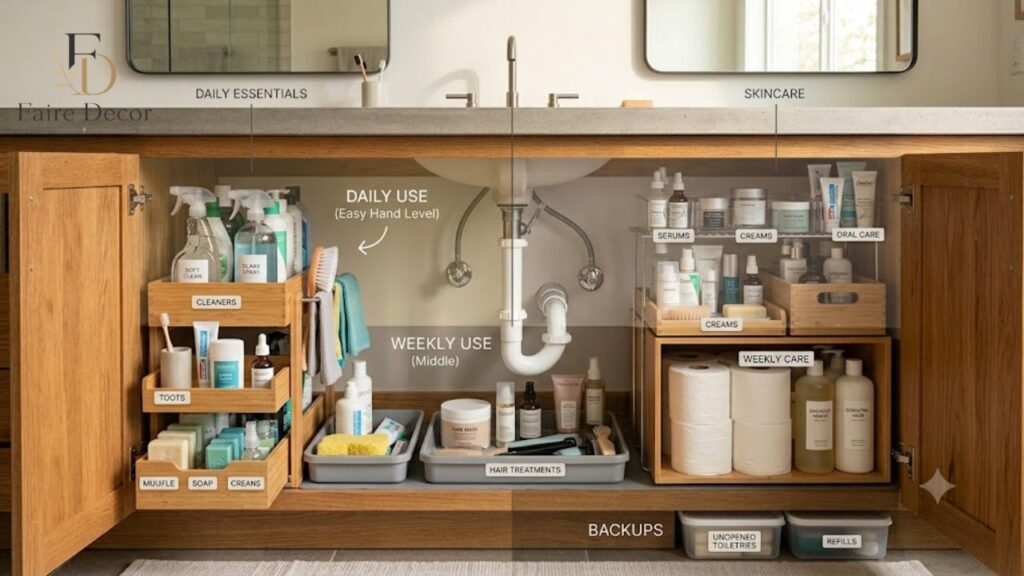
Product category is only one way to organize. Frequency matters more. Your everyday cleanser and a facial mask used twice a month may both be “skincare,” but they should not necessarily share the same premium shelf space. Think of the cabinet as three access zones.
Daily zone
This is the easiest area to reach without bending, stretching, or moving another container. It can hold toothpaste, floss, daily skincare, deodorant, shaving products, contact-lens supplies, or whatever actually belongs to your routine. Aim for one-motion access. You should not routinely have to remove one category to reach another.
Weekly or occasional zone
Give the next-best space to hair treatments, grooming tools, manicure supplies, spare washcloths and other products that are used but not needed every morning.
Backup zone
Unopened refills and bulk purchases can live deeper, higher or lower. Keep backups together. Mixing one spare toothpaste beside daily dental products, another beneath the sink and another inside a linen basket makes inventory invisible. A single backup zone answers a useful question instantly: “Do we already have another one?”
Organize by routine when categories are not enough
Some households work better with activity-based storage. Instead of creating separate skincare, dental, and hair categories, consider a morning caddy containing the products that move through the same routine. An evening skincare tray can do the same thing. This approach is particularly useful when several products are used together.
Take out one tray. Complete the routine. Return one tray. Ten loose bottles have effectively become one movable object. Recent organization discussions show why this works in real homes: People frequently struggle not because every product is unnecessary.
But because wiping or using the vanity requires moving too many individual things. Grouping the routine into a caddy reduces that friction. Do not force routine-based organization if categories make more sense to you. The correct system is the one you can understand without stopping to think about it.
How to organize underneath a bathroom sink
For anyone wondering how to organize bathroom cabinet space under a sink, the plumbing should determine the layout. Trying to create perfect left-to-right symmetry around a P-trap usually wastes space. Treat each side of the plumbing as a separate storage column.
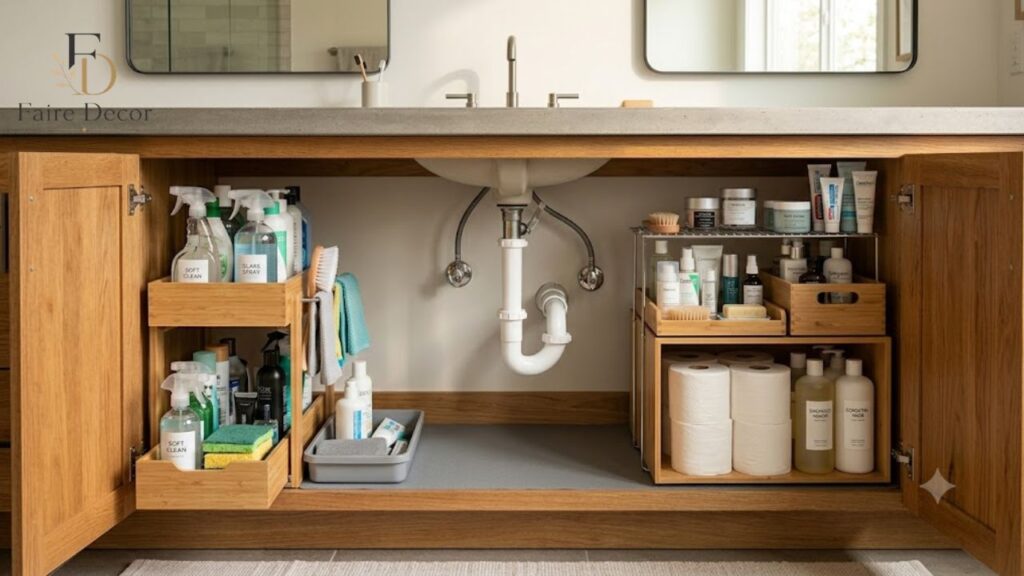
A pull-out organizer can work well in a deep side cavity because the products at the back come toward you rather than requiring you to reach behind the front row. Stackable drawers can use height where plumbing leaves vertical clearance.
A small turntable works best where there is enough radius for it to rotate without hitting the pipe or cabinet wall. Do not buy one simply because every bathroom organization article recommends one. For liquids, use a washable tray or liner beneath the category.
This will not stop plumbing leaks, but it can contain small drips from products and make routine cleaning easier. Use cabinet doors only after the main storage has been arranged. Slim baskets or hooks can be useful for lightweight items, but check the closing path before mounting them.
Professional-organizer advice published by Martha Stewart similarly emphasizes pull-out drawers, bins, adjustable shelving, cabinet-door space and turntables for awkward under-sink cabinets.
How to organize a deep bathroom cabinet
Depth is valuable only when you can reach it. A deep shelf filled with rows of individual bottles usually creates an archaeological site: new things live in front; forgotten things migrate toward the wall. Instead of treating depth as a place to line products up, make the depth movable.
Use handled bins that can slide forward as a group. One could hold backup shower products, another travel supplies, and another infrequently used grooming items. Keep daily products in shallow storage toward the front.
Avoid permanently stacking one active category behind another. If reaching the back requires unloading the front every time, the setup is technically organized but functionally poor.
Tiered shelves can help when products need visibility rather than containment. They are especially useful for short jars or bottles that otherwise disappear behind taller ones. The test is simple: can you see or retrieve the item without beginning a small excavation?
How to organize cabinets without drawers
A cabinet with one large open cavity often feels less useful than a vanity with drawers because small objects have nowhere to stop. Create artificial drawers. Freestanding stackable drawers, handled bins and shallow baskets let one large cavity behave like several smaller compartments.
Hunker similarly recommends studying shelf spacing first, then using risers, freestanding shelves, stackable bins and door storage where clearance permits. For renters, freestanding solutions are particularly useful because the cabinet can be improved without permanent construction.
Do not fill every inch vertically just because stackable storage makes it possible. A tower of containers that requires removing the top two to open the bottom one will become irritating quickly. Accessibility beats maximum theoretical capacity.
Give vanity drawers very specific jobs
Drawers are easiest to maintain when each one has a narrow purpose. The shallow top drawer is prime territory for compact items used daily. Adjustable dividers can prevent toothbrush heads, floss, razors, makeup and hair accessories from drifting into one another.
Deeper drawers are better for larger grooming items, backup toiletries or appliance storage. Avoid making one drawer the “miscellaneous bathroom drawer.”
Miscellaneous is not a category. It is usually a temporary name for decisions that have not been made yet. For very small objects, use shallow compartments rather than deep containers. You want to see the object when the drawer opens.
Make a shared bathroom understandable to everyone
A beautifully labeled system can still fail when four people use the room differently. Shared bathrooms often need ownership zones. One basket per person is sometimes easier than forcing everyone’s skincare into one category and everyone’s grooming supplies into another.
Young children can have a simple caddy containing the items they are meant to use independently, while products requiring adult supervision remain elsewhere. For couples, separate daily zones can prevent one person’s routine from slowly swallowing the entire vanity.
Shared supplies such as toothpaste, toilet paper, and hand soap backups can remain communal. The goal is not equal shelf area. It is clear responsibility. Everyone should be able to answer two questions: “Where do I find my things?” “Where do I put them back?”
Organize the bathroom cabinet on a budget
The cheapest answer to how to organize bathroom cabinet storage is to buy nothing until the decluttering and measuring are finished. You may already own usable containers. A clean shoebox lid can divide a shallow drawer. Small washable baskets can contain toiletries.
An existing caddy can become a morning-routine kit. A spare tray can protect a cabinet shelf beneath bottles. Spend money where the cabinet has a genuine mechanical problem. If items disappear in the back, a pull-out solution may be worthwhile.
If vertical space is wasted, add a riser or stackable drawer. If tiny objects migrate across a drawer, buy dividers. If everything is already visible and accessible, matching acrylic containers may improve appearance but are unlikely to improve function. That distinction protects both your budget and your storage space.
Common bathroom cabinet organization mistakes
Buying organizers first
This reverses the process. You end up deciding what to keep based on how many containers you purchased instead of determining what you need and buying storage accordingly.
Choosing containers that are too deep
A deep opaque basket can hide clutter almost as effectively as an unorganized cabinet. Use depth when you can pull the whole container out.
Giving every category equal space
Your daily dental routine and your collection of travel bottles do not deserve identical accessibility. Storage should reflect usage.
Keeping too many backups
Buying in bulk can save money, but only when the products are actually consumed before storage becomes a problem. Choose a realistic backup quantity for your household rather than treating the bathroom as a miniature warehouse.
Storing active products behind active products
Back rows work for backup inventory. They are frustrating for daily routines.
Using too many tiny containers
Micro-categories can look beautiful but create unnecessary decisions. If you have separate bins for hair clips, hair ties, scrunchies and headbands but normally use all of them together, one “hair accessories” container may be easier.
Ignoring moisture
A neat cabinet with damp towels, leaking bottles or moisture-sensitive products in the wrong location is not well organized.
Forgetting return space
If a container is packed tightly, putting something away becomes harder than taking it out. A durable system needs a little working room.
Use three practical rules to keep the cabinet from becoming messy again
First, give everything a return address. It does not necessarily need a printed label. The boundary itself can communicate the category. But if several people use the bathroom, labels remove ambiguity. Second, keep backups visible as inventory.
When you open the backup bin, you should be able to tell quickly whether shampoo, toothpaste or soap actually needs replacing. Third, reset before disorder compounds. Once a week, return wandering items to their zones, remove empties and wipe obvious spills.
Periodically check dates and ask whether products that have sat untouched still deserve space. This should take minutes, not require another complete makeover. If weekly maintenance becomes a major project, the storage system probably contains too many steps.
Three realistic bathroom cabinet setups
Small apartment vanity
The cabinet has no drawers and one central pipe. Put a narrow pull-out drawer stack on one side of the pipe and a handled daily-use caddy on the other. Use the cabinet door only if a shallow organizer clears the internal storage. Backups go in the lowest drawer. Nothing needs to be permanently installed.
Family bathroom
Assign one small daily bin to each person. Shared oral-care supplies occupy the easiest central zone. Bulk toiletries and toilet paper move to lower or less convenient storage.
Cleaning products have a separate secured location appropriate for the household. The cabinet becomes understandable even when several routines happen during the same morning.
Deep double vanity
Do not fill the whole depth with bottles. Use front trays for products currently in use and handled bins deeper in the cabinet for backups. Give one side of the vanity to each adult if that matches how the space is used. The crucial difference is that the back half functions like inventory, not active storage.
The advanced test: measure friction, not neatness
A photo can tell you whether a cabinet looks organized. Only using it tells you whether the organization works. For the first week after reorganizing, notice what repeatedly gets left on the counter. That object is giving you useful information.
Maybe its assigned container is too far away. Maybe a lid creates an unnecessary step. Maybe the basket is packed too tightly. Maybe the product belongs in the daily zone instead of the weekly zone. Do not blame yourself for failing to maintain the system. Change the system.
Likewise, notice what you never touch. Unused items occupying the easiest storage locations should move back while frequently used products move forward. Organization improves when the cabinet responds to actual behavior rather than an idealized version of your routine.
Frequently Asked Questions
What is the best way to organize bathroom cabinets?
Empty everything first, discard or relocate what does not belong, then organize remaining products by frequency and routine. Keep daily items easiest to reach, occasional products farther away and backups together. Use containers only after measuring the available space.
What should be stored in a bathroom cabinet?
Frequently used toiletries, oral-care products, appropriate skincare, grooming supplies, clean towels and other products that tolerate the bathroom environment can work well. Storage instructions on individual products should always take priority.
What should not be stored in a bathroom cabinet?
Items that are sensitive to heat or humidity may need another location. Medicines are an important example: FDA guidance notes that damp bathroom cabinets can affect medicine effectiveness, so follow the storage directions on the package and use a cooler, dry location when appropriate.
How do you organize under a bathroom sink with pipes?
Measure both sides of the plumbing separately. Use pull-out drawers, narrow bins or small risers in the usable pockets rather than forcing one large organizer around the pipes. Keep potentially leaky bottles on a washable tray.
Are clear bins better for bathroom cabinets?
They are useful when visibility matters, but they are not automatically superior. Opaque bins may be fine for a clearly labeled category. What matters most is whether you can identify, retrieve and return items easily.
What is the best way to organize a deep bathroom cabinet?
Use depth for pull-forward storage. Handled bins, sliding drawers and trays let the back of the cabinet come toward you. Avoid permanent rows of everyday products hidden behind other everyday products.
How do you organize a bathroom cabinet with no drawers?
Create compartments with freestanding drawers, shallow baskets, bins, shelf risers and, where clearance permits, door-mounted organizers. Measure before buying so the storage does not interfere with hinges or plumbing.
How do you keep bathroom cabinets organized permanently?
Make frequently used products the easiest to return, keep categories simple and perform quick resets before clutter accumulates. If an item repeatedly gets left outside the cabinet, reconsider where you assigned it.
A functional bathroom does not require perfectly matching containers. Once you understand how to organize bathroom cabinet storage around access, frequency, safety and actual routines, the cabinet stops behaving like a hiding place and starts behaving like useful storage.
That is the difference between a cabinet you reorganize every few months and one that mostly takes care of itself.