

A bedroom can be beautiful and still feel exhausting. There may be attractive furniture, expensive bedding, carefully chosen artwork, and plenty of storage, yet the room somehow feels noisy. Too many things compete for attention. The lighting is harsh.
The furniture is oversized. Clothes collect on a chair. The nightstand becomes a charging station. Japanese interiors take a very different approach. Rather than asking how much can fit into a room, the design starts with a more useful question:
What deserves to remain visible? That shift is one reason Japanese-inspired bedrooms continue to appeal to people who want their homes to feel quieter and more intentional. A well-designed Japanese bedroom isn’t simply a room filled with tatami, bamboo, paper lamps, and minimalist furniture.
Traditional Japanese interiors have their own architectural language, while contemporary homes often interpret those principles in much more flexible ways.
You can borrow the calm proportions, natural materials, thoughtful storage, and relationship with light without trying to recreate a historical Japanese house. The result can be warm, comfortable, and distinctly personal.
The Real Secret Behind Japanese Bedroom Design
The most interesting thing about Japanese interiors isn’t what they contain. It’s what they don’t need. A traditional Japanese room can serve different purposes throughout the day. Furniture may be moved or stored, bedding can be put away, and open floor area can serve different functions.
Tatami, sliding doors, and built-in storage all contribute to this flexibility. That idea translates beautifully to a modern bedroom. Instead of purchasing furniture simply because a bedroom “should” have it, consider how often you use each piece.
Do you need a large dresser? Could the wardrobe handle your clothes? Does the chair actually get used, or does it exist mainly as a place to throw yesterday’s jeans? Would a narrow bedside shelf work better than a bulky nightstand?
These questions may sound like ordinary decluttering advice, but they have a profound effect on the appearance of the room. A bedroom with fewer competing objects gives architectural details, materials, and light more room to breathe.
Start With the Shape of the Room
Before choosing paint or bedding, look at the bedroom as a floor plan. Where is the door? Where does daylight enter? Which wall is interrupted by windows? Where are the electrical outlets? Where does the wardrobe open? Where do you naturally walk when getting into bed?
These details should determine the furniture arrangement. A common mistake is placing the bed first and then squeezing everything else around it. Try the opposite approach. Establish the walking routes first. Then position the largest piece of furniture.
After that, add only what the room genuinely needs. This works particularly well in smaller bedrooms because circulation becomes part of the design rather than an afterthought.
Low Furniture Changes the Entire Mood
One of the easiest ways to introduce Japanese influence is to lower the visual center of the room. A low platform bed does this immediately.
There is more uninterrupted wall above the mattress and more visible floor around the furniture. The bedroom can feel wider and less top-heavy even when its actual dimensions haven’t changed. Look for a frame with:
- clean horizontal lines
- a relatively thin profile
- natural wood or a subdued finish
- little or no decorative carving
- enough clearance for practical cleaning
Don’t assume that “low” means the mattress must sit almost on the floor. A platform can be low while still offering comfortable access. That’s an important distinction for anyone who loves the appearance of Japanese interiors but doesn’t want to change the way they sleep.
Should You Sleep on a Futon?
Not necessarily. Traditional Japanese sleeping arrangements commonly use futons, including a shikibuton as the sleeping mattress and a kakefuton as the covering. Traditional setups are closely associated with tatami flooring. But modern Japanese homes aren’t frozen in tradition.
If you enjoy floor sleeping and have the space and routine needed to care for the bedding, a futon can be an excellent choice. If you prefer a conventional mattress, keep it. A low wooden bed can provide a similar visual effect while retaining the sleeping comfort you’re accustomed to. The practical question is not:
“What would make this room look more Japanese?” It’s: “What sleeping arrangement can I maintain comfortably every day?” That is a much better design decision.
Think in Materials, Not Decorations
If you want your bedroom to feel Japanese, resist the temptation to buy themed accessories. Start with materials. Natural timber is an obvious choice because its grain introduces visual variation without requiring patterns.
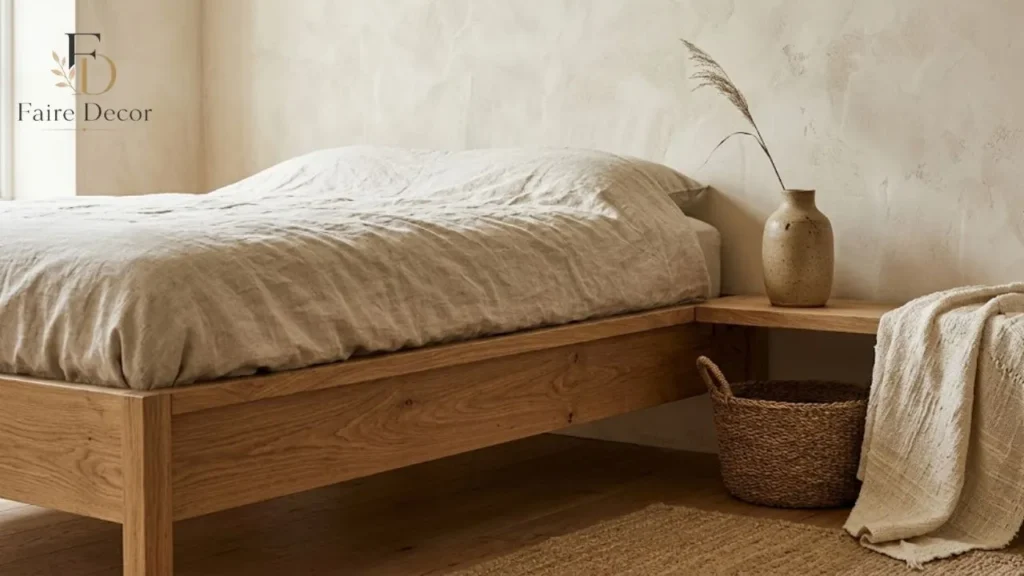
Pair it with tactile fabrics such as linen or cotton. Add matte ceramics, woven baskets, or a simple paper shade. You now have contrast without visual clutter. A useful material palette might look like:
| Material | Where to use it |
|---|---|
| Oak or ash | Bed frame, shelving |
| Walnut | Accent furniture |
| Linen | Curtains and bedding |
| Cotton | Sheets and blankets |
| Ceramic | Small decorative pieces |
| Paper | Lampshades |
| Woven fiber | Basket or rug |
| Stone | Small accessory or architectural accent |
You don’t need every material in one room. Three or four well-related materials are usually more convincing than ten different textures.
Build a Color Palette From the Floor Up
White walls and beige bedding are not a requirement. A more sophisticated Japanese-inspired palette can contain several layers of earth tones. Try: Warm ivory + pale oak + muted olive for a light, natural bedroom. Or: Mushroom + walnut + soft black
for something moodier. Or: Clay + cream + dark brown if you want more warmth. Deep colors can work particularly well when the furniture is simple.
A charcoal wall behind a pale wood bed, for example, creates depth without needing a collection of decorative objects. The trick is restraint. Choose one dominant neutral, one wood tone, and one or two supporting shades.
Why Natural Light Matters So Much
Lighting can make or break the entire concept. A room with beautiful furniture and a cold overhead LED can still feel clinical. Japanese architecture has historically paid close attention to filtered light, shade, and the relationship between indoor and outdoor spaces.
Shoji, overhangs, and transitional spaces can soften the way daylight enters an interior. You can translate that principle without copying traditional architecture. During the day, use:
- sheer curtains
- translucent shades
- light-filtering blinds
- natural textiles
At night, replace the single bright ceiling fixture with several smaller sources. A bedside lamp can provide reading light. A wall or floor lamp can illuminate a darker corner. Indirect light can create a gentle glow without putting the whole room under the same brightness level.
If you use LED bulbs, warmer evening light is generally more comfortable for a bedroom than a stark cool-white setup.
Use the Window as Part of the Composition
A window isn’t merely an opening in the wall. It is one of the largest visual elements in the room. If the bedroom overlooks trees, rooftops, or a garden, avoid blocking the view with oversized furniture. If privacy is necessary, consider layered window treatments rather than heavy curtains that remain closed all day.
A sheer layer can preserve daylight while softening the view. A blackout layer can handle sleep. This gives you flexibility instead of treating the window as something that must either be completely exposed or completely covered.
The Case for Tatami
Tatami is one of the most recognizable elements of traditional Japanese interiors. It isn’t simply a green mat. Traditional tatami has a structured construction and historically played an important role in defining the character of a Japanese room. Japanese cultural resources describe tatami as a defining feature of washitsu rooms.
If you’re building a traditional-style bedroom, authentic tatami can be meaningful. But installing tatami solely because it photographs well isn’t always practical. Consider:
- room dimensions
- humidity
- ventilation
- furniture weight
- cleaning requirements
- availability of suitable materials
- whether the room will be used only as a bedroom
For many homeowners, hardwood with a restrained textile or rug is a more practical interpretation.
Create a Japanese Feel Without Tatami
This deserves its own point because most readers don’t live in homes designed around tatami. You can still create a convincing atmosphere using five changes:
- Lower the bed.
- Simplify the furniture.
- Introduce natural wood.
- Soften the lighting.
- Remove visual clutter.
That’s enough to move a conventional bedroom in the right direction. The architecture of your house doesn’t have to change. The furniture hierarchy does.
Bring in Shoji-Inspired Light Filtering
Traditional shoji are sliding screens made with wooden framing and translucent material. They help divide spaces while allowing light to pass through. Modern homes can borrow that idea in several ways. Try a translucent screen between the bedroom and dressing area.
Use a timber-framed divider. Install fluted or frosted glass where appropriate. Choose curtains that diffuse sunlight rather than completely blocking it. The important feature is translucency, not a decorative grid pattern pasted onto the wall.
If you use fake shoji purely as a motif, the result can look theatrical. If you use filtered light and partial separation, the design feels much more natural.
Make Storage Almost Invisible
A peaceful bedroom still has to hold real life. Clothes. Extra bedding. Chargers. Books. Laundry. Seasonal items. The trick is to design storage so it doesn’t dominate the room. Closed wardrobes are particularly useful. Under-bed drawers can handle less frequently used items.
A narrow wooden cabinet can replace a large open shelving unit. If you use baskets, choose a few matching or complementary ones instead of covering every surface with containers.
Traditional Japanese architecture also incorporated dedicated storage spaces such as the oshiire, which can hold bedding and other household items. The modern lesson is straightforward: Calm surfaces require functional storage behind them.
Don’t Turn Minimalism Into an Empty Box
There is a fine line between peaceful and sterile. A bedroom needs softness. That’s where textiles matter. A rumpled linen duvet can be more inviting than perfectly pressed bedding. A wool throw at the end of the bed introduces texture. A woven rug can soften a hard floor.
A ceramic cup on the bedside table gives the room a little evidence of human life. The goal isn’t perfection. It’s controlled imperfection. That connects naturally with the broader Japanese appreciation for materials that show age, irregularity, and use.
A Little Wabi-Sabi Goes a Long Way
Wabi-sabi is frequently reduced to “loving imperfections,” but that shorthand misses much of the cultural and philosophical depth surrounding the concept. For bedroom design, the useful takeaway is simpler: don’t make every surface look manufactured and flawless.
Choose materials with character. Visible wood grain is better than plastic pretending to be wood. A handmade ceramic vessel can be more interesting than a mass-produced ornament. Natural linen doesn’t need to look perfectly pressed.
An older piece of furniture doesn’t necessarily need replacing just because its surface has developed patina. The Metropolitan Museum of Art discusses the relationship between Japanese aesthetics, Zen traditions, and ideas associated with wabi-sabi. The result is a room that feels lived in rather than staged.
Add Greenery Carefully
Plants work beautifully in this style, but restraint matters. One substantial plant may have more impact than six small pots scattered around the room. Good choices depend on your light and climate, so choose plants that can actually thrive in the room rather than selecting them because they look “Japanese.”
You can also use a simple branch arrangement. Seasonality is another useful idea. A changing natural element gives the bedroom character without requiring permanent decoration.
Choose Artwork With Restraint
The wall above the bed is not automatically asking for decoration. If you have an attractive architectural feature, a beautiful plaster finish, or a strong headboard, leave the wall alone. When artwork is appropriate, select one piece with enough visual weight to stand independently. Consider:
- monochrome artwork
- restrained landscapes
- botanical drawings
- abstract ink-style compositions
- textiles
- understated photography
Avoid covering every wall with stereotypical Japanese imagery. A room becomes more sophisticated when the influence is subtle.
What About a Japanese Bedroom TV?
If relaxation is the goal, the television deserves some thought. You don’t have to remove it. But consider whether it needs to be the first thing visible from the bed. A concealed television, low media console, or wall-mounted screen can reduce its visual dominance.
The same applies to computers and work equipment. If the bedroom doubles as an office, create a visual boundary between work and sleep. Even a simple curtain or screen can help. The room should not constantly remind you of unfinished emails when you’re trying to rest.
A Small Bedroom Can Actually Benefit From This Style
Japanese-inspired design is particularly effective in compact bedrooms because it emphasizes proportion. Imagine a 10-by-12-foot room. Instead of:
- oversized bed
- two deep nightstands
- large dresser
- chair
- bench
- open shelves
try:
- low bed
- one narrow bedside table
- full-height wardrobe
- wall-mounted light
- one small stool
You have removed furniture without removing functionality. That distinction matters. A small room doesn’t need to contain less life. It needs fewer obstacles.
The Best Layout for a Tiny Japanese-Inspired Bedroom
If space is extremely tight, place the bed where it leaves the longest uninterrupted walking route. Use a narrow nightstand or floating shelf. Move lighting onto the wall. Choose storage that reaches vertically rather than spreading across the floor.

Keep decorative objects at eye level or above. And resist buying a decorative bench simply because photographs of Japanese bedrooms often include one. If you don’t need somewhere to sit, don’t add somewhere to sit.
Designing a Japanese Bedroom in an Apartment
Apartments often have one advantage: fewer architectural distractions. You can establish the style with portable elements. Start with the bed. Then change the bedding. Replace a bright overhead lamp with warmer lamps. Introduce wood.
Use curtains to soften the windows. Hide cables. Remove excess objects. Add one plant and one piece of art. That’s enough. Renters don’t need to install permanent screens or replace their flooring. The atmosphere can come from the things that touch the room rather than the structure itself.
Japanese Bedroom Ideas for a Rental on a Tight Budget
You can prioritize improvements by impact.
Spend first on bedding
Large areas of fabric have a major effect on the room. Choose natural-looking materials in restrained colors.
Spend second on lighting
A beautiful lamp can change the room after sunset.
Spend third on the bed frame
If your existing mattress is comfortable, there’s no need to replace it. Change the base instead.
Spend fourth on storage
A cluttered room will never look calm, regardless of how attractive the accessories are.
Spend last on decoration
This is where many makeovers reverse the order. People buy decorative objects before fixing the foundation. Don’t.
How to Choose Japanese-Inspired Furniture
Look for furniture that has:
- simple geometry
- visible craftsmanship
- natural finishes
- low visual weight
- useful proportions
- limited ornamentation
Avoid furniture that tries too hard to look “Zen.” A genuinely beautiful wooden table doesn’t need a label telling you that it’s Japanese-inspired. The design language should be visible in the proportions.
What Makes a Bedroom Look Cheaply Themed?
There are a few obvious warning signs. Everything is bamboo. Every wall contains Japanese characters. There are artificial cherry blossoms everywhere. The bed is surrounded by decorative lanterns. The color scheme consists exclusively of beige.
A fake shoji screen is being used as a backdrop rather than as a functional divider. Individually, these objects aren’t necessarily bad. The problem is accumulation. When every object announces the theme, the room stops feeling like a home. It starts feeling like a set.
Japanese Bedroom vs Japandi Bedroom
These styles overlap, but they aren’t interchangeable. Japanese interiors have roots in Japanese architecture, materials, spatial organization, and cultural traditions. Japandi is a modern design fusion that combines Japanese restraint with Scandinavian simplicity, functionality and warmth.
A Japandi bedroom may feature pale oak, Scandinavian furniture shapes, and cozy textiles alongside Japanese-inspired simplicity.
A more distinctly Japanese room may place greater emphasis on low furniture, tatami, shoji, traditional materials, or specifically Japanese architectural references. Neither is better. The choice depends on how strongly you want the cultural influence to show.
Five Things I Would Change First
If you walked into an ordinary bedroom and wanted to move it toward Japanese design, I wouldn’t begin with shopping. I’d do this: First, remove furniture that blocks movement. Second: lower the visual height of the bed. Third: simplify the color palette.
Fourth: replace harsh lighting with layered sources. Fifth: give every visible object a reason to be there. Only after those changes would I start adding accessories. That’s because Japanese design is fundamentally difficult to fake with decoration. The room has to behave differently.
Common Mistakes Worth Avoiding
Buying everything from the same “Japanese” collection
Matching furniture can actually make the room feel less natural.
Making the room monochromatic
Natural interiors need variation.
Choosing style over comfort
A beautiful but uncomfortable bed is a poor bedroom.
Ignoring humidity
Floor bedding and natural materials require appropriate care, especially in humid environments. Modern Japanese-style bedroom guidance in humid climates specifically warns about moisture and mold when traditional sleeping arrangements aren’t adapted to local conditions.
Forgetting nighttime lighting
A bedroom can look wonderful in daylight and awful at 10 p.m.
Treating space as wasted space
The clear area is part of the design.
Adding too many plants
Greenery should support the room, not become another collection.
A Practical Formula for a Japanese-Inspired Bedroom
If you want a simple starting formula, use: One low bed, one dominant wood tone, two or three quiet colors, natural bedding, layered lighting, closed storage, one meaningful decorative element, some deliberate space. That’s enough. You can build on it later if the room genuinely needs more.
How to Know When You’re Finished
This may be the most useful test. Stand in the doorway. Look around. What catches your eye first? If the answer is a television, pile of clothes, oversized dresser, or collection of decorative objects, the room probably needs editing.
If your eye moves naturally across the bed, the window, the wood, and the open floor, you’re closer. Then ask one final question: Does this room make me want to stay for a while? If yes, stop decorating. You have probably reached the point where another accessory would make the room worse rather than better.
Final Thoughts
A Japanese bedroom doesn’t have to be austere, traditional, or expensive. It doesn’t require a tatami floor. It doesn’t require a futon. It doesn’t require a collection of Japanese artifacts. What matters more is the way the room handles space.
Furniture can sit lower. Storage can disappear. Materials can become more tactile. Light can become softer. Decoration can become more selective. And the empty parts of the room can finally be treated as useful rather than unfinished.
That is what makes Japanese-inspired bedroom design so appealing. It doesn’t ask you to add a new identity to your home. It asks you to remove some of the noise. Once that happens, the wood, linen, light, and carefully chosen objects have enough space to speak for themselves.
Frequently Asked Questions
What is a Japanese-style bedroom?
A Japanese-style bedroom combines simple furniture, natural materials, low-profile forms, calm colors, soft lighting, and an uncluttered layout to create a peaceful sleeping space.
How can I make my bedroom look Japanese?
Start with a low-profile bed, natural wood, neutral or earthy colors, simple bedding, warm lighting, concealed storage, and fewer decorative objects. You don’t need to install tatami or use a traditional futon.
What colors work best in a Japanese bedroom?
Warm white, cream, beige, taupe, soft gray, muted green, natural brown, charcoal, and other earthy shades work well. Pairing a quiet wall color with natural wood creates depth without visual clutter.
Do Japanese bedrooms use beds or futons?
Both are possible. Traditional Japanese sleeping arrangements commonly use futons, while contemporary bedrooms may use Western-style mattresses and low platform beds.
Does a Japanese bedroom need tatami flooring?
No. Tatami is an important feature of traditional Japanese rooms, but hardwood, bamboo-inspired flooring, or a simple natural-fiber rug can work well in a modern interpretation.
What furniture should I use in a Japanese bedroom?
Choose furniture with clean lines, natural finishes, low profiles, and practical proportions. A platform bed, compact nightstand, closed wardrobe, low dresser, and simple bench or stool are usually enough.
How do I create a Japanese bedroom in a small room?
Prioritize circulation and floor space. Choose a low bed, narrow bedside furniture, vertical or concealed storage, wall-mounted lighting, and a limited number of decorative pieces.
How can I make a Japanese bedroom feel cozy?
Add warmth through texture rather than clutter. Linen bedding, cotton throws, natural wood, woven materials, soft rugs, ceramics, and warm layered lighting can make the room comfortable without losing its simplicity.