

There is a big difference between a kitchen that looks like it belongs near the ocean and one that simply has a few beach decorations scattered around it. The first feels effortless. The second can feel like a vacation rental.
A well-designed coastal kitchen is less about anchors, seashells, and obvious nautical references and more about the qualities associated with coastal living: generous light, comfortable materials, natural color, easy movement, and a relaxed sense of order.
That is why the style can work just as well in a suburban house, city apartment, or countryside cottage as it does in a waterfront home. Current design thinking is also moving toward a more restrained interpretation.
Designers are increasingly using natural finishes, warm whites, pale timber, subtle blue and green, brass, and tactile surfaces instead of filling rooms with literal seaside motifs. The result is a kitchen that feels fresh without being cold and casual without looking unfinished.
What Does a Coastal Kitchen Actually Look Like?
A coastal kitchen doesn’t have one mandatory color scheme or cabinet style. Instead, it usually has a recognizable combination of visual characteristics:
- Soft or sun-washed colors
- Natural-looking materials
- Plenty of visual light
- Simple cabinetry
- Subtle contrast
- Organic textures
- Comfortable seating
- Unfussy decoration
- A connection between indoors and outdoors
White is common, but it isn’t a requirement. Blue is common, but you don’t need blue cabinets. Wood works beautifully, but you don’t need reclaimed barn wood. Think of coastal design as a material and mood language, rather than a decorating checklist.
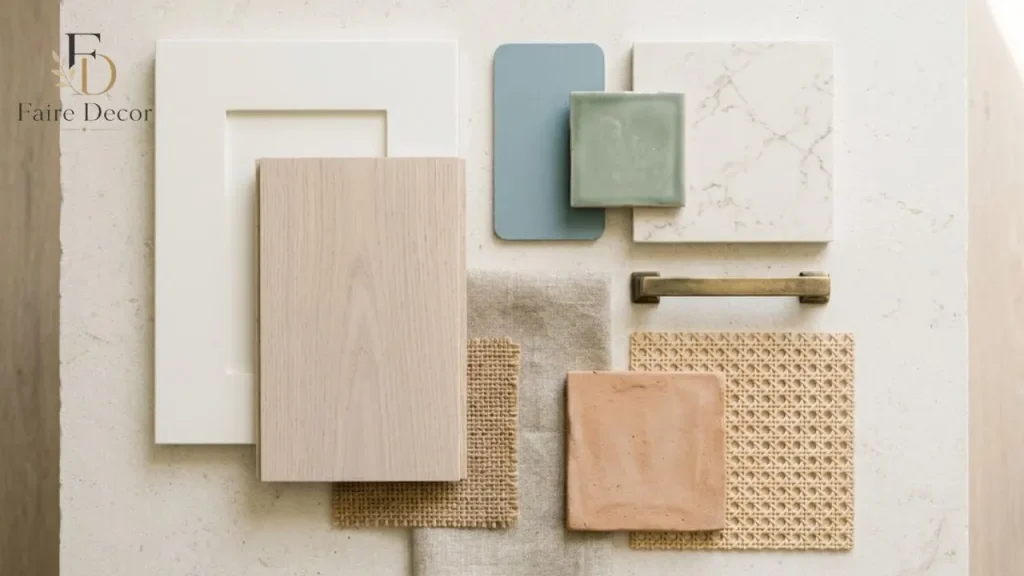
A kitchen with cream cabinets, pale oak, aged brass, and soft green can feel just as coastal as a white-and-blue room. In fact, moving beyond the predictable blue-and-white formula is one of the easiest ways to make the style feel more personal.
The New Coastal Look Is Warmer
For years, coastal kitchens were heavily associated with crisp white cabinetry, cool blue accents, and bright contrast. That combination still works. But a warmer interpretation is becoming increasingly appealing.
Creamy whites, natural oak, warm stone, muted green, sandy beige, and aged metals can create a room that feels softer and more established. Recent kitchen design coverage also points toward warmer neutrals and natural finishes as alternatives to stark, high-contrast schemes.
This matters because an overly cool kitchen can feel beautiful in photographs while feeling slightly uncomfortable in everyday life.
If your kitchen is where people eat breakfast, help with homework, talk after dinner, and linger with friends, warmth matters. You want the room to look good at noon and still feel welcoming at 9 p.m.
Start With the Architecture, Not the Accessories
Before choosing cabinet colors or coastal artwork, look at what the room already gives you. Does it have:
- Large windows?
- Wood floors?
- Exposed beams?
- A view of trees?
- An open connection to the dining room?
- A compact footprint?
- High ceilings?
- Existing dark cabinetry?
- Lots of natural light?
- Little natural light?
These details should influence the design. A bright kitchen with large windows can handle more contrast. A dark kitchen may benefit from warmer pale colors and reflective surfaces. A historic cottage may look better with traditional cabinetry and aged hardware than with ultra-modern flat panels.
A contemporary apartment might suit slab doors, pale oak and a restrained stone backsplash. The best coastal rooms don’t force an existing home to become something it isn’t. They translate the coastal feeling into the architecture that’s already there.
Choose a Color Palette That Feels Collected
The easiest way to create a sophisticated coastal palette is to choose three levels: A dominant neutral + a supporting natural tone + one watery or botanical accent. For example:
Palette A: Soft and Classic
- Warm white
- Pale oak
- Dusty blue
Palette B: Organic Coastal
- Cream
- Natural walnut or oak
- Sage green
Palette C: Contemporary
- Soft greige
- White oak
- Deep blue-gray
Palette D: Cottage Coastal
- Ivory
- Weathered timber
- Muted sea green
Notice what these combinations don’t contain: five competing shades of blue. That is deliberate. Too many unrelated colors make a kitchen feel decorated instead of designed. If you’re unsure, choose your strongest color for only one major feature, such as the island, range wall, backsplash, or lower cabinetry.
Let the Cabinets Set the Personality
Cabinetry occupies so much wall space that its finish often determines whether the kitchen feels sophisticated, cottage-like, modern, or traditional.
Warm white cabinetry
This is an excellent foundation for a timeless room. Choose warmer whites when:
- Your floors are natural wood.
- Your countertops have warm veining.
- Your home has traditional architecture.
- You want brass hardware.
- The kitchen receives softer daylight.
Avoid assuming that every white paint will behave the same way. Undertones become particularly noticeable beside stone, flooring, and artificial lighting.
Pale blue cabinets
Blue cabinetry creates an immediate connection with water without requiring nautical decoration. Pale blue is gentle. Blue-gray is more sophisticated. Deep navy is dramatic. The deeper the blue, the more carefully you should balance the room with light countertops, pale walls or natural timber.
Green cabinets
Sage, eucalyptus and muted sea-glass greens are excellent alternatives when blue feels too predictable. They also work particularly well with plants, oak, rattan and natural stone.
Natural wood
Pale oak is especially useful when the goal is to make a room feel relaxed rather than decorated. You can use wood throughout the kitchen or limit it to an island, pantry wall, shelves or stools. A current design direction worth watching is the movement away from making the island dramatically different just for contrast.
Designers are increasingly favoring cohesion and material interest over an isolated “statement island.” That doesn’t mean colorful islands are finished. It means the island should look like it belongs to the rest of the room.
Use the Island to Create a Gathering Place
A beautiful kitchen island should do more than provide another countertop. It should give people somewhere to gather. Think about how your household actually uses the kitchen. Maybe children sit there while you cook. Maybe friends lean against it during dinner parties.
Maybe it doubles as a breakfast table. Maybe nobody ever sits there, and what you really need is more preparation space. Don’t automatically install four stools because a photograph shows four stools. The island should match your routine. For a relaxed coastal atmosphere, consider:
- A generous overhang
- Comfortable counter stools
- Rounded or softened edges
- Natural wood details
- A light stone countertop
- Subtle cabinetry color
- Integrated storage
If the kitchen is small, don’t sacrifice circulation simply to create a larger island. A smaller island that people can move around comfortably is far more useful than an oversized one that turns the kitchen into an obstacle course.
Bring in Wood, but Keep It Refined
Wood is one of the easiest ways to prevent a pale kitchen from becoming visually flat. But there is a difference between natural character and an intentionally distressed beach-house effect. For a refined look, consider:
- White oak
- Natural ash
- Pale maple
- Light walnut used selectively
- Limewashed timber
- Natural wood shelving
Use the same or closely related wood tones in several locations. For example:
oak shelves + oak stools + oak island detail
Creates continuity. What tends to look less successful is introducing multiple unrelated timber colors throughout the room. The goal is not to make the kitchen look old. The goal is to make it feel connected to nature.
Choose Countertops for Real Life
Countertops are one place where appearance shouldn’t be the only consideration. A busy family kitchen, a rarely used second home, and a serious home cook may need completely different materials.
Quartz
A practical choice for homeowners who want a relatively easy-care surface with consistent appearance. Soft white and warm stone-look options work particularly well with coastal palettes.
Natural stone
Marble, quartzite, and other natural stones can add depth that manufactured surfaces sometimes struggle to reproduce. But each stone behaves differently. Ask about:
- Porosity
- Sealing
- Etching
- Staining
- Heat
- Cleaning
- Expected maintenance
Don’t choose a countertop simply because someone called it “coastal.” Choose one that fits your tolerance for maintenance.
Wood countertops
Wood can bring cottage warmth and work beautifully on a smaller island or prep area. It does require different care from stone, though. That is not necessarily a disadvantage. A material that develops character over time can actually suit a relaxed interior beautifully.
Rethink the Coastal Backsplash
The backsplash is where you can add personality without covering the entire kitchen in color. Classic white tile remains useful, but today’s options are broader. Consider:
Handmade-look ceramic tile
Slight variations in surface and color make the wall feel less mass-produced.
Soft blue tile
Ideal if the cabinets are neutral.
Green tile
A beautiful alternative to traditional blue.
Stone slab
A continuous stone backsplash creates a calmer, more architectural appearance.
Small-format tile
Can work beautifully, but avoid using tiny, highly patterned tile everywhere.
Patchwork or mixed tile
This is becoming more expressive in 2026, with designers using controlled variations in color, shape and finish to create personality. The trick is keeping the overall palette cohesive rather than turning the backsplash into visual noise.
A useful design test is to step back several feet. If the backsplash is the first thing you notice, ask whether that was intentional. Sometimes it should be. Often it shouldn’t.
Add Texture Through Lighting
Lighting is an underrated part of coastal design. A plain kitchen can suddenly feel much warmer when the pendant lights introduce texture. Good options include:
- Woven shades
- Linen
- Cane
- Ribbed glass
- Ceramic
- Aged brass
- Simple painted metal
But don’t use woven materials everywhere. One of the more useful designer observations in current coastal coverage is that repeating the same woven texture across stools, pendants, and accessories can become excessive. One or two strong applications usually have more impact.
Also consider the quality of the light itself. Your decorative fixtures should look good, but your work surfaces need proper task lighting. A pretty kitchen that casts shadows over the chopping board isn’t doing you any favors.
Use Hardware as the Jewelry of the Room
Hardware is relatively inexpensive compared with cabinetry, which makes it a useful way to shift the character of a kitchen.
Brass
Warm and slightly traditional. Especially good with:
- Cream
- White oak
- Navy
- Marble
- Soft green
Brushed nickel
A quieter choice that works well when you want the cabinetry and stone to dominate.
Polished nickel
More reflective and traditional.
Matte black
Useful when the room needs definition, although it creates a more contemporary effect.
Unlacquered brass
Particularly interesting if you like materials that develop a patina over time. The finish should relate to the other metals in the room. You don’t necessarily need every metal to match perfectly, but random combinations can make a small kitchen feel unnecessarily busy.
Don’t Ignore the Ceiling
Most homeowners focus on the cabinets and forget the fifth wall. A ceiling can make a major difference in a coastal-inspired room. Possible treatments include:
- Painted tongue-and-groove boards
- Light wood planks
- Exposed beams
- Warm white paint
- Subtle paneling
Traditional coastal interiors often use paneling because it adds architectural texture without requiring a strong color. If your ceiling is already low, however, don’t automatically add heavy beams. Sometimes a simple warm white ceiling with good lighting will create more visual height.
Make Windows Part of the Design
If your kitchen has a good view, don’t cover it unnecessarily. The outdoors can become part of the color palette. A garden can provide green. Trees can bring darker natural tones. Sky can introduce blue. Water can provide reflected light.
Even a small window can become a visual focal point if the surrounding materials are kept quiet. For window treatments, consider lightweight linen or woven shades where privacy and light control are needed. The aim is to soften the room without blocking the very daylight that helps create the coastal feeling.
What About Open Shelving?
Open shelving looks effortless. Living with it is another matter. Before installing it, ask yourself: Am I willing to keep the things on these shelves visually tidy? If yes, open shelving can be lovely. Use it for:
- Everyday dishes
- Glassware
- Ceramic bowls
- Cookbooks
- A few plants
- Pieces you genuinely like
If your kitchen is already short on storage, don’t remove valuable cabinets just to make the room look more coastal. You can get the same feeling through one small display shelf while keeping the majority of your storage behind doors. Function wins.
A Coastal Kitchen Doesn’t Need Nautical Accessories
This is worth repeating because it changes the entire design. You do not need:
- Anchor signs
- Ship wheels
- Shell collections
- Rope wrapped around everything
- Lighthouse artwork
- Fish-shaped decorations
Some designers explicitly recommend avoiding these clichés and focusing instead on color, light, and natural materials. If you love maritime objects, use them selectively. One old nautical chart can be interesting. An entire gallery wall of anchors is something else. The difference is restraint.
Coastal Style for a Dark Kitchen
Not every kitchen comes with floor-to-ceiling windows. If yours is naturally dark, don’t try to copy a bright beach house exactly. Instead:
- Use warm pale cabinetry.
- Keep countertops light.
- Add layered artificial lighting.
- Avoid overly cool gray paint.
- Use reflective surfaces strategically.
- Introduce natural wood in small amounts.
- Keep upper areas visually quiet.
- Reduce clutter.
A darker kitchen may actually look better with creamy white than stark white. And if you already have dark floors, don’t rush to replace them. They can provide grounding contrast against pale cabinetry.
Coastal Style for a Tiny Kitchen
Small spaces need editing. You don’t have enough room for every idea, so choose the few that have the greatest visual impact. A compact kitchen might use: Warm white cabinets + pale stone + one blue-green accent + light wood + a textured pendant.
That’s enough. You don’t need six different coastal accessories. For narrow kitchens, current designer advice also emphasizes organization, functional zoning, clutter-free counters, and layered lighting rather than simply adding decorative elements. If space is limited, prioritize:
- Storage
- Counter space
- Lighting
- Circulation
- Then decoration
That order will save you frustration later.
A Coastal Kitchen on a Smaller Budget
You can change the atmosphere without gutting the room. Start with the pieces people notice most.
Under $100-level changes
- New cabinet pulls
- Ceramic accessories
- Linen towels
- A simple plant
- Natural wood cutting boards
- Small artwork
More noticeable updates
- Paint the walls
- Replace one dated light fixture
- Add counter stools
- Install a runner
- Introduce a natural wood shelf
Larger improvements
- Paint the cabinets
- Replace the backsplash
- Change the countertop
- Upgrade lighting throughout the room
- Add better storage
The important principle is to avoid spending money in the wrong order. If the cabinets are fine but the lighting is terrible, lighting may create a bigger transformation than replacing the doors. If the layout is dysfunctional, decoration is not the solution.
Five Coastal Kitchen Looks to Consider
The Soft Traditional Kitchen
Cream cabinetry, marble or marble-look stone, aged brass, oak floors and understated blue accents. Best for older homes and classic architecture.
The Blue-and-White Kitchen
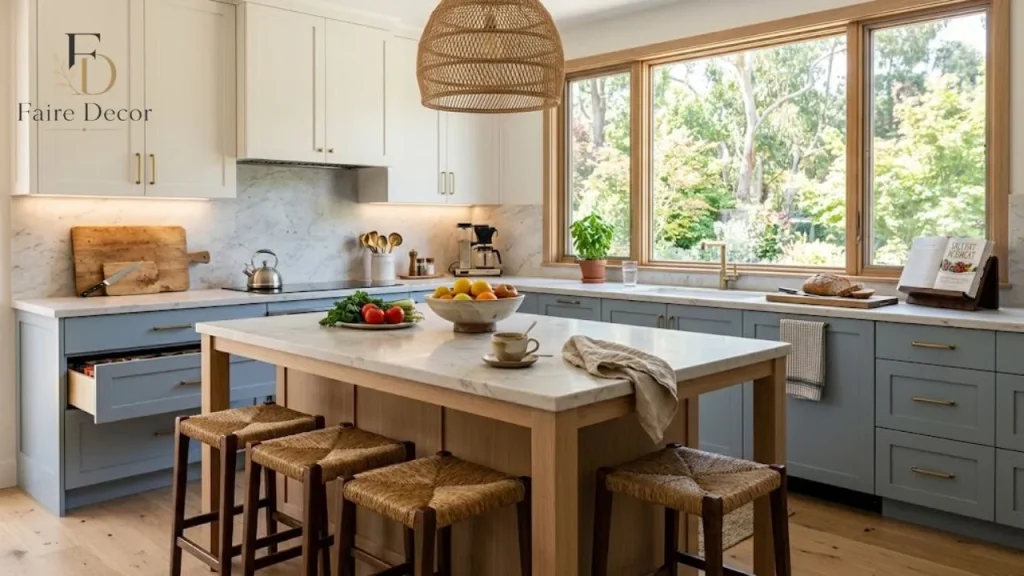
White cabinetry, blue lower cabinets or island, pale countertops and woven lighting. A recognizable coastal combination that remains easy to personalize.
The Organic Coastal Kitchen
Oak cabinetry, warm white walls, stone countertops, linen, green accents, and handmade ceramics. Ideal if you dislike obvious beach styling.
The Modern Coastal Kitchen
Flat-panel or very simple Shaker cabinetry, pale oak, restrained stone, minimal hardware and carefully controlled color. Works especially well in contemporary homes.
The Cottage Coastal Kitchen
Beadboard, painted cabinetry, vintage-inspired hardware, open shelving, soft colors and a slightly more collected mix of furniture. This version can tolerate more personality and imperfection.
How to Make the Kitchen Feel Relaxed, Not Empty
There is another common mistake. People remove so much decoration in pursuit of an “airy” kitchen that the room loses personality. Relaxed does not mean empty. A lived-in kitchen can contain:
- A bowl of fruit
- A stack of cookbooks
- A favorite cutting board
- Fresh flowers
- Ceramic serving pieces
- Framed art
- A few plants
- A linen runner
The key is to organize these things rather than scatter them. Leave some surfaces empty. That negative space is part of the design.
Design for How You Spend Time There
The most successful coastal kitchens aren’t just attractive. They’re social. A designer quoted by Homes & Gardens described coastal kitchens as spaces for sitting, eating, homework, and family time, emphasizing comfortable seating and practical performance textiles. That idea is more important than any specific cabinet color. Ask:
- Where does someone sit while another person cooks?
- Is there enough space to open the dishwasher?
- Can two people prepare food together?
- Is the coffee station actually convenient?
- Is there somewhere to put groceries when you walk in?
- Can children reach the things they use?
- Does the lighting work after sunset?
The kitchen should support the relaxed lifestyle you’re trying to create.
Common Mistakes That Make Coastal Kitchens Look Dated
Too much distressed wood
A little texture adds character. Too much can make the room look artificially aged.
Cold white everywhere
Without warm materials, white can feel clinical.
Matching everything
A kitchen doesn’t need every surface to be identical. Controlled variation creates depth.
Too many competing blues
Pick a blue family and stay within it.
Excessive open shelving
Beautiful in photographs. Potentially annoying in daily life.
Overdecorating
If every shelf has a coastal object, nothing feels special.
Ignoring the home’s architecture
The style should adapt to the building.
Following trends too literally
A kitchen renovation should last much longer than a social-media trend.
The Most Important Coastal Design Rule
If you remember only one thing, remember this:
Create the atmosphere first and the theme second.
Light creates atmosphere. Wood creates warmth. Texture creates depth. Color creates mood. Good planning creates comfort. Accessories simply finish the story. That approach also gives you freedom. Maybe you don’t like blue. Use sage.
Maybe you hate rattan. Use oak and linen. Maybe your house is modern. Use clean cabinetry and pale stone. Maybe your home is traditional. Use cream cabinets, paneling and aged brass. The coastal idea can adapt.
A Simple Formula for Designing Your Own Kitchen
If you’re starting from a blank page, use this sequence.
Photograph the room
Take pictures in morning, afternoon, and evening light.
Identify the fixed elements
Write down what you’re keeping:
- Flooring
- Windows
- Appliances
- Architecture
- Countertops
- Cabinetry
Choose your base
Select your dominant neutral.
Choose one accent
Blue, green, or another muted nature-inspired color.
Select your wood
Choose one primary timber tone.
Add stone
Select the countertop only after considering cabinet and floor undertones.
Choose the backsplash
Don’t choose tile in isolation. Look at the complete sample board.
Add lighting
Mix functional and decorative sources.
Add hardware
Use it to reinforce the overall finish palette.
Decorate last
This is where personality enters. Not before.
Coastal Kitchen Ideas That Will Age Well
Trends change quickly, but some decisions have staying power. If longevity matters, prioritize:
- Simple cabinet profiles
- Natural wood
- Warm whites
- Quality stone
- Durable hardware
- Classic tile shapes
- Good lighting
- Functional storage
- Comfortable seating
- Restrained decoration
You can then bring trends in through inexpensive, replaceable elements. Change the pendant. Paint the island. Swap the stools. Replace textiles. Update artwork. You don’t need to remodel the whole kitchen every time your taste changes.
Final Thoughts
The best coastal kitchen isn’t the one with the most obvious seaside references. It is the one that feels naturally bright, comfortable, and connected to its surroundings. Sometimes that means white cabinets and pale blue tile. Sometimes it means green cabinetry and oak.
Sometimes it means a warm cream kitchen with aged brass and almost no blue at all. What matters is the relationship between the materials. A pale cabinet needs something that gives it warmth. A bold blue needs something that lets it breathe.
A textured backsplash needs quieter surroundings. A beautiful island still needs enough room for people to walk around it. And a kitchen designed for coastal living should ultimately feel easy to live in. That is the part worth copying. Not the seashells. Not the anchors. Not the staged beach-house props. The feeling.
Frequently Asked Questions About Coastal Kitchens
What is a coastal kitchen?
A coastal kitchen is a kitchen influenced by the colors, materials, light, and relaxed atmosphere associated with coastal environments. It commonly uses warm whites, muted blues or greens, natural wood, stone, and organic textures.
What colors work best in a coastal kitchen?
What colors work Warm white, cream, pale blue, blue-gray, sage, sea-glass green, sandy beige, and natural wood tones are versatile choices. The right combination depends on natural light and the existing finishes in your home.
Do coastal kitchens have to be blue and white?
No. Blue and white are classic, but green, cream, beige, oak, and warm neutrals can create a more contemporary interpretation.
How can I make my kitchen coastal without remodeling?
Change the wall color, cabinet hardware, lighting, stools, textiles, and accessories first. Natural wood and woven materials can also add coastal character without major construction.
What cabinets look best in coastal kitchens?
Warm white, pale blue, muted green, and natural light wood are particularly versatile. Simple Shaker and contemporary slab cabinetry can both work.
What backsplash is best for a coastal kitchen?
Handmade-look ceramic tile, simple white tile, pale blue or green tile, natural stone, and restrained patterned tile can all work. Choose the backsplash in relation to the cabinetry and countertop rather than separately.
Can a coastal kitchen be modern?
Yes. Modern coastal kitchens often use simple cabinetry, pale timber, natural stone, warm whites, minimal decoration, and carefully controlled color. Contemporary examples increasingly emphasize material quality rather than nautical decoration.
Is rattan still good for coastal kitchens?
Yes, but restraint is important. A woven pendant or a pair of woven stools can add texture. Using woven material on every surface can make the room feel overly themed.