

Laundry rooms have a funny way of collecting things. A bottle of detergent arrives. Then comes stain remover, bleach, fabric softener, dryer balls, clothespins, hangers, spare towels, laundry baskets, and the cleaning supplies nobody knows where else to keep.
Before long, the room that was supposed to make household chores easier becomes one of the messiest spaces in the house. Well-planned laundry room cabinets can change that. But the goal isn’t to cover every wall with cupboards.
Good laundry storage is about putting the right things in the right places while leaving enough room to open appliances, move comfortably, and actually do laundry.
Whether you’re remodeling a spacious utility room, working with a narrow laundry closet, or simply trying to improve an existing setup, the cabinet plan should begin with the way you use the room. Here’s how to approach it.
Think About the Work, Not Just the Storage
Before choosing cabinet doors, make a list of everything you currently do in the laundry area. You may wash and dry clothes there, but you might also:
- Sort dirty clothing
- Fold clean clothes
- Hang shirts straight from the dryer
- Treat stains
- Store towels
- Keep cleaning products
- Keep pet supplies
- Iron clothes
- Air-dry delicate garments
- Store a vacuum or mop
- Keep extra paper goods
- Store seasonal bedding
Each activity creates a different storage requirement. For example, someone who folds nearly everything in the laundry room needs a useful worktop. Someone who takes clothes directly upstairs may get more value from a tall storage cabinet.
This is why copying a photograph from a showroom rarely produces the best result. The room may look beautiful, but its owner may have completely different habits. Start with your routine. Then build the cabinetry around it.
Decide What Kind of Storage You Actually Need
Most laundry storage falls into five categories.
Everyday supplies
These include detergent, stain remover, dryer products, and laundry accessories. They should be easy to reach.
Clothing storage
This could include hampers, sorting bins, hanging space and temporary storage for clean clothes.
Household cleaning equipment
Think vacuum cleaners, mops, brooms, dusters and buckets. These usually need taller storage.
Linen storage
If towels, sheets and spare blankets live in the laundry room, shelves need to accommodate bulky folded items.
Work surfaces
A countertop can be used for folding, sorting, treating stains, or simply putting down a laundry basket. Once these categories are identified, cabinet planning becomes much easier.
Pick the Cabinet Arrangement Around Your Appliances
The washer and dryer are the largest objects in the room, so they determine what can happen around them.
Side-by-side machines
This is the most flexible arrangement. You can install wall cabinets above the machines, add a countertop across the top, or use one side of the room for tall storage. A common arrangement looks like this:
upper storage → appliances → worktop → tall cabinet
The countertop is particularly useful with front-loading machines because it turns otherwise unused space into a work surface.
Stacked machines
Stacking frees valuable floor area, but it changes the storage strategy. Instead of trying to create a massive cabinet above the appliances, use the surrounding walls. A slim cabinet beside the stack can hold cleaning tools. A narrow pull-out can store bottles.
Wall shelves can handle baskets or folded towels. Be careful with extremely high storage. The fact that a shelf fits does not mean it is convenient. Daily-use products should remain within comfortable reach.
Top-loading washer
Top-loaders require special consideration because the lid needs room to open. This means a cabinet or countertop positioned above the appliance may be impractical. If you have a top-loading washer, measure the fully opened lid before committing to overhead cabinetry. This is a small detail that can save a very expensive mistake.
Laundry closet
A laundry closet requires even more discipline. The temptation is to use every available inch. Don’t. If cabinets make it difficult to stand in front of the machines, carry a basket, or open the doors, the additional storage isn’t helping. Shallow storage and vertical organization usually work better than deep cabinetry in tight spaces.
Use Wall Cabinets for the Things You Touch Every Week
Upper cabinets are ideal for smaller laundry supplies. Store everyday items where you can reach them without bending down. A practical arrangement might include:
- One shelf for detergent
- One shelf for stain treatments
- One shelf for dryer accessories
- A small section for clothespins
- Space for spare cleaning cloths
Adjustable shelves are particularly useful because bottles aren’t all the same size. If the shelves are fixed, you can easily end up with six inches of wasted space above every container. Another advantage of enclosed wall cabinets is visual calm.
Instead of seeing colorful bottles every time you enter the room, you see a clean run of cabinet doors. That difference can make a small laundry room feel much tidier.
Don’t Make Upper Cabinets Too Deep
Deep storage sounds attractive until you try to reach the back. Wall cabinets in laundry rooms are often kept relatively shallow. Around 12 inches is a common starting point, although the final size should depend on your room and storage needs.
Going deeper may give you more cubic capacity, but it can also make supplies difficult to see. A cabinet isn’t efficient if you have to remove six bottles to find the one hiding behind them. For everyday products, visibility usually beats maximum depth.
Give Bulkier Items Their Own Cabinet
Some laundry items simply don’t belong in ordinary cupboards. An ironing board is a good example. So is a vacuum cleaner. And a mop. Trying to squeeze these into a standard base cabinet usually results in awkward piles. A tall utility cabinet is much better. Use the vertical space for:
- Brooms
- Mops
- Irons
- Ironing boards
- Drying racks
- Vacuum accessories
- Buckets
- Dustpans
A narrow tall cabinet can be surprisingly useful, particularly in a compact laundry room. You can also add hooks or internal brackets to stop long-handled tools from falling against one another. The best version of this cabinet is not necessarily the largest one. It is the one designed around the objects you actually own.
Build a Folding Area If You Have the Room
A folding surface may be the most useful part of the entire room. If you’re constantly carrying warm laundry to a bedroom, sofa, or dining table just to fold it, you’re doing extra work. A countertop above front-loading machines can create a natural folding station.
Another option is a separate base cabinet with a worktop. Consider what you want the surface to accommodate. A shirt doesn’t need much space. A king-size sheet does. If you regularly fold bedding, a generous uninterrupted counter is far more useful than several small decorative sections.
Keep the worktop easy to clean too. Laundry rooms are working rooms, and lint has a remarkable ability to find every surface.
Drawers Can Beat Cabinets for Small Items
Cabinets are excellent for bottles and bulky objects. Drawers are often better for little things. Consider drawers for:
- Clothespins
- Laundry bags
- Sewing supplies
- Measuring scoops
- Small brushes
- Spare buttons
- Delicate-wash accessories
A shallow drawer can prevent these small objects from disappearing into the back of a cabinet. Deep drawers have their place, but they should be assigned to larger items rather than becoming a miscellaneous catch-all. A useful test is simple:
Can you see most of what’s inside when the drawer is open?
If the answer is no, reconsider the storage depth.
Add a Dedicated Hamper Zone
A laundry room can become messy even when the cabinets are perfectly organized if dirty clothing has nowhere to go. Built-in hampers are one solution. You could use:
- Pull-out hampers
- Tilt-out hampers
- Removable baskets
- Separate bins for lights and darks
- Individual hampers for family members
The right choice depends on your household. If you sort clothes before washing, multiple compartments can save time. If you sort only when loading the machine, one large basket may be simpler. Don’t build four beautiful hamper compartments because a design magazine showed four. Build the number you will actually use.
Consider a Utility Sink Before Finalizing the Cabinets
If the room has plumbing for a sink, decide on it before the cabinet layout is finalized. A laundry sink can be useful for:
- Hand-washing delicate items
- Soaking stained clothing
- Cleaning muddy shoes
- Washing paintbrushes
- Rinsing household items
- Cleaning pet-related messes
The cabinet below the sink can store buckets, cleaning cloths, and plumbing-related supplies. However, a sink also takes up valuable counter and cabinet space. If you rarely hand-wash anything, that space may be more useful as a folding area. Design for your actual routine, not an imagined version of it.
Make the Cabinet Interior Work Harder
The outside of a cabinet gets most of the attention. The inside determines whether the storage is genuinely useful. A few small upgrades can make a major difference.
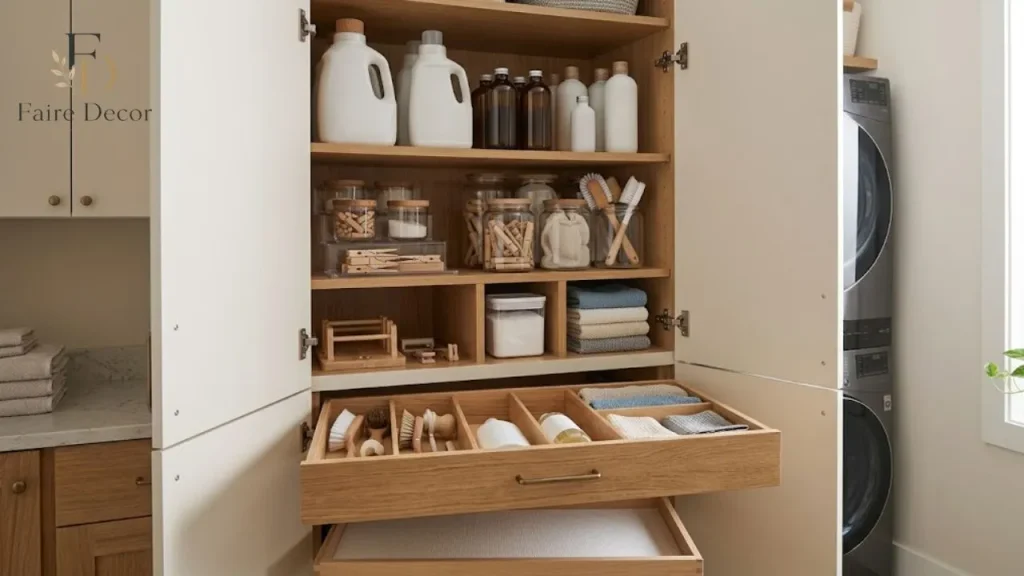
Adjustable shelves
These let you change the cabinet when your storage needs change.
Full-extension drawers
They make the back of a drawer accessible instead of turning it into a dark storage pit.
Pull-out shelves
Useful for deep cabinets containing heavy bottles or cleaning supplies.
Door-mounted organizers
These can provide a convenient home for smaller accessories.
Internal hooks
Excellent for brushes, cloths, and lightweight tools.
Dividers
Helpful for keeping small laundry accessories from becoming one tangled pile. You don’t need every feature. Choose the ones that solve an actual annoyance.
Choose Cabinet Materials With Moisture in Mind
Laundry rooms can be exposed to humidity, splashes, and occasional water leaks. That doesn’t mean you need waterproof cabinets. It does mean you should think carefully about construction.
Plywood
Plywood is commonly valued for strength and good screw-holding ability. Quality and edge treatment still matter.
MDF
MDF can provide an exceptionally smooth painted finish. However, exposed edges and prolonged moisture exposure deserve attention.
Laminate
Laminate surfaces can be practical in hardworking rooms because they are generally easy to wipe clean.
Thermofoil
Thermofoil offers a seamless finished appearance and easy cleaning, but the specific product and installation environment matter.
Solid wood
Solid wood can provide beautiful doors and durable construction, although wood responds to changes in humidity. There isn’t one material that wins every laundry-room project. Construction quality, finishing, ventilation, and moisture exposure all matter.
Think Carefully About Cabinet Color
Laundry rooms don’t have to look like utility closets. Cabinet color can change the character of the room considerably.
White
White cabinetry makes a small room feel bright and clean and works with almost any countertop.
Soft green
Green can add warmth without becoming overpowering.
Blue
Blue cabinetry works particularly well when the room already has cool tile, white appliances, or chrome hardware.
Natural wood
Wood tones can prevent an all-white room from feeling sterile.
Dark cabinetry
Deep green, navy, or charcoal can look sophisticated, especially in a larger laundry room with good lighting. If the room is tiny and poorly lit, very dark cabinetry can make it feel enclosed. Color should support the room’s natural light rather than fight it.
Don’t Forget the Cabinet Hardware
Hardware gets handled constantly in a laundry room. Choose pulls and knobs that are comfortable with wet or busy hands. Longer pulls can be easier to grip than tiny knobs, especially on drawers. Hardware also provides an opportunity to connect the laundry room visually with the rest of the house.
If your kitchen uses simple brushed-metal pulls, repeating a similar finish in the laundry room creates continuity. It doesn’t need to match perfectly. It just needs to feel intentional.
Lighting Should Be Planned With the Cabinets
A beautiful cabinet interior is useless if you can’t see what’s inside. Laundry rooms often benefit from multiple layers of lighting. Use general ceiling lighting for the room itself.
Then consider task lighting around the worktop. Under-cabinet lighting is particularly helpful over a folding counter because it puts light directly where you’re working. Good lighting also makes stain treatment easier. A shadowy corner is not where you want to discover a red wine mark on a white shirt.
Plan Around Appliance Clearances
This is the part of cabinet planning that deserves more attention than it usually gets. The washer and dryer are not simply boxes that need to fit inside a hole. They have:
- Hoses
- Electrical connections
- Drain connections
- Venting
- Doors
- Service requirements
- Airflow considerations
Manufacturer instructions should be checked before cabinetry is ordered. Dryer installation is especially important because venting requirements can affect cabinet placement and enclosure design.
Whirlpool, for example, publishes detailed requirements concerning dryer venting, while individual appliance manufacturers provide their own clearance and installation specifications.
Some enclosed appliance installations also have specific ventilation requirements. Never use a generic cabinet dimension as a substitute for the installation instructions for your actual machines.
Leave Room for Future Repairs
This is an unglamorous consideration that homeowners appreciate later. Washers and dryers eventually need maintenance. A machine may need to be pulled forward. A hose may need replacing. A connection may need inspection.

Don’t design cabinetry so tightly around the appliances that a technician has to dismantle the room to reach them. A few inches of planning flexibility can save hours of frustration later. This is especially important with built-in or stacked configurations.
Decide Between Open Shelves and Closed Cabinets
Both have advantages.
Open shelving
Good for:
- Attractive baskets
- Towels
- Frequently used items
- Decorative objects
- Quick access
But shelves collect dust and lint.
Closed cabinetry
Better for:
- Detergent bottles
- Cleaning supplies
- Bulk products
- Clutter
- Items you don’t use every day
Many laundry rooms work best with a mixture. Keep attractive or frequently used items accessible while hiding the visual mess behind doors.
Make Safety Part of the Storage Plan
Laundry products should not be treated like ordinary household objects. Detergent packets and other laundry products can pose serious risks to children if swallowed or mishandled. The American Academy of Pediatrics recommends storing laundry products securely, out of sight and out of reach of children.
That means a low, easily opened drawer may not be the right location for these products in a family home. Consider higher enclosed storage or appropriate child-resistant solutions.
The same principle applies to bleach, stain removers, and other chemical products. Good cabinet design should make safe storage easier, not merely make the room prettier.
When Custom Cabinets Make Sense
Custom cabinetry isn’t automatically better. It becomes more valuable when the room has unusual constraints. Consider custom work if you have:
- A very narrow room
- Sloping ceilings
- Odd corners
- Unusually sized appliances
- A combined mudroom and laundry room
- A utility sink that needs unusual positioning
- Specific storage requirements
- A desire for floor-to-ceiling fitting
If your room has standard dimensions and ordinary storage needs, stock or semi-custom cabinetry may provide most of the benefit at a lower price. Spend the money where it solves a problem.
When Stock Cabinets Are Enough
Stock cabinets can be surprisingly effective. They’re worth considering when:
- The room is rectangular
- Standard cabinet widths fit
- You don’t need unusual storage
- You are comfortable working around fixed dimensions
- Budget matters
You can often improve stock cabinetry with better hardware, adjustable shelving, organizers, and thoughtful placement. A modest cabinet system designed properly can outperform expensive custom cabinetry arranged poorly.
A Practical Cabinet Plan for a Small Laundry Room
Imagine a room only slightly wider than the washer and dryer. Don’t try to squeeze in a full kitchen. Instead: Place shallow cabinets above the appliances if the appliance configuration allows it. Use a slim vertical cabinet at one end for cleaning tools.
Add a wall-mounted drying rail. Use baskets rather than additional bulky furniture. If front-loading machines are present, a compact worktop can provide a folding surface. The objective is to preserve the central walking and working zone. Small rooms benefit from visual simplicity.
A Practical Cabinet Plan for a Family Laundry Room
A busy household may need more organization. One useful configuration could include:
- Two or three sorting hampers
- Upper cabinets for daily products
- Drawers for small accessories
- A large folding counter
- A tall cabinet for cleaning equipment
- Hanging space for clothes
- Linen shelves
Labeling baskets can help, but don’t over-organize. The system needs to be quick enough that people actually use it. If putting away a towel requires opening two doors and pulling out a basket, the system is probably too complicated.
A Practical Cabinet Plan for a Large Utility Room
With more space, you can create separate zones.
Laundry zone
Washer, dryer, detergent, and folding counter.
Cleaning zone
Tall cabinet for mop, vacuum, and supplies.
Linen zone
Shelves or drawers for towels and bedding.
Hanging zone
A rod or drying rack for garments.
Utility zone
Sink and additional countertop. This zoning approach keeps unrelated activities from competing for the same cabinet space.
The Most Common Planning Mistakes
Designing from Pinterest instead of measurements
A photograph doesn’t tell you where the plumbing, outlets, or vents are.
Filling every wall
Empty wall space isn’t automatically wasted space.
Ignoring the appliance doors
The machine may fit while the door cannot open comfortably.
Making everything deep
Deep storage isn’t automatically better.
Forgetting countertop overhangs
A counter may need room beyond the cabinet box depending on its construction and use.
Choosing cabinet color before considering lighting
A color that looks soft in a showroom may look completely different in your room.
Forgetting lint and dust
Intricate trim and excessive open shelving can create extra cleaning work.
Putting everyday supplies too high
Convenience matters more than maximizing vertical capacity.
Creating storage nobody uses
The most elaborate organization system is useless if the household doesn’t follow it.
A Simple Pre-Installation Checklist
Before cabinets are ordered, check:
- Exact washer dimensions
- Exact dryer dimensions
- Door-opening direction
- Top-loader lid clearance
- Electrical outlet positions
- Water supply locations
- Drain position
- Dryer vent location
- Gas connection if applicable
- Floor condition
- Wall condition
- Baseboard and trim
- Ceiling height
- Walking clearance
- Cabinet door swing
- Countertop depth
- Service access
- Lighting locations
- Storage requirements
Then compare everything with the installation manuals for the actual appliances. This step may feel tedious. It is much less tedious than rebuilding a cabinet after delivery.
How to Make the Room Feel Less Like a Utility Space
Once the functional decisions are settled, have some fun. Add a backsplash if the budget allows. Use a countertop that complements nearby rooms. Choose attractive baskets. Hang artwork where it won’t interfere with the work area. Add a small plant if the light conditions are appropriate.
Use a simple runner if it doesn’t interfere with appliance doors or create a trip hazard. The goal isn’t to disguise the laundry room. It is to make a hardworking room feel like a deliberate part of the home.
The Best Laundry Cabinet Is the One You Don’t Have to Fight
The most successful laundry room isn’t necessarily the one with the largest number of cabinets. It’s the room where you can walk in with a basket, unload the machines, treat a stain, fold clothes, hang a shirt, and put supplies away without constantly moving something out of the way.
That’s the real test. A cabinet should remove friction from the routine. If it creates more bending, reaching, opening, closing,g and rearranging, it has missed the point. So before choosing cabinet colors or scrolling through hardware options, stand in your laundry room and imagine doing a normal load from beginning to end.
Where would you reach? Where would you put the basket? Where would you fold? Where would the mop go? Where would you store the detergent? Where would you hang a shirt that shouldn’t go into the dryer? Those answers are the blueprint.
The prettiest laundry room cabinets may catch your eye first, but the smartest ones will make you wonder how you ever managed without them.
Frequently Asked Questions About Laundry Room Cabinets
What are the best cabinets for a laundry room?
The best cabinets depend on the room and your routine. A useful combination is often upper cabinets for everyday supplies, a tall cabinet for cleaning tools, drawers for small accessories, and a countertop for folding.
How deep should laundry room cabinets be?
Upper cabinets are often around 12–15 inches deep, while base cabinets commonly start around 24 inches deep. Actual dimensions should be determined by appliance requirements, available space, and comfortable access.
Can I use kitchen cabinets in a laundry room?
Yes. Kitchen-style cabinetry can work well in laundry rooms when the dimensions, construction, moisture exposure, and appliance clearances are appropriate.
Should cabinets go above a washer and dryer?
They can be an efficient use of wall space, particularly with front-loading appliances. However, check the appliance installation requirements before installing cabinetry.
Can you put a countertop over a washer and dryer?
A countertop can be useful over compatible side-by-side front-loading machines. The design must account for the appliance dimensions, controls, vibration, access, and the manufacturer’s installation requirements.
What should I put in tall laundry cabinets?
Tall cabinets are useful for brooms, mops, ironing boards, drying racks, vacuum accessories, buckets and other awkwardly shaped household equipment.
Are drawers useful in a laundry room?
Yes. Shallow drawers are particularly useful for small items such as clothespins, laundry bags, stain brushes and other accessories.
What is better for a small laundry room: shelves or cabinets?
It depends on what you store. Shallow cabinets hide clutter, while open shelves provide easier access and can make a small room feel less enclosed. A combination often works best.