

A modern kitchen does not have to look cold, glossy, or overly minimalist. Some of the most successful kitchens right now combine clean cabinetry with warm timber, soft colors, textured surfaces, practical storage, and lighting that makes the room feel comfortable after dark.
The appearance may be streamlined, but the thinking behind it is anything but simple. That is what makes choosing modern kitchen cabinets more interesting than picking a fashionable door color. Cabinetry affects almost everything:
How the kitchen feels when you walk into it, how easily you reach your cookware, how much visual clutter you see from the living room, and how well the room will adapt when your tastes change. The best approach is to start with the way you want the kitchen to work. Then choose the cabinet style that supports it.
What Does a Modern Kitchen Cabinet Actually Look Like?
There is no single template. A modern cabinet can have a pale painted finish, natural timber, a bold dark color, or a material that resembles stone. It can have visible handles or no handles at all. It can be completely flat or have a very restrained profile. What ties these choices together is usually simplicity of form.
Modern cabinetry tends to avoid unnecessary decoration. Instead of making the cabinet door itself the focal point, designers often let proportion, material, shadow lines, texture, and the surrounding architecture do the work. Common characteristics include:
- simple door fronts
- limited decorative molding
- generous drawer storage
- concealed hinges
- coordinated cabinet lines
- integrated or panel-ready appliances
- restrained hardware
- tall storage units
- uncomplicated color palettes
- strong horizontal or vertical lines
- a deliberate relationship between cabinets, counters, flooring, and lighting
That last point is easy to overlook. A cabinet never exists in isolation. A beautiful door can look wrong beside the wrong countertop or flooring. Conversely, an inexpensive-looking cabinet can become surprisingly sophisticated when its proportions and surrounding materials are carefully coordinated.
Modern, Contemporary, Minimalist: Are They the Same?
Not quite. These words are often used interchangeably by retailers and design websites, but they describe different ideas.
Modern generally refers to a design language influenced by clean geometry, practical forms, restrained decoration, and materials used honestly.
Contemporary means current. It can change as design preferences change. Minimalist takes reduction further. The goal is often to remove anything that does not serve a purpose.
A kitchen can therefore be modern without being minimalist. For example, imagine a kitchen with simple walnut cabinetry, handmade backsplash tile, pendant lights, open shelving, and an antique-looking dining table.
The cabinets can still be unmistakably modern even though the overall room has warmth and character. This distinction is useful because trying to make every component ultra-modern can actually make a kitchen feel less personal.
The Door Style Sets the Tone
When people shop for cabinets, they often begin with color. That is understandable. Color is easy to notice. But the door profile usually has a bigger influence on the character of the kitchen.
Flat slab doors
A slab door has a straightforward face without a raised panel or decorative center. It is one of the easiest routes to a streamlined kitchen because there is very little visual interruption. Slab doors are especially effective when:
- the room has strong architectural features
- the countertop has noticeable veining
- you want wood grain to stand out
- the kitchen opens directly into a living area
- you prefer understated hardware
- you want large blocks of uninterrupted color
There is one catch. Simple doors leave nowhere for sloppy installation to hide. When the cabinetry is visually quiet, uneven gaps, misaligned drawers, and inconsistent reveals become much more noticeable.
Slim Shaker doors
Shaker cabinetry can take on a completely different personality depending on its proportions. A narrow rail, simple finish, minimal hardware, and clean surrounding architecture can push a Shaker door toward a contemporary appearance.
This is worth considering if you want something cleaner than traditional cabinetry but don’t want the completely flat appearance of slab fronts.
Textured doors
Some modern kitchens use subtle fluting, reeded surfaces, or textured timber. These details add dimension without relying on ornate decoration. The important word is subtle. A heavily textured cabinet wall can quickly become the busiest surface in the room.
The Cabinet Box Matters More Than You Think
The door is what you see. The box is what you live with. When comparing cabinet quotations, look beyond the finish and ask what sits behind it. Important questions include:
- What material is used for the sides?
- How thick are the cabinet panels?
- How are the corners joined?
- What supports the shelves?
- What are the drawer bottoms made from?
- What type of hinges are included?
- Are drawer runners full extension?
- Can the hinges be adjusted after installation?
- Is soft-close hardware standard?
- What does the warranty cover?
A cabinet can have an attractive door and disappointing internal construction. The reverse can also happen: a relatively understated cabinet can be exceptionally well engineered. For a major renovation, those details deserve more attention than the latest color trend.
Framed or Frameless?
The choice between framed and frameless construction is partly aesthetic and partly functional. Traditional framed cabinets have a visible frame around the front of the cabinet box.
Frameless cabinets remove that face frame, leaving the cabinet interior more directly accessible and creating a cleaner exterior when combined with suitable doors. Frameless construction is common in European-style cabinetry and pairs naturally with minimalist door fronts.
That does not make framed cabinets old-fashioned. A carefully specified framed cabinet can produce a beautiful modern kitchen. The question is not: “Which one is modern?” The better question is: “Which construction gives me the appearance, storage access, durability, and budget balance I want?” That question leads to a much better purchase.
Full Overlay Is a Different Decision
This distinction causes plenty of confusion. A full-overlay door covers most of the cabinet’s front edge, leaving relatively small gaps between adjacent doors and drawers. An overlay is therefore about the relationship between the door and cabinet face.
Frameless construction is about how the cabinet itself is built. They often appear together, which explains why homeowners sometimes assume they’re identical. They’re not. Understanding that difference makes it easier to compare quotes from different manufacturers without getting trapped by terminology.
Choosing a Cabinet Finish That Will Age Well
The safest finish is not necessarily the one that is most fashionable today. Ask yourself what you want the kitchen to look like after years of cooking, cleaning, sunlight, fingerprints, and ordinary family life.
Natural timber
Wood brings variation that painted cabinetry cannot reproduce. Oak can give a kitchen a relaxed architectural quality. Walnut creates deeper contrast and a richer atmosphere. Other species and veneers can produce entirely different effects.
One reason timber works so well in modern kitchens cabinets is that the grain provides decoration without requiring a decorative cabinet profile. The result can feel warm without becoming visually busy.
Painted finishes
Painted cabinetry gives you almost unlimited color possibilities. Soft white, cream, mushroom, gray-green, muted blue, charcoal, and earthy neutrals can all work beautifully. The quality of the finish matters, though.
On large, simple cabinet fronts, uneven sheen, visible brush marks, chipped edges, or inconsistent color can be surprisingly obvious.
Laminate and engineered surfaces
Modern laminates have moved far beyond the cheap-looking finishes many people remember. Some reproduce timber convincingly. Others have ultra-matte surfaces, subtle textures, or solid colors.
They can be particularly useful for busy households because the right product can provide a practical balance between appearance, maintenance, and price. Always check the manufacturer’s cleaning and heat-resistance recommendations rather than assuming all laminates perform the same way.
Should You Choose Light or Dark Cabinets?
This decision should begin with the room, not Pinterest. A dark cabinet can look magnificent in a large kitchen with abundant natural light. Put the same finish into a compact room with one small window, and it may feel visually heavy.
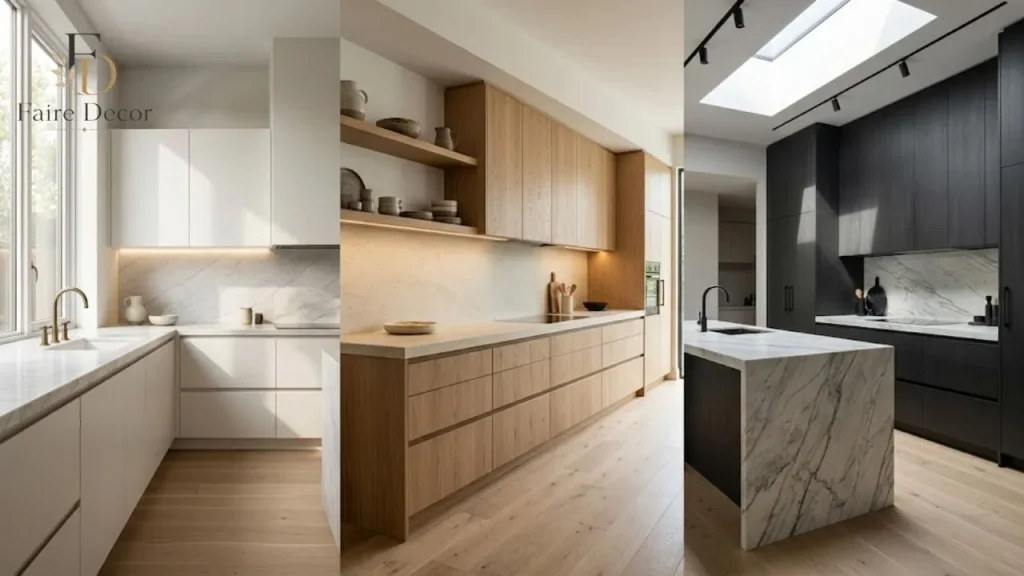
Light cabinetry tends to reflect more light and can make a small room feel more open. But an entirely pale kitchen can also become flat. That is where contrast becomes useful. For example: cream cabinetry + natural oak island + warm stone or:
charcoal base cabinets + pale wall cabinets + timber accents or: soft green cabinetry + creamy countertop + aged metal hardware. The goal isn’t simply to make the kitchen lighter or darker. It is to control where the eye goes.
Why Warm Modern Kitchens Are So Appealing
The word “modern” sometimes makes people picture a room full of glossy white surfaces. That interpretation is becoming less useful. Many homeowners want the convenience of contemporary cabinetry without sacrificing comfort. Wood is an obvious way to introduce warmth, but it isn’t the only one. You can also use:
- textured backsplash tile
- woven counter stools
- warm metal
- natural stone
- timber shelving
- softer paint colors
- layered lighting
- natural flooring
- plants
- handmade-looking accessories
The cabinets can remain simple while the room gains personality elsewhere. That balance is often more successful than trying to make every surface compete for attention.
Don’t Let the Island Become an Afterthought
The kitchen island often becomes the largest single piece of cabinetry in the room. That makes it an opportunity to do something slightly different. An island can:
- introduce a second cabinet color
- bring in natural wood
- conceal recycling bins
- provide deep drawers
- house a microwave
- create seating
- include a prep sink
- provide appliance storage
- hide everyday clutter
But a contrasting island does not automatically improve the design. If the room already contains several strong materials, a quiet island may be the better decision. The island should relate to the main cabinetry rather than compete with it.
Storage Should Follow Your Routine
The most attractive kitchen in the world becomes frustrating when you have to reach over three drawers to find a frying pan. Plan storage around habits. Think about what you use every day. If you make coffee every morning, place the coffee equipment, cups, beans, and accessories together.
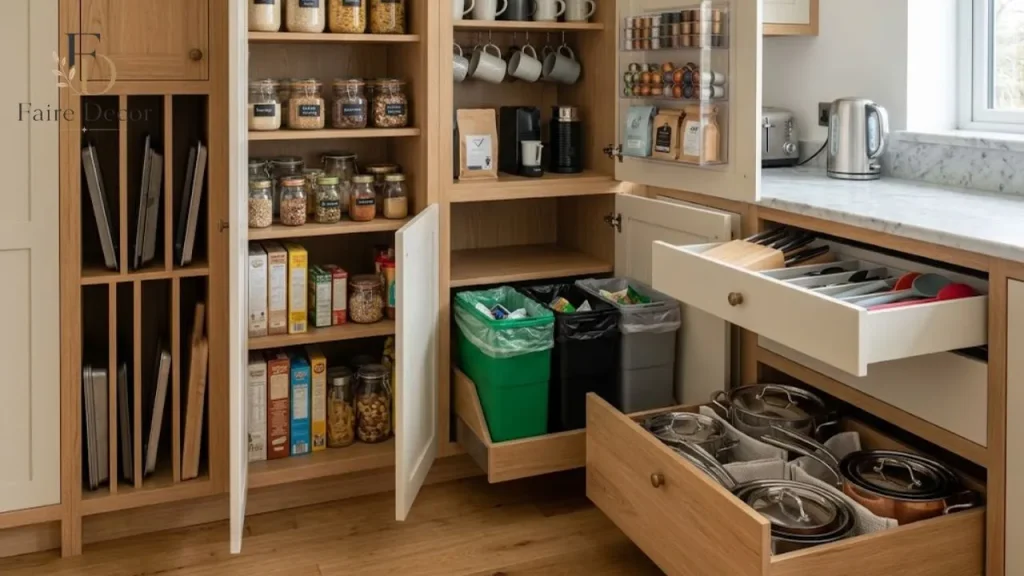
If you bake regularly, keep mixing bowls, trays, measuring tools, and ingredients close to the work area. If children prepare their own snacks, create an accessible storage zone rather than making them open five different cupboards.
This is one of the strongest arguments for drawers. A deep drawer can let you see an entire collection of cookware from above instead of forcing you to kneel down and search through a dark cabinet.
Which Storage Features Are Worth Considering?
Not every accessory deserves a place in the budget. Some genuinely improve the kitchen.
Deep drawers
Excellent for cookware, dishes, appliances, and food storage.
Pull-out pantry units
Useful when a tall cabinet would otherwise become a black hole.
Tray dividers
Helpful if you regularly store baking sheets, cutting boards, and serving trays vertically.
Waste and recycling centers
Not glamorous, but incredibly practical.
Corner storage
Worth investigating carefully. Some corner mechanisms are brilliant; others are expensive solutions to a problem created by the layout.
Appliance garages
These can hide small appliances while keeping them accessible. But they need enough depth and ventilation where required. The best accessory is the one that solves a real annoyance.
Modern Cabinet Hardware Can Change Everything
Hardware is small. Its visual influence isn’t. A long pull can emphasize the horizontal lines of a cabinet wall. A vertical pull can reinforce tall pantry doors. A small knob can make a modern kitchen feel slightly more relaxed.
Integrated pulls produce a furniture-like appearance. And completely handleless doors create the cleanest possible front. But there is an important practical test:
Open the cabinet repeatedly before you buy it.
If you need to grip an awkward edge every time, you may eventually resent the beautiful design. Also consider how the hardware feels in your hand. Kitchen hardware is not artwork. You touch it constantly.
Modern Cabinets in a Small Kitchen
Small kitchens benefit from visual discipline. You do not necessarily need fewer cabinets. You need fewer competing visual interruptions. A useful approach is to make the cabinetry read as a continuous surface. That might mean:
- matching upper and lower cabinet finishes
- taking cabinets higher
- using large drawers
- reducing open shelving
- integrating appliances
- limiting the number of accent colors
- choosing simple pulls
- using under-cabinet illumination
A tall cabinet can be particularly valuable because it uses vertical space that would otherwise be wasted. However, don’t push cabinets all the way to the ceiling simply because it is fashionable. Check ceiling height, ventilation requirements, crown details, access, and installation tolerances first.
Should You Hide the Appliances?
Integrated appliances can create a very calm appearance, particularly in an open-plan kitchen.A panel-ready dishwasher can disappear almost completely. A refrigerator can be concealed behind matching fronts. Even small appliances can be hidden behind pocket doors or inside dedicated storage areas.
But integration comes with planning requirements. Appliance dimensions must be known before cabinet orders are finalized. Door clearances matter. Ventilation matters.
Service access matters.Replacement planning matters. A beautifully integrated appliance that becomes a nightmare to repair is not necessarily a successful design.
Lighting Makes Simple Cabinets Look Better
Modern cabinetry relies heavily on lighting because there are fewer decorative details to create visual interest. Use multiple layers rather than relying on a single ceiling fixture.
General lighting
Provides overall illumination.
Task lighting
Helps with chopping, washing, and cooking.
Accent lighting
Adds atmosphere and can highlight shelves, glass doors, or architectural features. Under-cabinet lighting deserves special attention. A poorly positioned strip can create harsh reflections on glossy countertops.
A well-planned system can make the work surface dramatically easier to use. Warm light often works well in living-oriented kitchens because it keeps the room from feeling clinical after sunset.
Five Expensive Mistakes to Avoid
Choosing cabinet color from a screen
Digital images are unreliable for judging exact color. Get physical samples. Look at them in morning light, afternoon light, and artificial light.
Designing around the photograph
A beautiful image can inspire you, but your kitchen has different dimensions, windows, plumbing, appliances, and habits. Copying an image exactly rarely works. Borrow the principle instead.
Underestimating installation
Cabinet installation is not just attaching boxes to a wall. Walls may not be perfectly straight. Floors may not be level. Corners may be out of square. Modern doors expose these problems. A good installer is therefore part of the cabinet purchase.
Saving money on drawer hardware
A drawer that feels solid and glides smoothly every morning is worth more than a decorative feature you barely notice.
Filling every wall
More cabinets are not automatically better. Visual breathing room can make the cabinetry you do have look more intentional.
How to Compare Cabinet Quotes Properly
Suppose you have three quotations. One is dramatically cheaper. Before celebrating, compare the specifications line by line. Check:
- number of cabinets
- cabinet dimensions
- door material
- cabinet-box material
- drawer construction
- hinge brand or specification
- runner type
- finish
- interior finish
- shelves
- accessories
- fillers
- end panels
- decorative panels
- installation
- delivery
- warranty
A quote isn’t genuinely cheaper if half the things you expected are listed as upgrades. This is particularly important with semi-custom and custom cabinetry.
Where to Spend More
If your budget forces you to prioritize, focus on things that are difficult or expensive to replace later. Good places to spend include: cabinet construction, drawer and hinge hardware installation, storage planning, durable finishes, and accurate measurement
You can change cabinet pulls later. Replacing an entire cabinet wall because the original storage plan was wrong is a very different proposition.
Where You Can Usually Simplify
You may not need:
- elaborate decorative end panels
- excessive internal accessories
- expensive specialty mechanisms
- multiple cabinet finishes
- trendy colors that you don’t actually like
- unnecessary glass doors
- complicated lighting everywhere
Simple does not mean cheap. It means knowing which details genuinely improve the room.
A Practical Design Formula
If you’re overwhelmed by options, start with four decisions.
Choose the atmosphere
Do you want the room to feel:
- warm and natural?
- crisp and bright?
- dramatic?
- calm?
- sophisticated?
- relaxed?
Choose the cabinet shape
Decide between:
- slab
- simple Shaker
- textured
- another restrained profile
Choose the dominant material
This could be:
- painted cabinetry
- natural wood
- veneer
- laminate
- a combination
Build the room around it
Only then select:
- countertops
- backsplash
- hardware
- flooring
- lighting
- stools
- accessories
This order prevents the common mistake of choosing seven beautiful individual things that don’t work together.
A Few Design Combinations That Work
Warm minimalist
Natural oak cabinetry, pale stone, simple black hardware, warm white walls, and concealed lighting. The wood supplies enough texture that the rest of the room can remain quiet.
Soft contemporary
Cream cabinets, lightly veined countertop, muted brass hardware, oak flooring, and handmade-look backsplash tile. This is modern without feeling severe.
Dark and architectural
Deep charcoal cabinetry, pale countertop, integrated appliances, large-format flooring, and carefully positioned lighting. Best suited to rooms with enough natural or artificial illumination.
Modern with character
Simple painted cabinets, reclaimed-looking timber shelving, distinctive pendant lights, and textured tile. The cabinetry remains restrained while the accessories keep the room from feeling anonymous.
What Will Make Your Cabinets Feel Dated First?
Usually, it isn’t one particular color. A kitchen tends to age visually when several highly specific trends are combined, and none of them has a timeless relationship with the architecture. That’s why restraint matters.
If you love a strong trend, use it where it can be changed relatively easily. Hardware, lighting, paint, stools, and accessories are easier to replace than cabinetry. The cabinet itself should earn a longer lease on your design decisions.
A Final Checklist Before Ordering
Before you sign off on your cabinetry, make sure you can answer all of these questions:
- Do I know exactly what construction I am buying?
- Have I inspected a physical door sample?
- Have I looked at the finish in my actual lighting?
- Are appliance dimensions confirmed?
- Does the storage plan reflect how I cook?
- Are frequently used items easy to reach?
- Have I compared hardware specifications?
- Is installation included?
- Do I understand the warranty?
- Have I checked what counts as an upgrade?
- Have I planned lighting?
- Have I allowed for fillers and panels?
- Have I considered future appliance replacement?
- Does the design still look good without decorative accessories?
If you can answer those confidently, you’re much closer to a kitchen that will work beyond the first photograph.
Final Thoughts
The smartest approach to modern kitchen cabinets is not to chase the newest cabinet color or reproduce a showroom you found online. Start with the room you actually have. Think about what you cook, where you store things, how much maintenance you tolerate,
How the kitchen connects to neighboring rooms, and which details you are willing to live with for the next decade. Then let the appearance follow the function. A restrained slab door can look luxurious. A simple Shaker cabinet can feel contemporary. Natural wood can make a minimalist kitchen welcoming.
A well-planned drawer can be more valuable than an expensive decorative feature. Modern design works best when it removes friction rather than simply removing decoration. That is the difference between a kitchen that looks modern and one that genuinely feels well designed.
Frequently Asked Questions
What are the most popular modern kitchen cabinet styles?
Slab, flat-panel, frameless, and slim Shaker cabinets are popular modern choices. The best style depends on the home’s architecture, desired level of minimalism, and how much visual detail you prefer.
Are flat-panel cabinets a good choice for a modern kitchen?
Yes. Flat-panel cabinets create a smooth, uninterrupted appearance and work especially well with natural wood, matte finishes, integrated appliances, and simple hardware.
What is the best cabinet color for a modern kitchen?
There is no single best color. Warm white, natural oak, walnut, soft gray, muted green, cream, and charcoal can all work well. Choose a shade that complements your lighting, flooring, countertops, and room size.
Do modern cabinets need to be frameless?
No. Frameless construction is common in contemporary European-style kitchens, but framed cabinets can also look distinctly modern when paired with simple doors, clean proportions, and appropriate hardware.
Are modern kitchen cabinets difficult to keep clean?
Simple cabinet fronts are generally easy to wipe down because they have fewer decorative grooves and profiles. However, glossy and very dark finishes can make fingerprints or smudges more noticeable.
What type of hardware works best with modern cabinets?
Long bar pulls, slim edge pulls, minimalist knobs, and integrated handles can all work. Choose hardware according to the cabinet proportions and how comfortable it feels during everyday use.
Are wood cabinets still considered modern?
Yes. Natural wood is particularly effective in contemporary kitchens because its grain adds warmth and texture without requiring decorative cabinet detailing.
How can I make modern cabinets feel less cold?
Combine simple cabinetry with warm materials such as natural wood, textured tile, stone, warm lighting, soft neutral colors, or aged metal hardware. You do not need to add lots of decoration.