

Custom furniture sounds simple until the decisions begin. You may start with a sofa you like, only to discover dozens of fabrics, several cushion styles, different leg finishes, and optional motion features.
A recliner can introduce another layer of choices involving controls, head support, lumbar adjustment, and operating mechanisms. More choice can produce a better result, but it also increases the possibility of an expensive mismatch.
This guide explains how to customize Best Home Furnishings in a logical order. It covers the journey from establishing a design direction to approving the final order, with practical advice for selecting colors, materials, functions, and coordinating pieces.
Why Custom Furniture Requires a Different Shopping Process
When purchasing furniture from available stock, the decision is largely about accepting or rejecting a finished product. Custom ordering is different because you are creating a combination that may not exist on the showroom floor.
You might test one sofa in a neutral fabric, view another color on a small sample, and select a power feature demonstrated on a separate chair. Your final order brings those decisions together. That makes imagination part of the buying process.
Unfortunately, imagination is not always accurate. Colors change when spread across a large surface. A bold pattern can become more dominant than expected. Thick upholstery may soften the visual definition of a tailored frame.
A powered mechanism may affect the appearance or dimensions of a chair. The safest custom purchase is made through a sequence of small, verified decisions rather than one emotional showroom visit.
Begin With a One-Sentence Design Brief
Before browsing furniture, write one sentence describing what the finished room should achieve. For example: A relaxed family room with durable seating, warm colors, and enough flexibility for conversation and television. Or:
A quiet reading room with one statement chair, traditional details, and a collected rather than coordinated appearance. This sentence becomes a filter.
When a salesperson shows you a fashionable fabric or an impressive feature, you can ask whether it supports the room you originally intended to create. A useful design brief identifies:
- How the room will be used
- Who will use it
- The desired atmosphere
- The most important practical requirement
- One or two style characteristics
Avoid vague descriptions such as “I want something beautiful.” Almost every showroom display is designed to look attractive. Your brief should help distinguish between options.
Build a Room Palette Before Choosing Upholstery
Upholstery should not be selected in isolation. It must relate to the colors already fixed in the room. Start with elements that are expensive or difficult to change:
- Flooring
- Fireplace stone or brick
- Built-in cabinetry
- Large rugs
- Window treatments
- Wall paneling
- Existing furniture that will remain
Collect photographs and physical samples where possible. Paint chips, flooring pieces, curtain fabric, and rug fibers provide more reliable comparisons than images stored on a phone. Then create a small palette containing:
- One dominant neutral
- One supporting color
- One darker grounding tone
- One optional accent color
This does not mean every item must match. The purpose is to prevent unrelated colors from entering the room one purchase at a time.
Understand Undertones Before Selecting a Neutral Sofa
Neutral fabric is rarely truly neutral. Beige can lean yellow, pink, gray, or green. Gray may appear blue, purple, brown, or almost silver. White can feel warm and creamy or cool and sharp. Two neutral materials may look compatible separately but clash when placed together.
Compare upholstery samples directly with the room’s fixed finishes. If the floor has a warm golden tone, a cold blue-gray sofa may look disconnected. If the walls have a pink undertone, some beige fabrics may make that undertone more noticeable. View the sample:
- In daylight
- Under evening lamps
- Near the floor
- Beside the wall
- Next to the rug
- From several feet away
Artificial showroom lighting should never be the only basis for a color decision.
Use Digital Tools for Exploration, Not Final Color Approval
The Best Home Furnishings Design Center includes a furniture customizer, room-planning resources, and a searchable cover library. The company says its cover selection includes more than 700 fabric, leather, and performance styles. Digital visualization can help you:
- Compare light and dark covers
- Test solids against patterns
- Inspect furniture from different angles
- Narrow a large selection
- Save possible combinations
- Understand the overall silhouette
The manufacturer has also integrated 3D product visualization, including detailed models, product renders and 360-degree views.
These tools are valuable, but screens cannot reproduce every material accurately. Display brightness, photography, ambient lighting and individual monitor settings can all influence appearance. Use visualization to create a shortlist. Approve the final material through a physical sample.
Choose the Furniture Shape Before the Cover
A common mistake is beginning with an exciting fabric and trying to find somewhere to use it. The frame should come first. Furniture silhouette affects the room more than upholstery color alone. Consider:
- Arm shape
- Back height
- Cushion structure
- Leg visibility
- Overall width
- Visual weight
- Seat count
- Relationship to surrounding furniture
A roll-arm sofa communicates something different from a compact track-arm design. A skirted chair has a softer, more traditional presence than one raised on exposed wooden legs. A deeply padded recliner appears more casual than a high-leg model shaped like an accent chair.
Once the correct form is established, choose a cover that supports it. Large patterns may work beautifully on simple silhouettes. Highly detailed frames often look better in quieter fabrics that allow their shape to remain visible.
Decide Whether the Sofa Should Lead or Support the Room
Not every upholstered piece should compete for attention. A sofa covers a large visual area, so it usually performs one of two roles.
The supporting sofa
A supporting sofa uses a calm fabric that connects other elements without becoming the room’s focal point. It is useful when the room already contains:
- A patterned rug
- Dramatic artwork
- Colorful curtains
- An architectural fireplace
- Several decorative collections
Texture can keep a neutral sofa from feeling plain. Look at weaves, subtle herringbone effects or restrained color variation.
The statement sofa
A statement sofa may use a richer color, expressive pattern, or distinctive silhouette. It works best when the surrounding room gives it enough visual space. Before ordering a statement piece, ask whether you will still enjoy the color after seasonal accessories change.
A trend-driven shade may be appealing today but difficult to coordinate later. If you are uncertain, place the strongest fabric on a chair rather than the sofa. A smaller piece introduces personality with less visual and financial commitment.
Select Accent-Chair Fabric With Scale in Mind
An accent chair is one of the safest places to use pattern, but the printed sample can be misleading. Pattern repeat refers to the distance before a design begins again.
A large repeat may show only part of the motif on a small swatch. Ask to see a larger cutting or an image of the complete chair. Consider how the pattern will fall across:
- The back
- The seat
- The arms
- Separate cushions
- Matching seams
Direction also matters. Stripes and geometric designs make misalignment easier to see than irregular botanical or abstract prints. If two patterned chairs will sit together, confirm whether they will be produced as a matching pair and how natural fabric variation may affect them.
Learn the Difference Between Coordination and Exact Matching
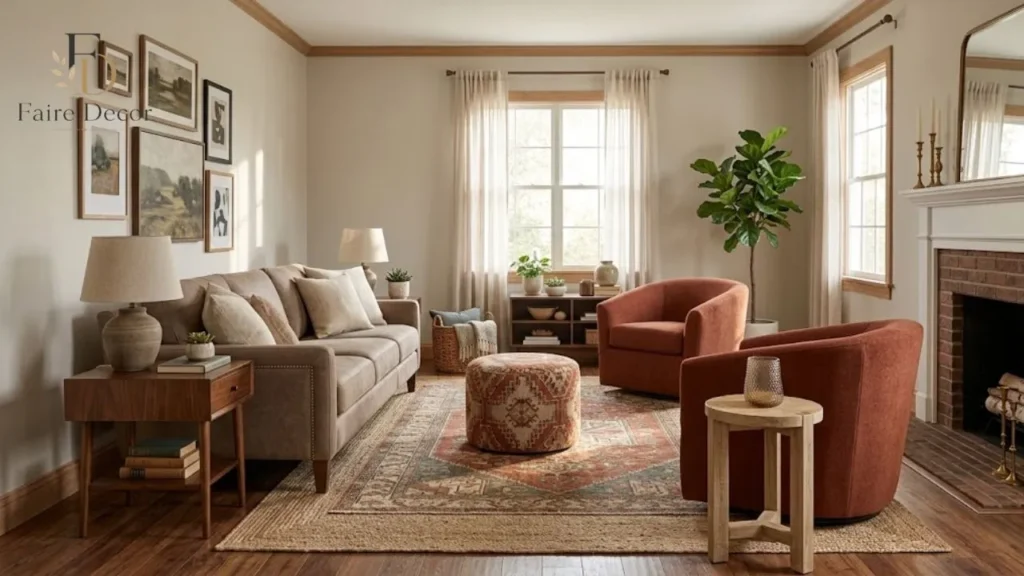
A polished room does not require every upholstered piece to be identical. Exact matching creates order, but too much repetition may make a home feel like a furniture display. Coordination uses common characteristics while allowing individual pieces to remain distinct. You can coordinate through:
- A shared color family
- Similar fabric texture
- Repeated wood finish
- Comparable arm shapes
- One pattern containing the sofa color
- Contrasting fabrics with the same undertone
- Repeated piping or trim color
For example, a warm taupe sofa could be combined with rust-colored swivel chairs and a small patterned ottoman containing both colors. The pieces do not match, yet the repetition creates a clear relationship.
Use Contrast Carefully
Contrast gives a room energy. Without it, furniture, walls, and flooring can merge into one flat field. If the walls are pale, a medium or deep sofa can add definition. If the room has dark paneling or a heavy floor, lighter upholstery can create relief. Contrast can also occur through texture:
- Smooth leather beside woven fabric
- Velvet near natural linen-like material
- A tailored sofa with a soft, rounded chair
- Solid upholstery beside a restrained print
Aim for intentional contrast rather than random difference. Two pieces can be different in color while sharing scale and shape.
Choose Performance Based on the Actual Risk
Performance fabric is often treated as the automatic upgrade for every household. A more sensible approach is to identify the most likely problem. Is the main concern:
- Drink spills?
- Food marks?
- Pet hair?
- Pet claws?
- Sun exposure?
- Body oils?
- Heavy daily use?
- Frequent cleaning?
- Color transfer from clothing?
A material that performs well against liquid may not be the best answer for snagging or fading. Ask for the characteristics and care instructions of the exact cover.
If you use cleaning products at home, compare their ingredients with the approved care method. Improvised stain treatments can make a small mark worse or leave a visible ring.
When Leather Is the Right Custom Choice
Leather can create a rich, long-lasting appearance, but it should be selected for more than prestige. It may be suitable if you value:
- A smooth surface
- Easier removal of loose hair
- Natural variation
- Development of character over time
- A tailored or substantial appearance
It may be less appealing if the room experiences strong sunlight, pets scratch furniture, or users dislike the temperature and feel of leather against the skin. Ask the dealer to identify the exact leather type and clarify whether non-contact areas use the same material.
Do not rely on general phrases such as “leather seating.” Natural markings, grain variation, and changes in appearance may be expected characteristics rather than defects. Make sure your expectations match the material.
Pick Motion Features Only After Testing the Basic Chair
The most important quality of a recliner is how well it supports you before optional technology is added. First test:
- Seat height
- Seat depth
- Back shape
- Arm position
- Head support
- Footrest length
- Ease of entering and leaving
Only then compare operational choices. Available functions vary by model, but the brand’s design resources reference features such as power tilt headrests, power lift, lay-flat positioning, and other motion configurations. A feature deserves its cost when it solves a defined need.
Adjustable head support may help someone who reads or watches television while reclined. Power lift may assist a user who finds standing difficult. A charging port may be convenient beside a frequently used seat. A feature that receives no clear answer to “How will we use this?” is a candidate for removal.
Understand Custom Comfort Options
Some products designated under the manufacturer’s Custom Comfort terminology include zippered access that allows pillow fibers to be added, removed, or redistributed.
This can be useful for people who want to adjust softness or support in certain upholstered areas. It does not mean the entire chair can be rebuilt at home, and it does not replace choosing the correct seat dimensions. Ask the retailer:
- Which parts of the selected model are adjustable?
- Is additional filling supplied?
- Can replacement material be obtained?
- Does adjusting the fiber affect warranty coverage?
- How should the material be redistributed?
If the feature matters to you, make sure the exact ordered model includes it.
Select Wood Finishes in the Room Where They Will Live
Exposed legs may represent a small part of the furniture, but a conflicting finish can make a coordinated room feel unsettled. You do not need to match every wooden surface exactly. In fact, a room containing only one wood tone can feel overly controlled. Instead, look for compatibility:
- Warm with warm
- Cool with cool
- Similar level of formality
- Enough contrast to appear intentional
- Repetition of each major finish at least once
A dark furniture leg can connect with a black lamp or picture frame. A warm oak tone can relate to a side table or flooring. Remember that natural wood can vary. A finish sample should be viewed as a guide rather than a guarantee of identical grain.
Plan the Sectional on Paper Before Choosing Its Fabric
A sectional order must be mechanically correct before it can be visually successful. Draw the room from above and label:
- Windows
- Doors
- Television
- Fireplace
- Walkways
- Tables
- Floor vents
- Electrical outlets
Then draw every sectional unit individually. Mark the location of arms, corners, chaises, consoles, and reclining seats. Confirm orientation using a manufacturer or dealer diagram. Spoken descriptions of left-facing and right-facing pieces can be misunderstood.
Check how people will enter and leave each seat. A large sectional may provide impressive capacity while making the center positions inconvenient to access. The configuration should work when all reclining elements are open, not only when the furniture is closed.
Order Fabric Samples Before Making a Deposit
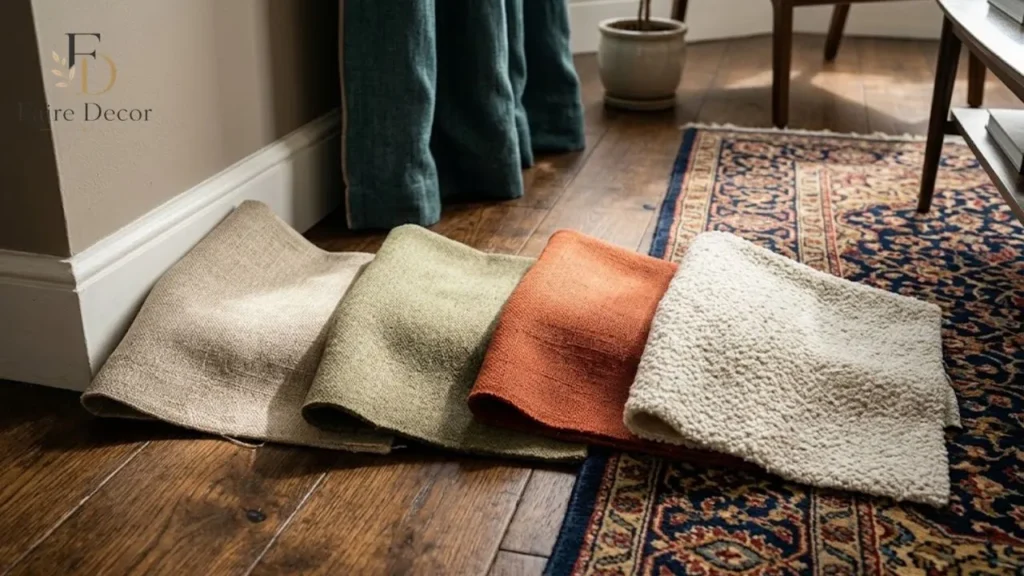
A serious custom order deserves more than one sample. Request your leading choice and at least two alternatives. Take photographs of each one in the intended room, but judge them primarily with your eyes because phone cameras also alter color. Leave the samples in place for several days. Observe them during:
- Bright morning light
- Cloudy daylight
- Afternoon sun
- Warm evening lighting
- Television lighting
- Normal household activity
A color that seems exciting in the showroom may become overwhelming after prolonged exposure. Another that initially looks quiet may prove more adaptable. If your retailer cannot provide a sample to keep, ask whether you can borrow one with a refundable deposit.
Create a Complete Specification Sheet
Before final approval, turn the custom design into a written specification. Include:
| Decision | Selected option |
|---|---|
| Product name | |
| Model number | |
| Configuration | |
| Cover name and code | |
| Cover grade | |
| Leg or wood finish | |
| Cushion choice | |
| Motion mechanism | |
| Power options | |
| Headrest or lumbar feature | |
| Accessories | |
| Quantity | |
| Individual dimensions | |
| Final price |
Ask the salesperson to compare this sheet with the formal order. Product names can be similar, and a single letter or number may identify a different configuration. Verify codes rather than relying on appearance.
Ask What Happens After the Order Is Submitted
Custom furniture involves several stages that may be handled by different parties. Request a clear explanation of:
- When the order becomes non-cancellable
- Whether changes are possible after submission
- How estimated timing will be communicated
- Where the furniture is received
- Whether the dealer inspects it
- How delivery is scheduled
- What preparation is required
- Who addresses an incorrect specification
- What happens if the cover differs from expectations
- How transit damage is documented
Independent retailers establish their own return and exchange policies. The manufacturer’s FAQ directs customers to the selling store for those policies and for warranty assistance. Obtain the retailer’s terms in writing before paying.
Prepare the Room Before Delivery
Custom furniture should arrive in a room ready to receive it. A few days before delivery:
- Remove small furniture and breakable objects.
- Protect vulnerable flooring if the delivery company does not provide protection.
- Clear the full route from the entrance.
- Secure pets in another room.
- Confirm outlet access for powered seating.
- Mark the approximate furniture position with removable tape.
- Keep the order specification available.
- Make sure the person approving placement will be present.
Do not position a rug based solely on showroom measurements. Final adjustment is easier after the furniture is assembled and placed.
Inspect the Custom Details Immediately
When the furniture arrives, compare it with the specification rather than simply asking whether it looks attractive. Verify:
- Frame or model
- Upholstery code
- Pattern and color
- Configuration
- Sectional direction
- Wood finish
- Cushion selection
- Motion features
- Controls
- Included accessories
Photograph the product labels and keep them with the invoice. The manufacturer states that the ID card beneath the frame may include the product ID, model number, fabric number and manufacturing date needed for service.
If something is incorrect, document it before the delivery team leaves whenever possible. Contact the dealer promptly and follow its reporting process.
Style the Furniture in Layers
New custom furniture can look unexpectedly bare when first placed in a room. Avoid reacting by purchasing many accessories immediately. Build the room gradually.
First layer: placement
Adjust the seating arrangement and make sure pathways work. Confirm that reclining pieces open freely.
Second layer: large textiles
Position the rug and curtains. These establish the room’s broader color balance.
Third layer: functional surfaces
Add coffee and side tables where people can reach them comfortably.
Fourth layer: lighting
Provide a mixture of general and task lighting. A reading chair needs usable light, not only atmosphere.
Fifth layer: soft accents
Add cushions and throws selectively. They should introduce texture or connect colors rather than hide the upholstery you carefully selected.
Final layer: personal objects
Books, art, photographs, and collected pieces prevent a customized room from feeling like a showroom set. Leave some space. Not every wall, table, and sofa corner needs decoration.
Seven Custom Order Mistakes to Avoid
Ordering from a screen color
Digital previews are useful for comparison but should not replace a physical cover sample.
Choosing fabric before furniture shape
The frame determines proportion, comfort, and function. Upholstery should support that decision. Adding every available feature. More technology does not guarantee a better chair. Select features connected to real habits.
Forgetting pattern scale
A small swatch may show only a fraction of the complete design.
Assuming custom furniture can be returned
Special orders may be subject to strict cancellation or return terms established by the dealer.
Mixing undertones accidentally
Beige, gray, and white materials can conflict even when they are all described as neutral.
Approving an incomplete receipt
Every chosen feature, code, finish, and charge should appear on the final documentation.
Is Customizing Best Home Furnishings Worth It?
Customization is worthwhile when it produces a result that standard inventory cannot provide. It can help you create:
- A better visual relationship with existing finishes
- More suitable upholstery for daily life
- A distinctive accent piece
- A sectional adapted to a specific floor plan
- A recliner with genuinely useful functions
- Coordinated furniture that does not look identical
- Seating that reflects personal style rather than showroom defaults
The process requires patience. A custom product is not a guaranteed improvement if the decisions are rushed or based on incomplete information. The value lies in informed selection, not in customization for its own sake.
Final Thoughts
The extensive cover and configuration choices offered by Best Home Furnishings can turn an ordinary frame into something closely suited to a particular room. They can also overwhelm shoppers who try to make every decision during a single store visit.
Work from large decisions to small ones. Define the room first. Choose the silhouette next. Test comfort before considering technology. Narrow the palette, inspect real samples, and record every selection by code. Only then should the final order be approved.
Well-chosen custom furniture does not need to shout for attention. It should look as if it naturally belongs in the room, support the people who use it, and continue working as the home evolves.
Frequently Asked Questions
How many upholstery choices does Best Home Furnishings offer?
The company’s Design Center currently states that shoppers can explore more than 700 fabric, leather, and performance-cover styles. The selection available for a particular product may be narrower.
Can I see customized furniture before ordering?
The online customizer and 3D visualization tools can show selected combinations and different viewing angles. Always verify the final color and texture through a physical sample.
Can every cover be used on every frame?
Not necessarily. Cover availability can depend on the product, material and manufacturing requirements. Confirm compatibility with an authorized dealer.
Can I change a custom order after submitting it?
The answer depends on the order stage and retailer policy. Ask when the order becomes final before paying a deposit.
Are custom orders returnable?
Independent dealers establish their own return and exchange terms. Many custom products have tighter restrictions than stocked furniture, so obtain the policy in writing.
Should my sofa and chairs use the same fabric?
They do not need to match. Coordinating through shared undertones, repeated colors or compatible textures can produce a more personal result.
Is performance fabric always the best upgrade?
No. Select material based on the household’s primary risks and cleaning habits. Performance characteristics differ between covers.
How do I confirm that the delivered furniture is correct?
Compare the product with your order sheet, including its model, upholstery code, finish, configuration and optional functions.